XChangic presents itself in the independent online-exchange mould, serving users who want to convert crypto and selected payment instruments without navigating a conventional exchange terminal. That model has a real audience. Plenty of people don't want charts, limit orders, or an account containing a permanent balance. They want to send one asset and receive another. XChangic is built for that job, but the trade-off is less public market depth and fewer institutional assurances.
The most sensible way to assess XChangic is by route, not by branding. An exchanger can be excellent for one stablecoin or local payment direction and mediocre for the next because each route relies on different reserves, counterparties, banks, and blockchain networks. A quoted exchange from USDT to another digital asset might be automated, while a payment-system withdrawal may need an operator. Treat every route as its own product.
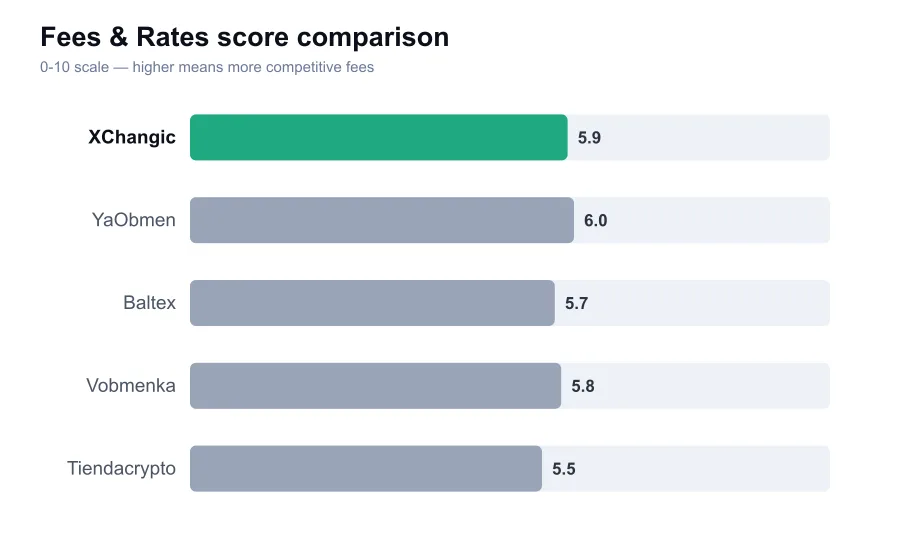
Fees are not usually presented in the tidy percentage format familiar from spot exchanges. Instead, XChangic's economic charge is generally incorporated into the displayed conversion rate. There may also be a blockchain withdrawal cost, an issuer fee from an electronic payment system, or a rate adjustment if a fixed quote expires before payment arrives. That is normal in this segment, but it makes the word "low fee" nearly useless without looking at the actual output.
The right comparison is embarrassingly simple and surprisingly neglected: enter the same send amount at XChangic, at another independent exchanger, and at a major exchange after its trading and withdrawal fees. Then compare what reaches your wallet. Do this close to the intended transaction time. Crypto prices move, available reserves change, and an attractive rate from an hour ago may no longer be real.
XChangic can be convenient because it removes several steps. You don't need to buy an asset on an order book, wait for an internal transfer, and then request a withdrawal. For a small conversion, that simplicity can justify a somewhat wider spread. For a four-figure or five-figure transfer, the spread becomes the fee that matters most. A difference of even one percent is material once the amount rises.
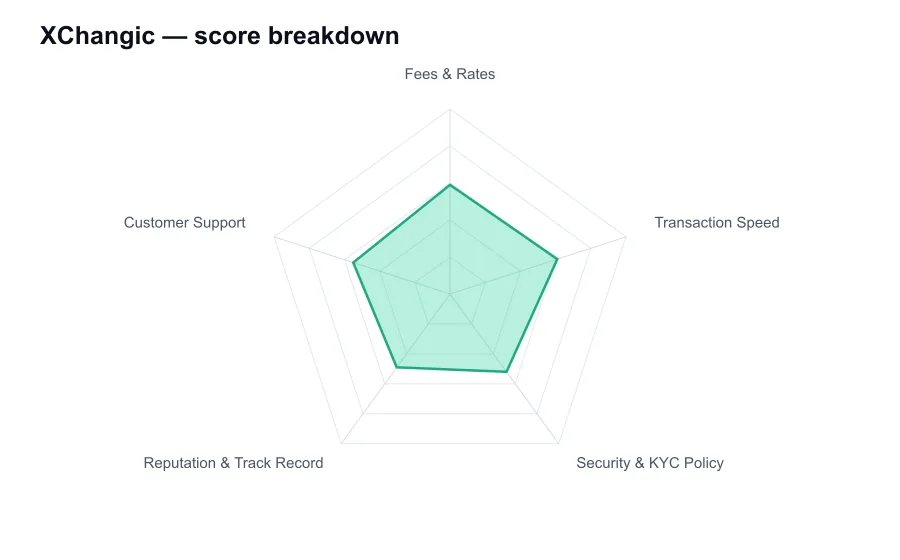
Speed is similarly route-sensitive. Blockchain settlement has its own timetable. Bitcoin transactions wait for confirmations, Ethereum and token transfers vary with network conditions, and some newer networks settle far faster. XChangic cannot force an incoming transaction to confirm faster than the network allows. What it can control is whether it recognizes the payment promptly, maintains adequate liquidity, and sends the payout without an unnecessary queue.
I would expect a clean, ordinary crypto-to-crypto order to be much faster than a bank or electronic-money direction, but users should not confuse expected speed with a service-level guarantee. A small desk can process straightforward orders rapidly during active hours and still struggle with an exception. That may be a wallet tag issue, an incorrect memo, a payment made from a third party, or a compliance flag. Those are exactly the situations that reveal the quality of an exchanger.
The security question is less about flashy claims and more about operating discipline. Verify the real domain through a trusted listing or your own saved bookmark. Do not follow sponsored search links blindly, and do not send coins to an address provided in an unsolicited message. Phishing against exchange customers is common because a payout address cannot generally be recalled after a transfer is broadcast.
XChangic's account-light approach can reduce the temptation to leave a balance sitting on a platform. That is a legitimate benefit. Still, you are trusting the service during the exchange itself. There is no magical safety created by not registering. You must rely on the provider's liquidity, payout controls, anti-fraud procedures, and willingness to resolve a bad order. Keep your own wallet under your own control before and after the transaction.
KYC policy deserves clear-eyed treatment. Many exchange services advertise a streamlined process, yet reserve the right to ask for identification if an order is flagged under anti-money-laundering procedures. Users sometimes interpret this as a bait-and-switch, but screening is widespread throughout crypto. The fair standard is disclosure. A provider should say that review is possible, explain how a paused transaction is handled, and avoid vague terms that give it unlimited discretion.
XChangic does not have the brand gravity of a top-tier centralized exchange, which naturally limits its reputation score. That does not make it illegitimate. It means there is less independent evidence to lean on, less public information about long-term resilience, and fewer clear signals for a customer deciding whether to send a large amount. Recent third-party feedback can help, especially comments that describe a concrete currency pair and a support outcome.
I am skeptical of perfect review profiles. Real payment businesses produce occasional delays, misunderstandings, and user errors. A healthier sign is a visible pattern of resolved complaints and precise responses. If every criticism is dismissed as fake, that is not reassuring. If every positive review says only "fast, good service," that is not very useful either. Read for detail rather than star count.
Support is likely to be the deciding factor if anything goes wrong. Before paying, make sure the order has an identifiable number and that you know where to submit it. Ask a specific pre-sale question if the transaction is important, such as whether a named network is accepted or whether a destination tag is required. The response time and clarity of that answer are more informative than a generic promise of 24-hour availability.
There is a practical user profile for XChangic. It can suit a person who already knows how blockchain transfers work, wants a relatively direct swap, and is prepared to compare the final quote. It is not ideal for a first-time buyer using money they cannot afford to have delayed. Nor is it the best venue for active trading, where market orders, liquidity data, and auditable fee tiers are more valuable than a simple exchange form.
My view is that XChangic should be used selectively rather than habitually. It may solve a particular conversion neatly, and that is enough for an independent exchanger to be useful. But it has not earned the automatic trust reserved for mature regulated platforms. Check the rate, test the process, document the order, and keep the transaction size proportionate to the public evidence available.