Explace is a small instant cryptocurrency exchange service aimed at the user who wants to swap one asset for another without signing up for a conventional trading platform. It belongs to a crowded corner of the market where presentation can be deceptively similar from one provider to the next. The practical question is not whether its swap form works, because most of them do. The question is whether the operator has earned enough trust to handle a meaningful transaction.
The service's appeal is obvious from the first screen. Choose the coins, enter a receiving address, review a rate, and send the deposit. That is a much easier experience than funding a centralized exchange, completing verification, navigating a trade page, then withdrawing. For someone converting a modest amount between personal wallets, less friction has genuine value. For anyone managing serious size, simplicity alone is not enough.
Explace should be treated as a transactional service, not a place to store crypto. There is no reason to leave coins in an intermediary wallet longer than needed, and the best way to use any instant exchange is to control both the sending and receiving addresses yourself. That keeps the exposure limited to the execution window. It also makes a recovery far less likely if you paste an incorrect destination address, so slow down before confirming.
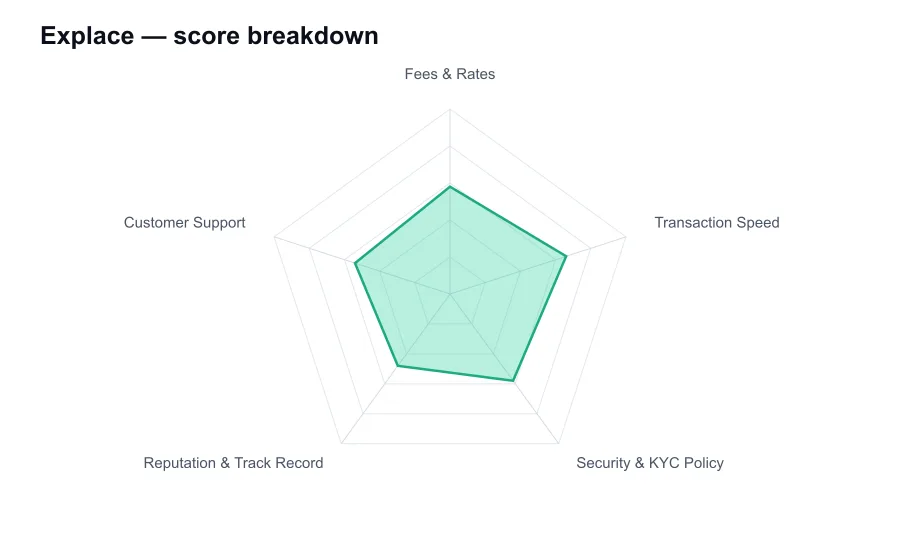
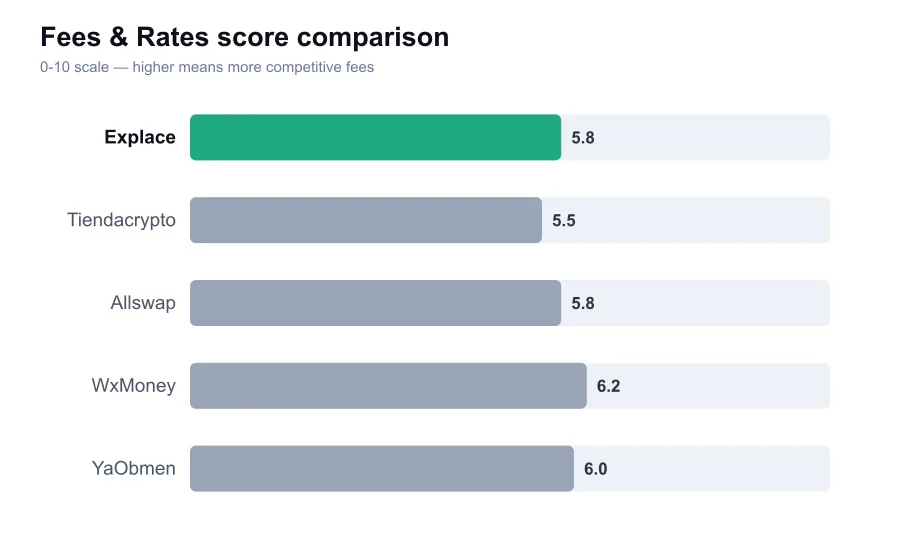
Pricing is the first area where Explace feels less mature than the best-known competitors. It presents an estimated output, but it does not offer the sort of clean fee schedule that lets a user separate service fee, network charge, and liquidity spread. This is normal among instant exchangers, yet it is still a weakness. A quote is the only number that really matters, but opaque pricing makes it harder to know whether that number is competitive.
For mainstream pairs, Explace can be usable if the displayed amount compares well with alternatives. It is not a venue I would assume is cheapest without checking. Binance, Kraken and Coinbase Advanced will normally offer tighter pricing for users who can access them and do not mind account verification. Among instant services, ChangeNOW, Exolix, Godex and SimpleSwap provide obvious benchmarks. A thirty-second comparison can save far more than a loyalty assumption.
Small swaps are particularly vulnerable to bad economics. Network charges can consume an outsized share of the transaction, and a wide conversion spread may be hidden by a pleasant-looking interface. The right approach is to compare the final destination amount for precisely the same input, at the same time, across several providers. Do not compare a claimed percentage fee against another site's payout. Compare the coins you actually receive.
Transaction speed depends mostly on the assets selected. A swap using fast networks can move from deposit to payout within minutes if liquidity is readily available. Bitcoin deposits with a low fee can take much longer, while Ethereum network congestion can delay token transfers. Explace is an intermediary in that process, not the blockchain itself. Anyone promising a guaranteed instant result before confirmations is selling an illusion.
My concern is less about ordinary speed than about exception handling. Every instant exchange looks efficient while markets are calm and a liquid pair executes normally. The real test is a deposit sent on the wrong network, a delayed confirmation, an amount outside the permitted tolerance, or a liquidity provider that cannot fill an order immediately. Smaller brands have fewer public case histories, which means customers have less evidence about how reliably difficult situations are resolved.
Explace's no-account style is attractive to privacy-minded users. You do not generally need to create a profile merely to obtain a swap address, which reduces the amount of personal data exposed in a routine transaction. That is better than handing documents to every platform by default. But no-registration should never be mistaken for a guaranteed no-KYC policy under all circumstances.
Like other exchange services that connect users to liquidity sources, Explace can apply transaction monitoring and may ask for verification if activity triggers risk controls. The exact consequences of a review matter more than a slogan on the homepage. A user may find that a swap cannot proceed until identity or source-of-funds details are supplied. This is a real risk for privacy-focused users, and one reason not to send funds that cannot withstand compliance scrutiny.
Security also includes the boring operational basics. Use the official site reached from a trusted bookmark, inspect the destination domain, and never accept support links from social media messages. Scam accounts often imitate smaller exchange brands because customers have less familiarity with their legitimate channels. Enable security protections on the wallet you are sending from, and record both transaction hashes before contacting support if anything goes wrong.
Reputation is Explace's biggest limitation. It has far less independently documented history than long-running centralized exchanges and less widespread community recognition than the leading instant-swap names. That does not prove it is unsafe, and smaller operators can execute perfectly well. It does mean the burden of caution stays with the customer. A company with limited public scrutiny should receive limited initial trust.
Support appears designed around online contact rather than the more extensive help infrastructure available at major exchanges. That can be enough for simple questions about an order ID or a pending transaction. It is less reassuring for urgent, high-value disputes, where users want clear escalation paths and accountable communication. Before sending a large amount, I would test not only the service but also how readily its support channel answers a basic pre-sale question.
Explace is not a provider I would dismiss outright, but neither is it a service I would recommend blindly. It can suit a small, carefully checked conversion where its live quote beats better-known competitors. The lack of deeply established reputation, transparent fee disclosure, and proven public support record keeps it out of the first tier. Use it as an option in a quote comparison, not as the default destination for substantial funds.