Allswap is a relatively small instant cryptocurrency exchange service that positions itself around quick, account light swaps. It belongs to a crowded market where the basic promise is easy to copy, select a pair, send crypto, receive crypto. The challenge for Allswap is not explaining the service. The challenge is proving that it can execute reliably and fairly beside brands with years of visible transaction history and much larger review footprints.
The product is designed for convenience rather than trading sophistication. There is no traditional order book to inspect, no advanced chart package, and no reason to leave a balance on the site after an exchange. That narrow focus is useful for users who simply need to turn one coin into another. It is limiting for anyone who wants price controls, recurring orders, tax reporting tools, or a single account that also handles fiat cash.
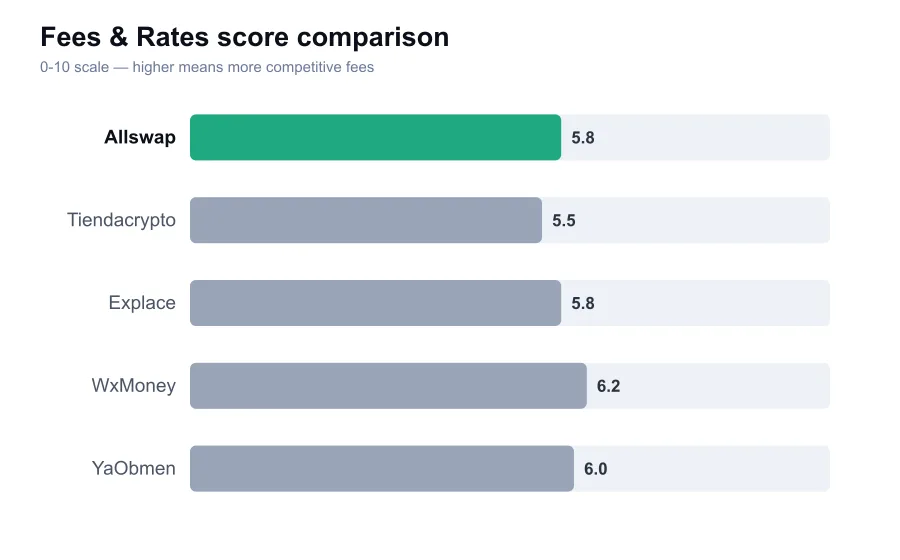
Allswap's pricing follows the familiar instant exchange model. The final quote is made up of liquidity pricing, the platform's margin, and relevant network costs. A user may see a rate option described as floating or fixed, but neither label tells you the true cost by itself. The only useful comparison is the quantity you will receive after every fee and network deduction. That requires opening several quotes at the same time, particularly for larger swaps.
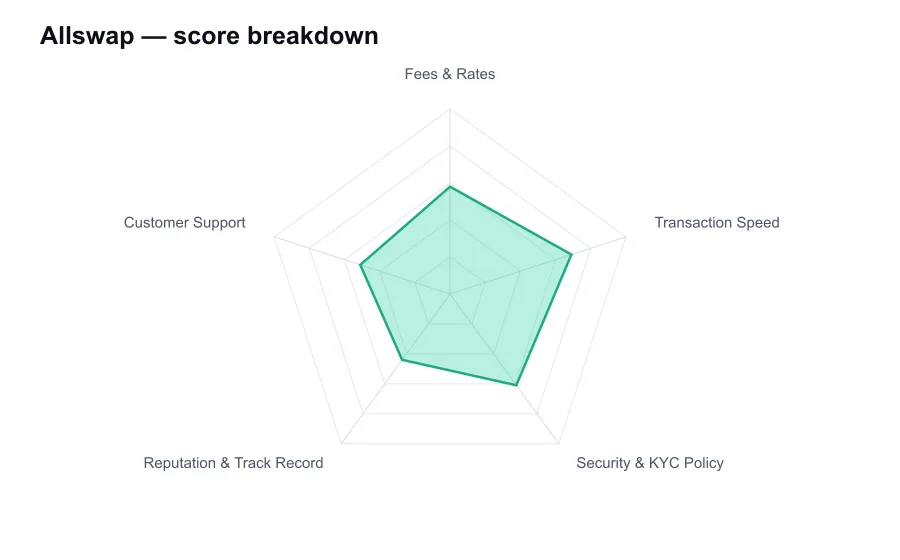
I would be cautious about assuming Allswap is a low fee provider because its fee presentation is less easy to audit than that of a conventional exchange with a published maker and taker table. This is not unique to Allswap. It is a structural weakness of the instant swap sector. On highly liquid pairs, the convenience premium may be modest. On lesser known coins, the available liquidity and spread can make the transaction materially more expensive than a user expects.
Fixed rates are the better fit for users moving an amount that would hurt to have repriced. They reduce the uncertainty caused by a rapid Bitcoin or Ethereum move while the deposit confirms. Floating rates can work well in quiet markets and may offer a slightly better starting quote. They also transfer market risk to the customer. Read the rate expiry terms and send the exact requested amount, because an underpayment can alter the path of the transaction.
Speed is a reasonable strength, assuming the blockchain and liquidity route cooperate. A swap on a fast chain with a liquid receiving asset can be processed quickly once Allswap sees the incoming deposit. That is the normal experience an instant exchanger is built to deliver. Bitcoin deposits, congested Ethereum transactions, and low fee transfers are different cases. The website may process an order promptly while the blockchain still dictates the clock.
The more difficult speed question concerns exceptions. A strong service is not just fast when everything is ordinary. It tells users clearly what has happened when a deposit is delayed, a route is unavailable, an amount differs from the order, or a compliance review starts. Allswap offers the basic transaction flow expected from the category, but its smaller public footprint gives me less confidence about how well it handles the awkward cases that determine whether support is actually good.
Allswap's no account approach has obvious appeal. There is less friction and less personal information sitting in another customer database for a normal crypto to crypto transaction. Still, no registration should not be interpreted as a promise that documents will never be requested. Risk systems can flag wallet activity, transaction size, sanctions exposure, or source of funds concerns. A request for KYC after sending is possible across much of this industry.
That is why I would not use Allswap with funds whose history I cannot explain. Keep the exchange order record, transaction hash, and wallet ownership evidence. If a service pauses an order, angry messages rarely resolve it. Clear documentation does. Users who need firm privacy guarantees should not use centralized exchange intermediaries at all. A self directed decentralized protocol has different risks, but at least its rules are visible in code rather than internal compliance procedures.
The noncustodial character of the ordinary flow is a point in Allswap's favor. You are not depositing funds into a standing exchange wallet and hoping the company stays solvent for years. You are authorizing a one time transfer. Yet there is still an interval in which the service controls the exchange process, and that makes operational trust important. Check the domain, reject unsolicited support messages, and never share a seed phrase. No legitimate exchange needs it.
Reputation is Allswap's weakest category. There is not enough broad, long running public evidence to put it in the same trust bracket as established services such as Changelly, ChangeNOW, or Alfacash. A smaller service can absolutely function well. But a prudent reviewer has to distinguish between a working website and a deeply proven operator. The relative lack of long term, independent discussion should lead users to start with small amounts rather than make a sweeping judgment from the interface alone.
Customer support appears to be online first, which is typical for this model. That can be completely adequate for a simple transaction, but it offers little reassurance to a newcomer who wants immediate help with a transfer worth several thousand dollars. Before relying on Allswap, inspect the support options, read its terms concerning refunds and AML checks, and ask a specific pre sale question. A clear answer is not a guarantee, though silence is a useful warning sign.
Allswap is best treated as a convenience tool for technically competent users who already understand wallets, confirmations, destination tags, and network selection. It may save time for an occasional small conversion. It is not where I would send a life changing amount or make my first crypto purchase. Those users need stronger disclosures, deeper support resources, and a provider whose regulatory and operational identity is easier to verify.
My view is guarded rather than dismissive. Allswap's model is practical, and the ability to swap without maintaining an account has value. The problem is that small instant exchangers must earn trust through transparent pricing, reliable execution, and a long record of resolving problems publicly. Allswap has less evidence on that front than the market leaders. Use it only after quote comparison and a small test, then decide whether its convenience justifies the extra uncertainty.