Vobmenka is another regional online exchange service aimed at users who want to convert crypto and local payment methods without operating on a conventional exchange. Its market position is practical rather than glamorous. The service is intended for people who need to exchange an asset, often USDT or Bitcoin, into a card or cash related route, not for traders studying charts all day. That distinction matters because the risks and costs are different.
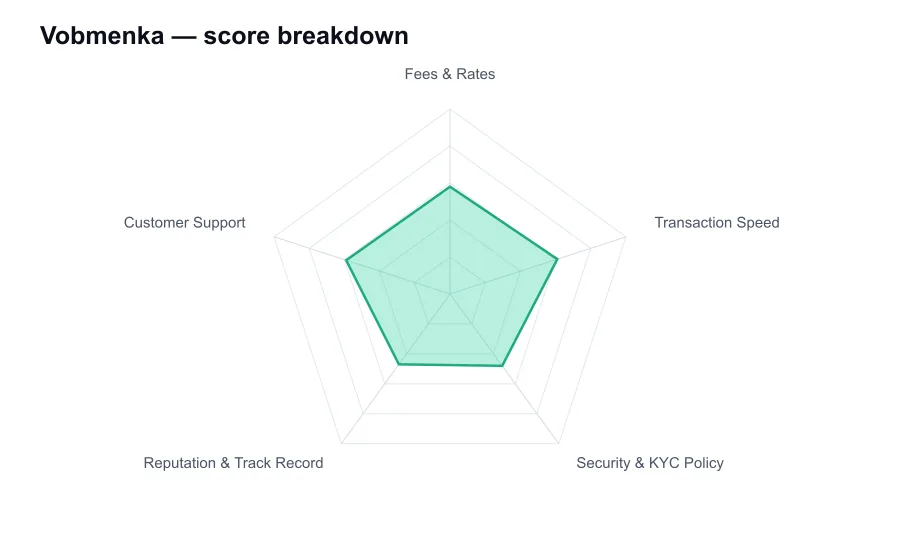
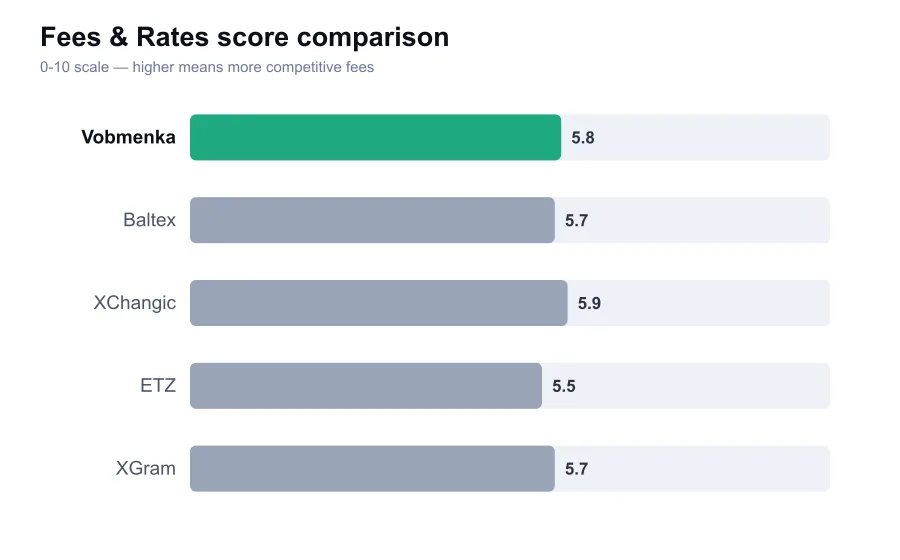
The first thing I would say about Vobmenka is that it should be judged order by order. Small exchangers rarely offer a stable fee table that tells the complete story. Instead, the provider quotes an amount to receive for a specific pair at a specific moment. Liquidity, network congestion, card processing costs, reserve size, and the provider's own margin all flow into that number. A headline claim about low commission means little without the final calculation.
For modest local exchanges, that approach can be perfectly sensible. Many people would rather accept a visible spread than place several orders on an exchange, withdraw coins, and manage a card transfer. The convenience has a price, though. Vobmenka is unlikely to beat a liquid spot market plus a cheap withdrawal for a large USDT, BTC, or ETH transaction. The larger the amount, the more seriously you should compare the quote.
Do not confuse a favorable advertised rate with a locked rate. Ask how long payment is reserved, whether the service accepts a small variance in crypto received, and how it calculates a recalculation if the rate moves. Those details determine whether the quote is really dependable. An exchanger that handles those rules clearly is much safer to use than one that simply promises the best rate and leaves the exceptions buried in an agreement.
Transaction speed has the same conditional character. A routine order can move quickly if Vobmenka has reserve available and the incoming crypto payment confirms promptly. USDT on a fast, low fee network will often be easier to process than a Bitcoin transaction during a busy mempool. The payout side is more uncertain. Bank cards, cash office arrangements, and financial institutions may create delays outside the exchanger's direct control.
I would be cautious with any claim of instant fiat payout. It may be technically instant from the provider's side, while the receiving bank holds the credit, applies a limit, or flags it for review. That is not always the exchanger's fault, but customers care about the actual arrival time. If you need money for rent, travel, or a business invoice, leave a time buffer and avoid sending the full amount until a small order has succeeded.
Security information is particularly important with smaller regional services because there is less public infrastructure to lean on. Vobmenka should be expected to use AML controls, and a seemingly no hassle exchange can still be stopped for wallet history or payment risk reasons. A person sending funds from a privacy service, questionable marketplace, or wallet connected to illicit activity may face a hold and document request. That risk exists across the industry.
What separates a good service from a troublesome one is how it communicates those policies. Customers should be able to find terms explaining the proof required, the handling of underpaid orders, the treatment of rejected card payments, and the process for refunds. If these answers are vague before payment, they rarely become clearer afterward. Read the rules closely, save the order details, and communicate through the official support channel only.
Vobmenka does not have the public footprint of WhiteBIT, Kraken, or Coinbase. That is not a decisive flaw for an exchange kiosk style service, but it should limit the amount you are prepared to risk. A smaller brand can offer attentive local support and competitive rates, yet it has less visible evidence of reserves, regulatory infrastructure, audited controls, and crisis management capacity. Trust should be earned gradually rather than assumed.
Public review profiles require some skepticism. Review platforms can show whether customers regularly complain about delays, recalculations, or missing payouts, but they can also contain promotional activity and unverified one line praise. Look for patterns in detailed comments, especially how a company responds to a disputed order. A respectful answer that identifies the payment issue is more meaningful than a page full of generic five star ratings.
Support is likely central to the Vobmenka experience. A one step exchange can become complicated quickly if a customer selects the wrong network, forgets a destination tag, or sends less than the invoice. Good support can save such cases. I would test response speed with a simple pre sale question and judge whether the reply is specific. A fast answer that does not address the actual problem is not good customer service.
The sensible approach is to treat Vobmenka as a convenience provider rather than a bank. Keep no residual balance on the platform. Send only from an address you control, verify the destination address character by character, and record transaction IDs. Never let a support agent redirect you to a random messenger account or ask for a seed phrase. A legitimate exchange does not need your wallet recovery words.
Vobmenka can make sense for users who want a straightforward regional conversion and are willing to do the homework that comes with using an exchanger. It is not designed for active trading, and its spread based pricing is not automatically cheap. Its value rests on convenience, local payment coverage, and the quality of execution on the exact route you need. Those strengths are real, but they are not universal.
My verdict is cautious rather than dismissive. Vobmenka may be a workable choice for small to medium transactions after rate comparison and a successful test order. Its limited public profile means I would not choose it for a life changing transfer, a business treasury balance, or a deadline sensitive payout. Use it like a local exchange counter, carefully and transaction by transaction, not like a permanent financial home.