Baltex is a smaller crypto exchange service built around quick conversions rather than a deep order-book trading experience. It belongs to the crowded instant-swap end of the market, where providers promise an uncomplicated path between assets and compete mostly on the final quote, supported coins, and how they handle problems. That last point is more important than the marketing copy suggests. Anyone can make an exchange widget. Running it reliably through network congestion, wallet maintenance, and compliance flags is the hard part.
The first impression is that Baltex is designed for a customer who already knows what they want to exchange. There is little need to learn charting tools or understand maker orders. Choose the sending and receiving assets, enter an address, and follow the payment instructions. That is an advantage for a quick swap, but it leaves less room for price discovery. A user who wants to work an order, view liquidity, or set a limit price will be better served by a conventional spot exchange.
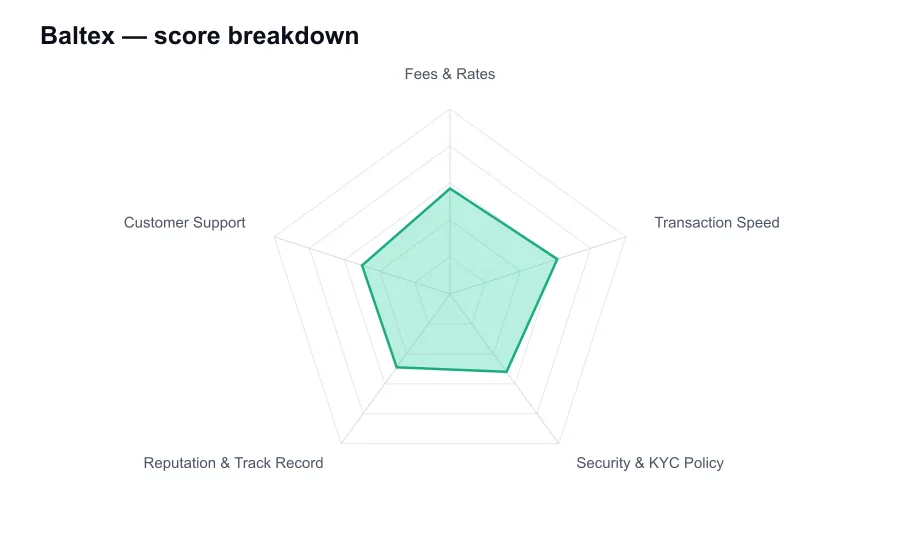
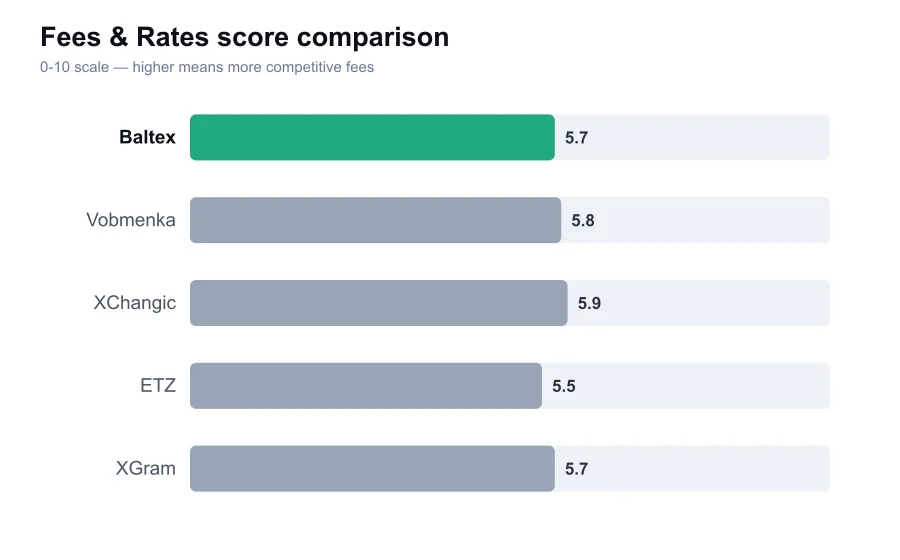
Baltex's cost is primarily embedded in its rate. This is normal for its category, but the language of low or zero commission can be misleading if taken literally. The relevant number is the difference between the market value of the deposit and the actual amount arriving in the destination wallet. For liquid pairs, the spread may be reasonable. For obscure tokens, volatile assets, or small trades where network fees dominate, it can be much less appealing.
I would not use Baltex without a quick quote check against ChangeNOW, SimpleSwap, StealthEX, and a liquid centralized exchange. That sounds tedious, but it takes less than a minute and often reveals whether convenience is being priced fairly. The difference may be tiny on a small stablecoin conversion. It can become expensive on a larger BTC, ETH, or USDT order. Baltex does not give me enough independent reason to skip that comparison step.
Quote type matters here too. A floating-rate order exposes the final result to market movement after you send the deposit. That may be acceptable if the source network confirms quickly and the market is calm. A fixed quote offers more certainty, but users should inspect the final output because certainty often costs more. The terms should also be read for deposit time limits and underpayment rules. Sending the wrong amount, even by a small margin, can turn a supposedly simple exchange into a support ticket.
Speed is solid in the best-case scenario and harder to judge in the awkward cases. A fast-chain swap can move from deposit to payout quite quickly once Baltex has received the required confirmations. Bitcoin and Ethereum-based transfers are another matter. Blockchain conditions, gas settings, and the provider's own payout process all affect delivery. Promising a precise completion time would be dishonest, because a service of this kind controls only part of the journey.
What Baltex can control is communication. A good exchange page should clearly show that a deposit is awaiting confirmation, being exchanged, awaiting payout, or sent. Baltex's process is straightforward, although it does not project the same operational maturity as a large brand with detailed status tooling and broad public incident reporting. For a routine order, that may not matter. For a delayed one, it quickly becomes the difference between an inconvenience and a stressful experience.
Baltex is often discussed as a no-account or low-friction service, but users should not equate that with a guaranteed absence of KYC. Crypto compliance screening is now built into much of the exchange ecosystem. An unusual amount, a high-risk source address, or an automated risk flag can lead to identity and source-of-funds requests. A legitimate provider needs a policy for that. The weakness of smaller instant exchangers is that their policy language can feel general until a specific customer needs an answer.
For privacy-minded users, the honest assessment is that Baltex may reduce routine data collection compared with a fully regulated custodial exchange, but it does not remove counterparty risk or compliance risk. You still hand coins to a third party during execution. You still have to trust its wallet controls, liquidity arrangements, screening process, and ability to return or complete funds if something goes wrong. That is why a noncustodial-looking interface should never be mistaken for a trustless swap.
On security, the safest behavior is basic but non-negotiable. Use the genuine domain, not a sponsored search result or a link from social media. Confirm both the destination address and network. Keep the exchange ID and transaction hash. Do not send money from an exchange account if you may need to prove ownership later, because withdrawal batching and third-party custody can complicate a review. And do not attempt a large first order simply because the interface looks clean.
Baltex's reputation is still developing. It has visibility as an exchange service, but it lacks the lengthy, heavily scrutinized record of companies such as Kraken or Bitstamp. That does not mean it is automatically unsafe. It means the available evidence is thinner, and the burden of cautious use is higher. I would be particularly conservative with orders large enough that a delayed payout would cause financial distress.
The public feedback pattern for providers in this tier is predictable. Quick swaps attract positive comments because the product works as intended and requires little conversation. Negative experiences cluster around delayed orders, final-rate disappointment, or verification requests. Those complaints can be justified, though they can also arise from a customer sending on the wrong network or misunderstanding a floating quote. A serious reviewer should resist both extremes, neither dismissing every complaint nor treating every delay as proof of fraud.
Support is adequate only if it can deal with the exceptions. Baltex offers customer contact options, but the experience is likely to be more ticket-based and less immediate than users expect from mainstream financial platforms. Give support the exact transaction hash, order ID, sending address, receiving address, amount, and screenshots. A vague message saying that funds are missing slows everything down. This is not glamorous advice, but it is the practical difference between a resolvable case and a long argument.
There is a place for Baltex. It can be useful for an experienced user who wants a quick exchange and sees a favorable live quote. It does not earn trust by scale, regulatory reach, or unusually transparent fee disclosures. It earns it one properly completed transaction at a time. That is a lower standard than I want for a primary exchange, but it is enough for occasional utility use if the customer keeps the amount sensible.
My take is more cautious than hostile. Baltex is not a venue I would recommend for holding funds, trading actively, or making a first large crypto purchase. It can serve as a transactional tool, provided its final quote is checked and the sender accepts that exceptions may take time to resolve. The basic service is convenient. The thin public footprint and opaque all-in pricing stop it from being a top-tier recommendation.