WxMoney is a small crypto exchange service aimed at users who want to swap coins, stablecoins, and, depending on the direction, electronic payment balances without opening an account at a large trading venue. It occupies the familiar independent-exchanger corner of the market: practical for a one-off conversion, less convincing as a place to keep money or execute sophisticated trades. That distinction matters. A service like this should be judged by the actual rate, reserve depth, and execution discipline, not by a polished promise of instant exchange.
The site experience is built around selecting a send currency, choosing a receive currency, entering an amount, and supplying payout details. That is straightforward enough for someone who already understands wallet addresses and network selection. Beginners need to slow down, though. Independent exchangers don't provide the same guardrails as Coinbase, Kraken, or a regulated bank app. A wrong network, a typo in a payout address, or an incorrectly selected asset can be hard to reverse.
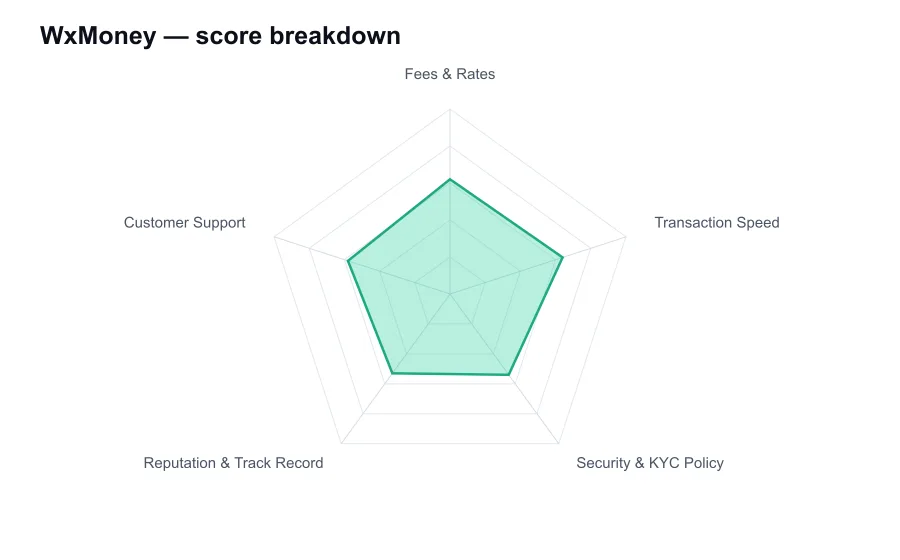
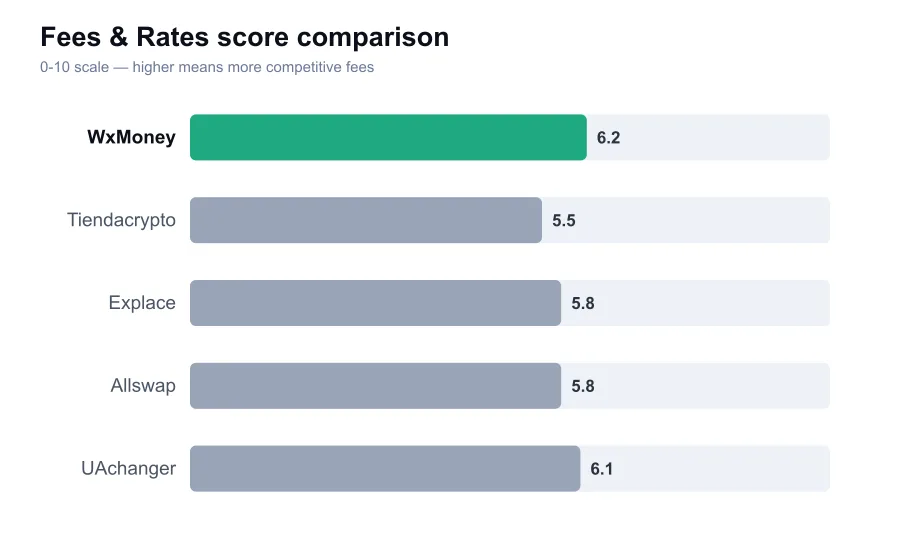
Pricing is WxMoney's central attraction only when its displayed rate genuinely beats the alternatives. Like many manual or semi-automatic exchangers, it does not work like an exchange with one neat published maker and taker fee. The cost is generally folded into the quote and can also be affected by payment rail charges, network fees, and the service's available reserve. That is common, but it makes lazy comparisons misleading. The number that matters is the final amount you will receive.
I would not call an embedded spread inherently unfair. A transparent all-in quote can be better than a low advertised fee followed by a card-processing surcharge and a withdrawal charge. The problem arises if a quoted rate changes after payment or if the service leaves too much room to reinterpret a transaction. Before sending funds, save the order page, quote, exchange direction, and stated completion window. For a first transaction, test the route with a modest amount.
WxMoney can look competitive on popular crypto-to-crypto routes, particularly where a user values simplicity more than an order book. It is less likely to be the cheapest choice for liquid major pairs such as BTC to USDT or ETH to USDC. On those pairs, large exchanges often have tighter market spreads, even after a withdrawal fee. A user moving a meaningful sum should compare the net output against at least two established instant-swap services and one major exchange.
Speed depends far more on the asset and payment method than on the word "instant". A USDT transfer on a fast network may be visible quickly, while a Bitcoin deposit still needs confirmations and can be slowed by a congested mempool or a low sender fee. Bank-linked and electronic-money directions may require human checks, which is where small exchange desks either prove their value or lose patience fast.
My reading of services in this category is that WxMoney should be treated as a same-day exchange tool, not as a guaranteed seconds-long conversion engine. Clean crypto-to-crypto orders can be quick once the incoming transaction is confirmed. More unusual pairs and fiat-adjacent payment methods deserve extra time. If the transfer is urgent, get a written confirmation from support that the specific pair is available and that the displayed reserve is current.
The security model is necessarily narrower than a full custodial exchange. You are not usually building a long-term account protected by withdrawal whitelists, hardware security keys, and institutional custody controls. Instead, you send funds to an address for a specific order and expect a matching payout. That reduces exposure to a standing account balance, but it raises the importance of checking the domain, order identifier, address, and support contact before paying.
KYC is another area where users should avoid assumptions. Smaller exchangers may accept routine crypto swaps with minimal information yet request identity evidence, source-of-funds details, or payment verification when an anti-fraud system flags an order. That is not automatically suspicious. It is how compliance pressure reaches this market. The concern is whether the policy is clearly explained before payment and whether a paused order has a practical resolution path.
I would never send WxMoney an amount that would create a personal crisis if compliance review takes several days. The service may be suitable for ordinary conversions, but it does not have the public institutional transparency of a licensed exchange with audited reports, named executives, and a mature legal-support structure. Privacy-conscious users should also understand that no-KYC marketing, where applicable to a route, is not a promise of immunity from screening.
Reputation is where WxMoney has a tougher job than its larger rivals. It does not carry the long, globally documented operating record of Kraken or Bitstamp, and independent monitoring sites can be useful only if reviews are recent, detailed, and tied to completed exchange directions. A large count alone means little. Look for how the service addresses delayed orders, changed rates, and disputed payment claims.
A good reputation signal is consistency: customers describe receiving the stated amount, within a believable timeframe, and getting a human response when something breaks. Warning signs are repetitive one-line praise, accusations with no visible attempt at resolution, or explanations that blame every delay on a vaguely defined security check. No exchange review can remove counterparty risk, but a cautious user can reduce it substantially by checking current feedback just before an order.
Support appears to be an important part of the proposition because these transactions can involve manual intervention. The test is not whether a chat bubble exists. It is whether an agent can identify an order, explain what confirmation or document is missing, and give a concrete next step. If you need a response at night or during a market panic, a smaller desk may not match the staffed operations of a major exchange.
Keep every relevant record. Save transaction hashes, screenshots of the order, the quoted amount, and messages with support. That advice sounds dull until a network confirmation arrives late or a payout needs tracing. It also makes a real support request much easier to handle than an emotional message saying funds have disappeared.
WxMoney is best approached as a transactional service, not as a financial home. For a user who compares quotes carefully, understands self-custody, and starts with a limited test, it can be a convenient option in a route that larger platforms do not serve elegantly. For large recurring volume, regulated fiat access, or a need for a deeply established compliance framework, I would choose a better-documented exchange. Convenience is valuable, but it should not replace verification.