UAchanger is a Ukrainian oriented exchange service built for people who want to swap crypto, electronic money, bank cards, and in some cases cash without learning a trading terminal. It sits closer to the classic exchanger model than to WhiteBIT or Binance. You select a direction, enter payment details, send funds, and wait for an operator or automated system to release the payout. That simplicity is its main appeal, particularly for local users moving between hryvnia and major cryptocurrencies.
The service's practical focus is more important than its interface polish. UAchanger appears designed around common regional payment routes rather than a broad global market. Bitcoin, Ethereum, Tether and other familiar assets tend to be the relevant choices, along with Ukrainian card rails and payment systems. A user looking for perpetual futures, staking, limit orders, or a large list of speculative tokens is in the wrong place. This is an exchanger for completing a conversion, not building a portfolio.
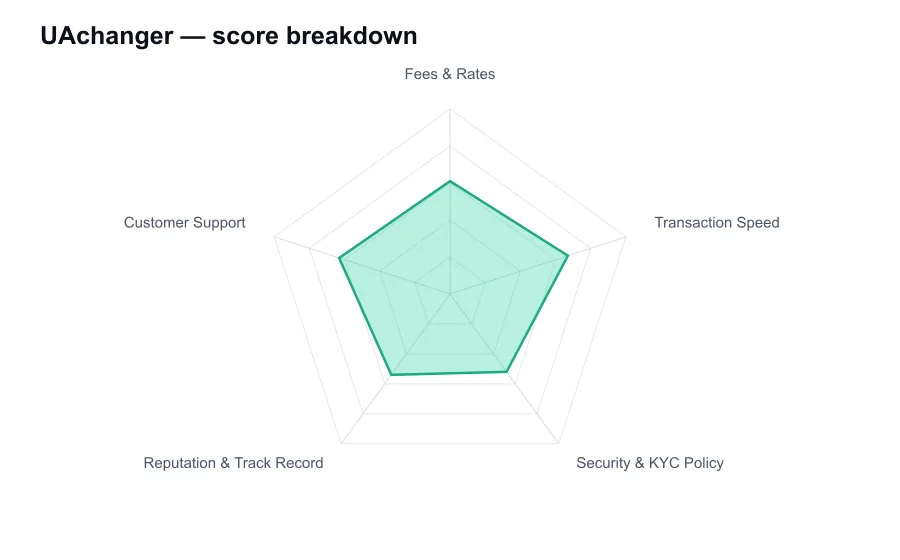
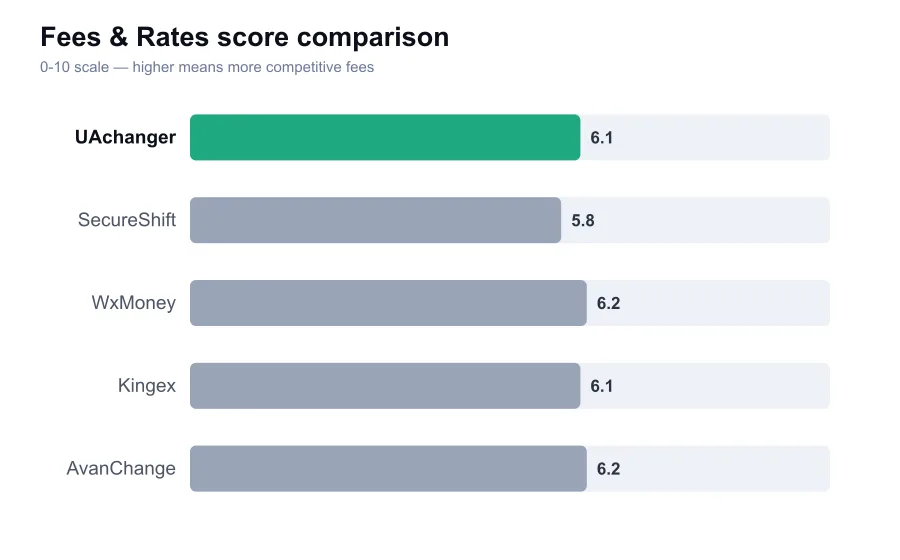
Fees need careful reading before you create an order. UAchanger does not present a simple exchange wide percentage comparable to a spot exchange's 0.1 percent trading fee. Its cost is embedded in the quoted rate, and that rate changes with liquidity, payment method, amount, and whether the direction involves cash or a bank card. That is normal for the exchanger category, but it makes direct comparison harder. The screen rate is the number that matters.
For common USDT and hryvnia directions, the quoted spread can be acceptable if convenience is your priority. It is less attractive for a large transfer where even a one or two percent difference is meaningful. A diligent buyer should compare the final receive amount against at least two established alternatives before paying. BestChange style monitoring sites can help with that, although a favorable listing should never replace checking the service's own current terms.
Fixed rate orders deserve special caution. A rate is only truly useful if the provider clearly says how long it is reserved and what happens when the received amount differs from the invoice. Blockchain fees, underpayments, delayed confirmations, and card payment holds can all change an apparently straightforward deal. Read the order page rather than assuming a screenshot of the quote is a guarantee. This is where smaller exchangers can generate the most frustration.
Speed is usually good for the simplest routes. Crypto deposits can be credited after the required network confirmations, then an automated payout may take minutes. Card payouts and bank transfers are less predictable because the provider cannot control the receiving bank's risk systems, maintenance windows, or card limits. A first order, a large amount, or a transaction that needs manual review can take substantially longer than the optimistic timing shown in an exchange widget.
I would not use UAchanger for a time critical arbitrage trade or a payment with a rigid settlement deadline. Exchanger services are only as fast as their least cooperative payment rail. They can be very convenient for turning USDT into hryvnia on an ordinary day, but they are not an institutional settlement desk. Send a small test amount first if a recipient is waiting on the other side.
Security is the section where prospective customers should keep their standards high. A service can operate legitimately and still provide less public assurance than a large regulated exchange. UAchanger may request identity documents, card ownership proof, source of funds information, or an AML explanation where its monitoring flags a transaction. Anyone attracted by a simple exchange form should understand that no formal KYC promise is absolute in a crypto transaction.
That policy is not inherently unreasonable. Screening is part of operating with bank cards and crypto liquidity partners. The problem is transparency: users need clear information about what triggers a hold, how documents are handled, and how long a review can take. Do not send funds from a mixer, sanctioned source, gambling related wallet, or a wallet with unclear history and expect a smooth order. Keep transaction records and use a wallet you control.
The public track record is respectable enough to put UAchanger above an anonymous Telegram dealer, but it is not in the same reputation class as a long established licensed exchange. Independent reviews of exchangers are useful clues, not proof. Some are affiliate driven, and a handful of positive comments cannot tell you how a platform handles its most difficult AML cases. The service needs to earn trust order by order.
Support appears to be a practical strength for ordinary exchange questions. Human chat support matters when a payer has used the wrong memo, sent a slightly incorrect amount, or needs clarification on a card payout. Still, response quality under pressure matters more than a chat icon. Before sending a large sum, test whether support can answer a precise question about reserve time, payout limits, or a particular network without falling back on vague reassurance.
The service is best treated as a transaction tool, not as a place to hold money. Once an exchange is completed, withdraw crypto to your own wallet and do not leave a balance waiting for a future swap. Confirm every address, especially on TRON and other networks where a quick copy error can be irreversible. If a rate looks dramatically better than competing exchangers, slow down rather than rushing to capture it.
UAchanger has a useful niche for Ukrainian users who value accessible payment options and a straightforward order process. Its fee model can be reasonable for modest conversions, but it is not automatically cheap. The speed can be perfectly adequate, yet it depends heavily on the asset and payout rail. I would use it for a carefully checked routine exchange, not as my default venue for major holdings or high value transfers.
My view is that UAchanger is a serviceable regional exchanger with the usual strengths and weaknesses of that model. It removes much of the friction of a trading platform, which is valuable to a newcomer who simply needs to exchange funds. In return, users accept rate spreads, less standardized disclosure, and a more limited public track record than the biggest exchanges offer. Start small, compare the receive amount, and keep your expectations grounded.