Trocador is one of the more distinctive names in the instant crypto exchange market because it acts primarily as an aggregator. Rather than asking users to trust one conversion desk's inventory and price, it compares offers from multiple exchange partners and lets the customer choose a route. That makes it closer to a search layer for swaps than a traditional centralized exchange, and it is especially popular with privacy-minded crypto users.
The difference matters. On a normal exchange, you may deposit funds, trade against an order book, and later withdraw. With Trocador, the intended flow is more direct: choose a pair, compare quoted providers, supply a receiving address, send the deposit, and receive the result to your wallet. It is a practical model for someone who values self-custody and does not want to maintain another account with another balance.
Trocador's strongest feature is price comparison. The service presents offers from different exchange partners, which can reveal that one route is materially better than another at the same moment. That is more useful than accepting the first quote from a single instant exchanger. The comparison is not merely cosmetic either, because liquidity, network support, and risk pricing differ widely among providers.
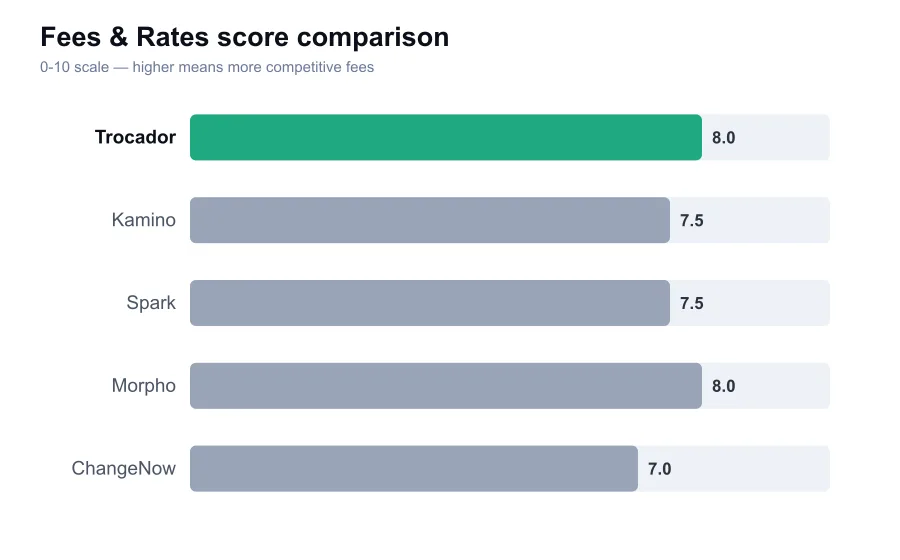
Its optional affiliate-fee setting is also unusually transparent. Users can set an affiliate fee from zero up to a stated maximum, and choosing zero means Trocador is not adding that optional affiliate share to the route. That does not make a transaction free. The underlying provider's exchange spread and network costs still apply. It does, however, give users a clearer lever than the hidden markup model common across instant swap sites.
The right way to judge cost is still the final payout. A route that shows a low provider fee can produce a worse received amount because its market rate is poor or its network expense is higher. Compare the amount delivered to your wallet, check whether the rate is fixed or floating, and pay attention to the selected chain. For common pairs, Trocador's aggregation gives it a genuine chance of finding a better deal than a single-provider competitor.
The platform is not automatically the cheapest option. A direct trade on Kraken, Binance, Coinbase Advanced, or a decentralized exchange can beat an instant-exchange route for a user who already has access, knows how to manage withdrawals, and trades enough to benefit from deep liquidity. Trocador earns its keep by reducing the search cost and preserving a direct wallet flow. For small and medium swaps, that can be a fair trade.
Speed varies according to the partner selected and the networks involved. A fast-chain exchange with an already liquid route can finish quickly after the deposit is confirmed. Bitcoin, Ethereum under high gas demand, thin pairs, and fixed-rate orders that need additional processing can take longer. Trocador's comparison page helps users see options, but it cannot make a slow underlying blockchain or partner operation behave like an instant card payment.
The platform's flow is best suited to users who can recognize a normal delay versus a serious issue. Check the partner name, expected processing time, minimum and maximum limits, and available status page before you send. If an order is time-sensitive, choose a well-known partner and a familiar network rather than chasing a marginally better quote on an obscure route. Saving the exchange ID and the deposit transaction hash is basic discipline, not paranoia.
Privacy is a major reason people use Trocador. The service itself does not require a conventional account for ordinary swaps, and it has long positioned itself as an aggregator that respects user privacy. There is also a privacy-oriented approach to features such as its donations and partner selection. But users must understand the boundary: Trocador's partner exchangers have their own policies, and some may request KYC for a particular transaction.
That means no-account access is not a promise that every swap will be anonymous under every circumstance. Risk screening, sanctioned-address exposure, unusual transaction patterns, or partner-specific compliance rules can lead to a hold. This is true across the instant-exchange market, but it is particularly important here because the user is choosing among third parties. Read the selected provider's terms before depositing, especially if losing access to funds during a review would be intolerable.
On security, Trocador's aggregation model has an attractive limitation: it is designed to avoid holding a user balance like a custodial exchange. Output goes to the address supplied by the user. Yet each swap still requires sending assets to a provider-controlled deposit address, so the user takes temporary counterparty risk. The service also has to be trusted to present legitimate routes and correct partner information. Verify the domain and never rely on a lookalike ad link.
Trocador has accumulated a stronger reputation than many anonymous-looking swap pages because it has been visible in the privacy and cryptocurrency community for years, has a recognizable public product identity, and offers a model users can inspect in practice. That does not turn it into a regulated bank or eliminate partner risk. It does put it ahead of a newly created instant exchanger with no known history, no clear policies, and no meaningful user community.
Support is reasonably structured for this type of service, with an order-focused approach and public documentation. The important limitation is that Trocador may need to coordinate with the underlying provider if the problem occurred at the partner level. That can add delay and can be frustrating for users who see Trocador as the only brand involved. Still, an aggregator that identifies the partner and provides traceable order information is more accountable than one that hides the routing entirely.
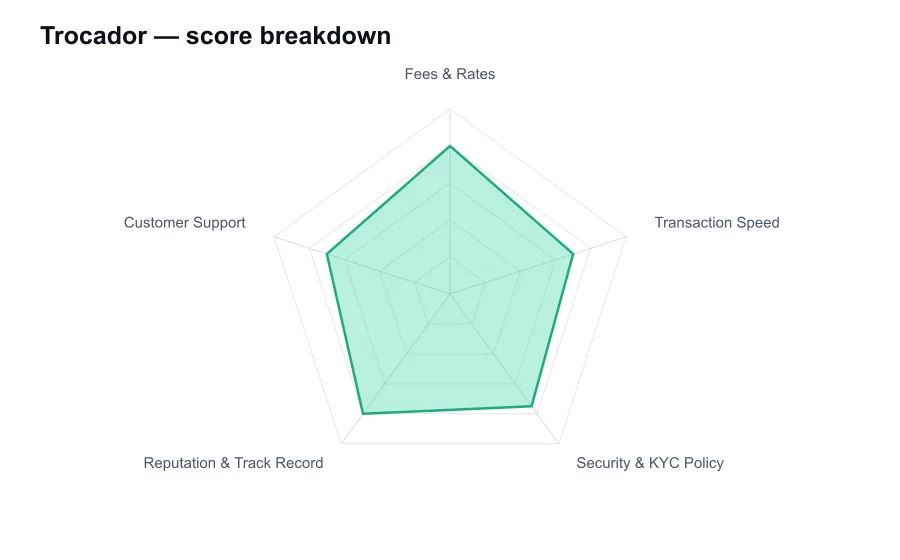
My verdict is positive, with firm boundaries. Trocador is among the better choices for a self-custody user who wants to compare instant-swap offers without creating a full exchange account. Its optional zero affiliate fee and multi-provider quotes are meaningful advantages, not gimmicks. It is not the best tool for maximum execution certainty, giant orders, or situations where a KYC review would be disastrous. Use it for deliberate wallet-to-wallet conversions, select partners carefully, and let a major exchange handle trades where institutional depth matters more than privacy and convenience.