Nexo sits in a different category from a simple instant swap service. It is a large, polished crypto financial platform offering an exchange, credit lines, interest products, card services and trading tools under one account. That breadth is its main attraction, especially for holders who want to borrow against assets rather than constantly sell them. It also means users are trusting one company with far more than a single conversion.
The exchange itself is capable and easy to navigate. Nexo Pro offers spot trading and a more conventional order-book experience, while the retail app makes conversions feel almost frictionless. A beginner can move between BTC, ETH, stablecoins and fiat-linked balances without learning how an exchange interface works. Experienced traders will find it less deep than Binance, Kraken or Coinbase Advanced, but it is much better than the token-swap screen many lending platforms bolt on as an afterthought.
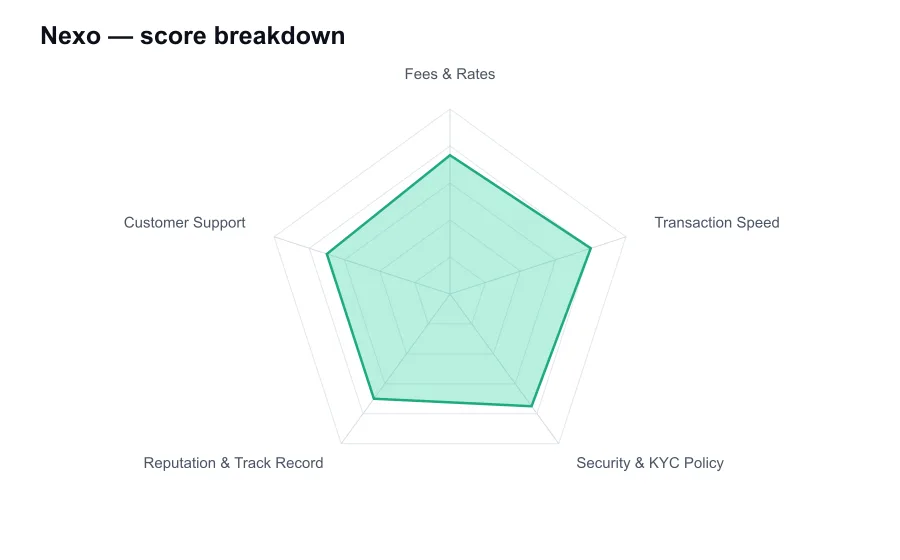
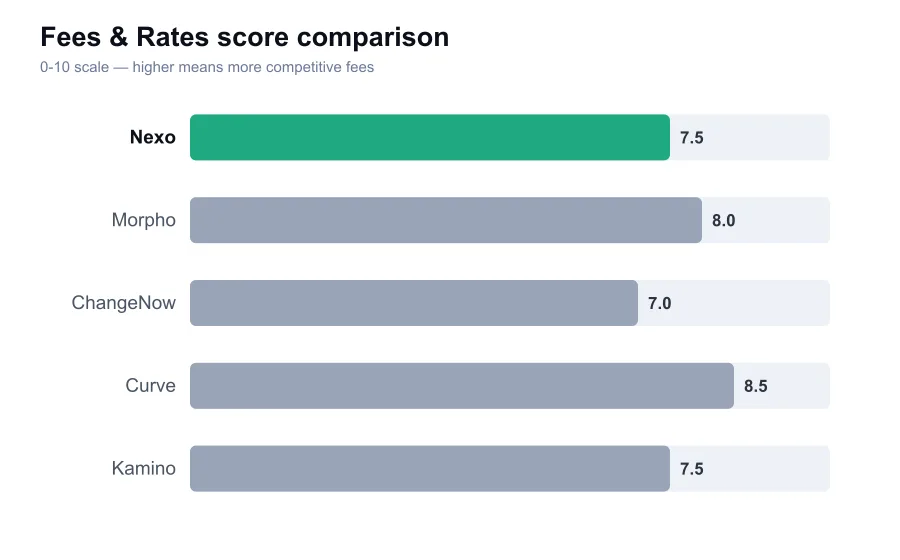
Nexo's listed exchange fees are competitive rather than exceptional. Standard spot fees start around 0.20% maker and 0.25% taker, with lower rates available to users who maintain higher loyalty tiers through NEXO token holdings. That is respectable, although active traders can find cheaper published schedules at Binance or OKX. The more important issue is that a simple in-app swap may include spread, so the quoted conversion is what matters, not just the headline fee.
The platform's loyalty model deserves skepticism. Holding NEXO can unlock lower borrowing rates, higher yield and trading discounts, but it also asks customers to take exposure to the company token to get the best deal. That is not a harmless membership point system. A user saving a few basis points on fees can lose far more if the token declines sharply. I would judge the exchange on its base pricing first and treat token-linked benefits as optional.
For liquid pairs, execution is generally quick. An internal balance conversion is near-instant, and spot orders on Nexo Pro are normally filled as soon as market liquidity allows. Deposits and withdrawals are a separate matter. Bitcoin, Ethereum and other blockchain transfers settle according to network conditions and confirmation requirements, while bank-transfer timing depends on the currency rail and the sending bank. Nexo cannot make a congested chain move faster.
Nexo's free withdrawal allowance is useful but not unlimited. The number of free withdrawals depends on loyalty tier, after which network charges apply. That arrangement is reasonable for investors who rebalance occasionally, but it is less appealing for someone regularly moving assets to self-custody or arbitraging between venues. Read the withdrawal screen before confirming. The network fee can change, and the cheapest chain is not always supported by the receiving service.
Security is one of Nexo's stronger areas on paper. The platform offers two-factor authentication, device and login controls, withdrawal address management and biometric app access. It has also publicized custody arrangements with institutional providers and insurance coverage connected to custodial partners. Those measures are meaningful, but no centralized platform should be described as risk-free simply because it has an insurance figure on a marketing page.
Account verification is mandatory for meaningful use. Nexo requires identity checks, and may request additional source-of-funds information under its anti-money-laundering procedures. Privacy-first users will not enjoy that process, but this is not a service trying to operate in the shadows. The practical benefit is that Nexo has clearer compliance infrastructure than many instant exchanges. The practical cost is that a review can delay access to funds if the system flags activity.
Its public history is mixed, which should influence the score. Nexo has operated since 2018 and survived several market shocks that destroyed less disciplined crypto lenders. It did not collapse like Celsius, Voyager or BlockFi. Yet its lending business has attracted regulatory pressure, including a 2023 settlement with US regulators over its Earn Interest Product. The company also left certain markets as rules tightened. Longevity is a real positive, but it is not a clean regulatory record.
Nexo has repeatedly pointed to reserves reporting and attestation efforts, though users should understand the limitations of such material. An attestation is not the same thing as a complete public audit of every liability, legal entity and liquidity mismatch. That distinction became painfully important during the 2022 lending crisis. I would rather see a customer treat Nexo as a managed counterparty exposure than confuse a dashboard with self-custody.
Customer support is better organized than at most anonymous swap sites. Nexo offers a help center, in-app support and live chat routes, with higher-tier clients often receiving more responsive service. Routine questions about deposits, cards and verification are usually covered well by documentation. The weak spot is familiar: account restrictions, compliance reviews and disputed transactions can become slow and scripted. That is frustrating, but it is also common at heavily monitored financial platforms.
The Nexo Card adds genuine utility for users who already hold assets on the platform. Its credit mode lets customers spend against collateral rather than sell crypto, while debit-style functionality can use available assets. That flexibility is clever, but borrowing to fund ordinary spending is not automatically financially smart. Users need to understand loan-to-value ratios, liquidation thresholds and interest terms before treating a crypto-backed card like a normal bank card.
For passive holders who want one app for buying, earning, borrowing and occasionally trading, Nexo remains one of the more mature names in its niche. Its interface is polished, liquidity is generally adequate and the business has outlasted several very visible competitors. It is not the cheapest trading venue, the most private service or the safest place to store every coin indefinitely.
My view is that Nexo earns consideration as a convenient, regulated-leaning crypto finance platform, not as a replacement for a self-custodied wallet and low-cost specialist exchange. Keep only the amount needed for the services you actively use, enable every security control, and do not buy NEXO merely to chase a minor fee discount. It is a credible operator with meaningful strengths, but its lending roots and centralized custody still demand caution.