Moneta365 presents itself as a cryptocurrency exchange service, but it sits far outside the group of providers that have built broad recognition, deep public documentation, or a clearly established market reputation. That distinction matters immediately. In crypto, a polished conversion page and a list of supported coins are easy to create. Reliable custody practices, accountable ownership, durable banking relationships, and years of visible dispute handling are much harder to establish.
For a reviewer, the central problem is not that every lesser-known service is automatically unsafe. Plenty of small brokers serve a local or niche audience competently. The problem is whether an ordinary customer can independently verify who operates the service, what legal entity is responsible, where complaints go, how client money is handled, and what happens if an order fails. Moneta365 does not offer the degree of readily verifiable public disclosure I would expect before trusting it with meaningful funds.
Its likely appeal is simplicity. Users who find order books intimidating often prefer a form that asks what they are sending, what they want to receive, and where the payout should go. That model can be useful for a one-time conversion. It is also the model in which poor execution is easiest to hide, because the customer sees a final quote rather than the underlying market price, liquidity source, and fee components.
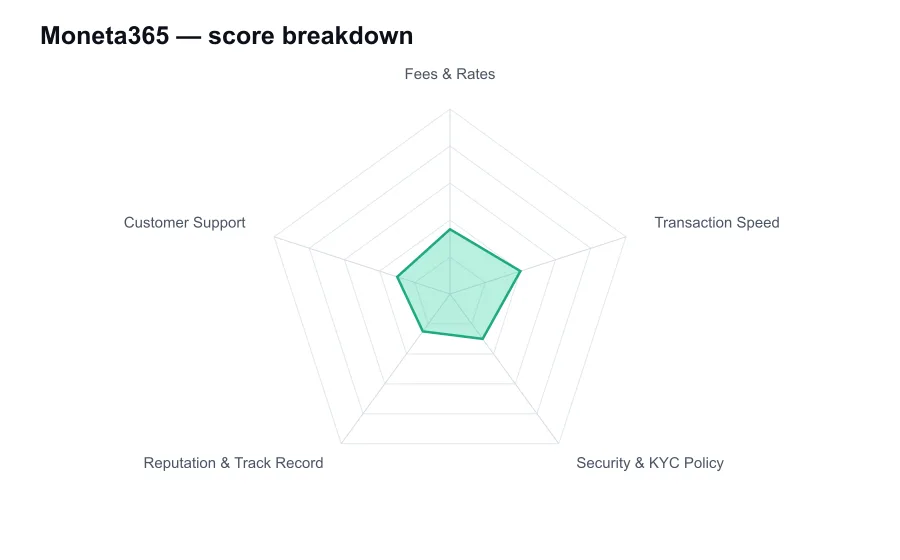
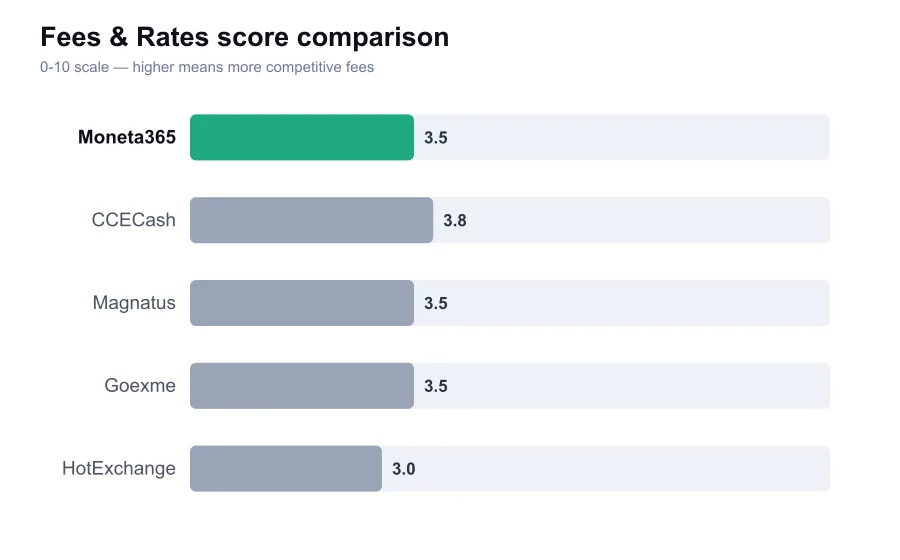
There is no convincing reason to assume Moneta365 is the cheapest route for a trade. Without a detailed, stable fee schedule and transparent spread methodology, the displayed quote becomes the only meaningful pricing information. A customer should calculate the all-in cost against a liquid market price at the moment of the transaction. Do not focus solely on a banner claiming low fees, zero fees, or a favorable rate. The amount that reaches the destination wallet is what matters.
Spread-based services can be perfectly legitimate, but they should earn trust by explaining their pricing. A traditional exchange might charge a visible trading fee, while a broker can advertise no commission and take its margin inside the rate. The latter can cost more, especially in illiquid assets or during rapid price moves. Moneta365 gives buyers little basis for judging how aggressively it marks up a quote compared with recognizable platforms.
Small transactions are where the service may be least objectionable. If a user wants to test the workflow with an amount they can genuinely afford to lose or wait for, the price difference may be tolerable. Large orders are another matter. A two percent or five percent execution disadvantage, a manual review, or an unresolved address error becomes far more serious as the ticket size grows. I would not use Moneta365 as a primary purchase channel for a substantial position.
Speed is difficult to assess responsibly without a long body of independently verifiable customer data. Any provider can say that exchanges are fast. The real test is how it behaves when the network is congested, the quoted asset moves sharply, a bank transfer is delayed, or automated checks stop a withdrawal. Moneta365 may complete straightforward orders quickly, but there is insufficient public evidence for me to promise consistently rapid settlement.
The customer should also separate blockchain settlement from provider processing. A transaction can have a valid on-chain confirmation while the service still has not released the payout. Conversely, an exchange can say it has sent funds while the receiving wallet has not refreshed. A competent provider makes this easy to investigate with a transaction ID, clear order states, and support that can explain the stage of the process. Thin operational transparency creates anxiety at exactly the wrong moment.
Security is the largest concern. There is not enough visible evidence of institutional controls, independently reviewed security architecture, proof of reserves, insurance arrangements, or a mature security disclosure process to rate Moneta365 generously. That does not prove a breach or misconduct. It does mean a cautious reviewer cannot grant credit based on claims alone. The burden of proof should rise with the amount of money a customer is asked to trust to a provider.
KYC and compliance policy should be treated carefully as well. A service may advertise ease of use, yet retain the right to request identification, source-of-funds information, or wallet history explanations after a deposit is made. That is common across the industry, particularly where payment fraud and sanctions screening are involved. Before paying, users should locate the current terms, identity policy, supported jurisdictions, and refund language. If those documents are vague or hard to find, walk away.
Moneta365 does not have the broad reputation cushion of a major regulated exchange. It is not comparable with Kraken's long public operating history, Coinbase's public-company disclosures, or Bitstamp's established European presence. Nor does it have the extensive third-party discussion one sees around leading instant-swap providers. A sparse reputation is not a neutral score in a sector where customers have many alternatives. It is a reason to reduce exposure.
Support is likely to be the deciding factor if something goes wrong, and it is hard to have confidence in support without clear public service standards or a large, credible history of resolved cases. Before placing an order, test the contact channel with a specific question about limits, verification, or refund handling. A useful reply should be direct and specific. Generic reassurance, pressure to deposit, or requests to continue only through private messaging are serious warning signs.
I would also avoid treating any online comments as definitive proof either way. Reviews can be genuine, outdated, incentivized, or fabricated. Look for consistency across independent communities, not just testimonials on the provider's own pages. Check whether criticism receives a substantive response and whether the service identifies a responsible legal operator. If you cannot answer basic questions about who is accountable, you are not ready to send a large transfer.
Moneta365 may work for a small, carefully tested conversion, but it has not earned my recommendation as a default exchange provider. The market has enough established alternatives that users do not need to accept unclear pricing and a thin public record for routine trades. Start tiny if you proceed. For meaningful purchases, recurring trading, fiat transfers, or any situation requiring dependable support, choose a provider with stronger verification, transparency, and history.