CCECash presents the kind of challenge that should make careful crypto users slow down. It operates in a corner of the market where names can look interchangeable, websites can be short on corporate detail and a clean exchange form can create a false sense of legitimacy. A service does not become trustworthy because it offers popular coins and a fast-swap promise. For CCECash, the issue is not that every small operator is unsafe. The issue is that its independently verifiable public record appears limited.
That puts it well outside the comfort zone I would recommend for substantial transactions. Crypto users are accustomed to self-custody risk, but they should not casually add opaque counterparty risk to the list. Once you send coins to an exchange address, your leverage is limited. You need to know who operates the service, how orders are processed, whether it has a meaningful history of resolving disputes and what recourse exists if the transaction is delayed. CCECash does not make those questions easy to answer.
Its apparent appeal is familiar: a low-friction route from one asset to another, without the lengthy process associated with a major centralized exchange. That format has genuine utility. If you hold crypto in a private wallet and want to rebalance a small amount, an instant exchange can be more direct than moving funds through a custodial account. Yet the same directness means there is less margin for error. There is no friendly bank transfer reversal if you select an incorrect network.
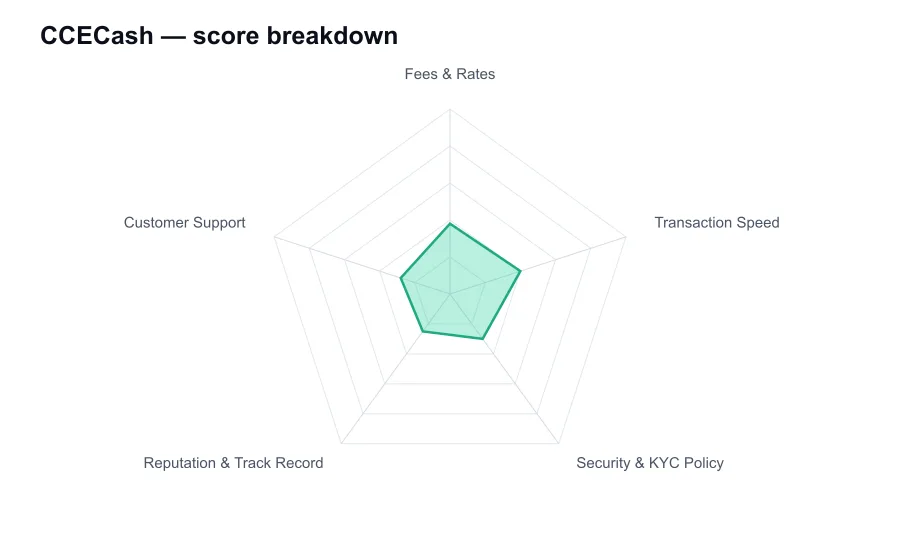
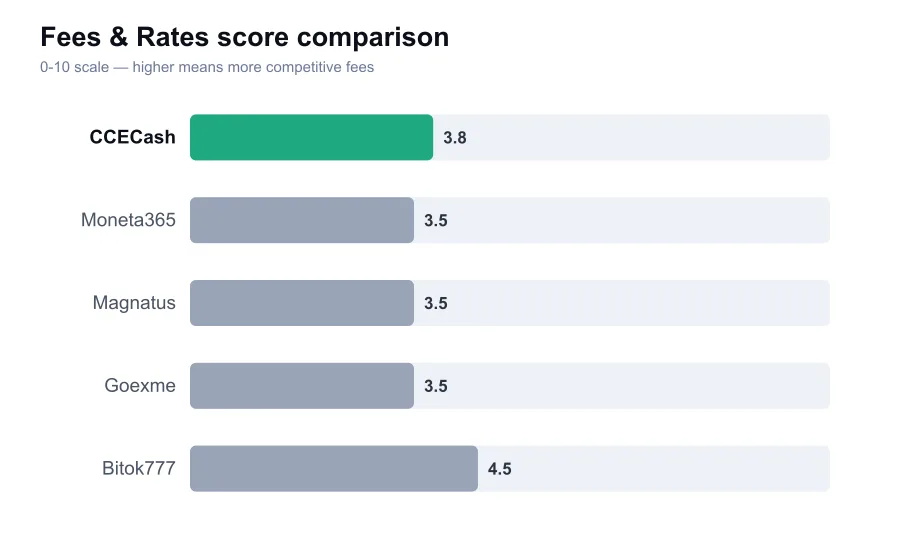
I would be especially skeptical of fee claims unless they can be verified at the order level. CCECash does not have the kind of transparent public fee documentation that supports a confident score on pricing. The key number is the exact amount arriving in your receiving wallet. A service can advertise a small commission while applying a less favorable exchange rate than the market, or it can pass on network costs in ways that are hard for newcomers to identify.
A useful check is to compare CCECash's quote against the mid-market price and against at least two reputable instant-exchange alternatives. Do this with identical amounts and the same chain. If the gap is small, the lesser-known service has not earned a reason to take extra risk. If the quote is noticeably better, do not assume that means it is superior either. It can reflect a temporary liquidity route, an estimate that floats, or simply a less visible cost elsewhere in the transaction.
Speed claims deserve similar caution. On-chain transactions have unavoidable confirmation requirements, and any exchange must source liquidity and send a payout. Bitcoin can take time, Ethereum fees can make operations costly, and token transfers can pause during network or wallet maintenance. A reliable provider tells users what stage an order has reached and offers a meaningful support path if that stage does not change. CCECash has not accumulated enough public operational evidence for me to call it dependable on speed.
That does not mean a small order cannot complete quickly. It may. The concern is exception handling. Crypto exchange reviews often look fine until you read the complaints involving delayed orders, requested documents, unsupported token contracts or deposits made from a flagged source. These are the moments that reveal whether a provider is serious. A polished first screen says almost nothing about how a company responds once an automated process breaks.
The security profile is therefore difficult to rate generously. An exchange that does not retain a customer balance after a completed order has a narrower custody risk than a traditional platform. That is a positive feature of the model. But it is not a security guarantee. Customers must still trust the service to receive the deposit, process the swap, protect operational infrastructure and either pay out or return funds if the trade cannot proceed.
KYC and compliance policy need particular attention. Any service dealing with cryptocurrency can screen transactions and request information. A claim of no registration should never be read as a contractual promise that documents will not be needed. If CCECash flags an order, the user may face a choice between completing a review, waiting for a decision or navigating a refund process. That possibility makes the service unsuitable for users whose funds are time-sensitive or whose privacy requirements are absolute.
The public reputation picture is the weakest part of the proposition. CCECash lacks the volume of independently discussed history that gives a reviewer confidence in a provider's behavior across market cycles and support disputes. Anonymous reviews, referral pages and promotional roundups are not enough. I want to see durable evidence, consistent customer feedback over time, transparent policies and identifiable accountability. Without that, a positive score would be speculation rather than criticism.
Customer support cannot be treated as an afterthought in this category. A user may need help with a missing destination tag, an exchange made on the wrong chain, a late deposit or a delayed payout. If support is slow or inaccessible, the user is left staring at a transaction hash with little practical power. Before depositing anything, ask CCECash a specific question about an asset, network or refund scenario. If the reply is unclear, canned or absent, walk away.
I also would not treat a website's use of security language as proof of operational maturity. HTTPS, a privacy notice and a transaction form are basic expectations, not evidence of robust asset protection. What matters more is whether the operator communicates limitations honestly, publishes sufficient terms and can be held accountable. CCECash does not provide enough public confidence on those fronts to justify use beyond a carefully measured test.
For users who want to experiment, the right approach is painfully boring. Use an amount you can afford to have delayed. Verify the destination address character by character. Confirm the source and destination chain. Save screenshots of the quote, order ID and transaction hash. Do not combine the test with a volatile trade where a delayed payout would materially change the result. Those steps are sensible anywhere, but they are essential with a lightly documented provider.
My opinion is that CCECash has not earned a recommendation as a regular exchange service. The theoretical convenience is not unique, and more established alternatives offer the same basic function with a clearer reputational foundation. It could complete a small swap perfectly well, but that is not the bar. A provider handling irreversible assets should make trust easy to evaluate. CCECash leaves too much for the customer to infer, and that is a poor bargain in crypto.