Bitok777 is a small crypto exchange service with a limited public profile, and that fact shapes the review more than any promotional claim on its site could. In an industry where new exchange brands appear constantly, the first question is not whether a widget can quote a swap. It is whether the operator has enough visible history, support capability, and transparency to justify receiving a customer's funds. Bitok777 has not established the kind of widely documented market presence that makes that answer easy.
The service appears aimed at quick crypto conversions rather than serious spot trading. That can be useful in principle. A user who wants to turn one asset into another without opening a full account may prefer a lightweight flow. The problem is that convenience services are only as good as their execution during exceptions. A normal order is easy. A stuck deposit, a wrong memo, a flagged wallet, or a disputed rate reveals whether there is a real operation behind the interface.
I would approach Bitok777 as an unproven counterparty rather than a default exchange. That is not an accusation of misconduct. It is simply the sensible standard for a provider without the widely known track record, licensing disclosures, extensive independent coverage, or established corporate identity of leading platforms. Crypto users often learn this lesson after a service delays a payout. The time to assess the operator is before sending, not after the transaction has become a problem.
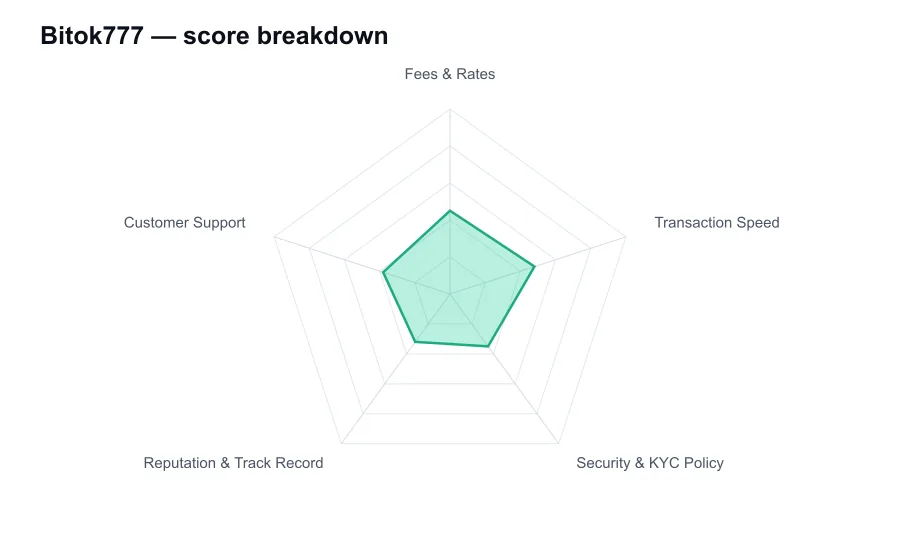
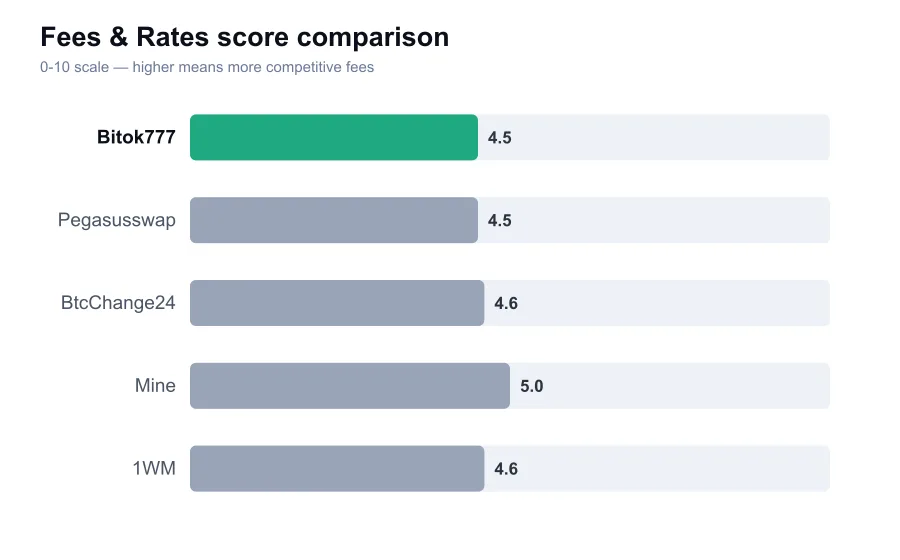
Fees are likely presented through the final exchange quote rather than a transparent order-book schedule. That model is not unusual, but it becomes less acceptable when a service has limited independent reputation. A customer cannot easily tell how much of the difference comes from a network fee, a liquidity provider, market movement, or Bitok777's own margin. For any material transaction, compare the received amount with at least two well-known instant exchangers and one liquid spot market.
If the quote is substantially better than established competitors, do not assume you have discovered a secret bargain. Check the exact network, minimum amount, fixed or floating rate status, and conditions attached to the order. Unrealistically attractive quotes are a reason for more scrutiny, not less. If the quote is worse, there is little rational case for accepting greater counterparty uncertainty as well. A small provider needs to compete on price, service, or a specific local advantage. Bitok777's public profile does not clearly demonstrate one.
Speed claims should be taken cautiously. Any exchange can state that swaps are fast, and many routine transactions will indeed complete quickly if liquidity is available and both blockchains are operating normally. The relevant question is how the service behaves when speed drops. Does it offer a clear live order page, explain confirmation requirements, publish wallet maintenance notices, and provide a traceable support channel? Those operational signals matter more than a generic promise of instant processing.
Network choice can make or break the experience. USDT exists on several chains, some fast and cheap, others more expensive or congested. Bitcoin deposits need confirmations. Ethereum token transfers can become expensive or delayed during busy periods. Users need to verify the network letter by letter before sending. A small exchanger may be less able to recover errors, especially cross-chain transfers or missing tags, than a larger company with dedicated asset-recovery teams.
Security is the most difficult category to score generously for Bitok777 because public transparency is limited. There is no reason for a prudent user to infer cold-storage procedures, insurance arrangements, audited reserves, or mature incident management from a basic exchange interface. Even providers that publicly describe those protections can fail, so silence deserves no benefit of the doubt. Never use a small service as a wallet or send an amount you cannot afford to have tied up.
The same caution applies to privacy and KYC. A website may appear to allow low-friction orders, but screening can still occur once a transaction is received. Users who are unwilling or unable to provide requested evidence should not take that risk with any centralized exchange service. Privacy-conscious customers are better served by understanding self-custodial tools and legal obligations than by relying on a vague promise of anonymity from an obscure website.
Reputation is where Bitok777 falls behind the other providers in this comparison. I could not identify the volume of durable, independently corroborated operational history that would support strong confidence. There may be positive user comments in affiliate-driven listings or social channels, but those are weak evidence in crypto. Look for detailed reports from identifiable users, transparent ownership, consistent customer-service behavior, and a track record through difficult market conditions. Until those signals exist, caution is the correct default.
Support deserves the same skeptical lens. A contact form, chat bubble, or messaging account is not the same as accountable customer service. Before using Bitok777, test whether support can answer concrete pre-sale questions: which entity operates the service, what happens if an order is underpaid, how are KYC holds handled, and what is the process for a failed payout? Evasive answers, copied boilerplate, or pressure to deposit first should end the conversation immediately.
A sensible first test, if someone insists on using the service, is a very small amount on a simple, liquid pair. Do not choose an obscure token, a complicated bridge route, or a transfer that needs a destination memo. Record the original quote, the order identifier, all wallet addresses, and both transaction hashes. Once the transaction is completed, compare the received amount with the quoted amount. This basic discipline is not paranoia. It is how responsible users evaluate an unfamiliar counterparty.
There are better choices for most people. Established instant exchangers may still charge a spread, but they generally have more visible transaction history and support infrastructure. Regulated exchanges such as Kraken offer clearer account controls and more transparent market pricing, even if onboarding takes longer. For decentralized assets, a reputable self-custody swap protocol may reduce custody risk, though it introduces smart-contract and slippage risks of its own. Bitok777 does not clearly beat these alternatives.
The service may appeal to users seeking a particular obscure route or a low-friction interface, but that is not enough to recommend it broadly. The crypto market has repeatedly shown that polished pages and attractive rates are cheap to produce. Reputation is built through years of handling customer funds, publishing clear terms, surviving market stress, and resolving disputes in public view. Bitok777 has too little demonstrated evidence on those points for me to call it a confident choice.
My final opinion is blunt: Bitok777 belongs in the use-with-extreme-caution category. It might process a small routine swap without issue, but there is not enough public information to justify large transfers or reliance on it as a financial provider. The right benchmark is not whether it looks functional. The benchmark is whether it offers a better, safer, or more transparent deal than established alternatives. At present, I do not see a convincing case.