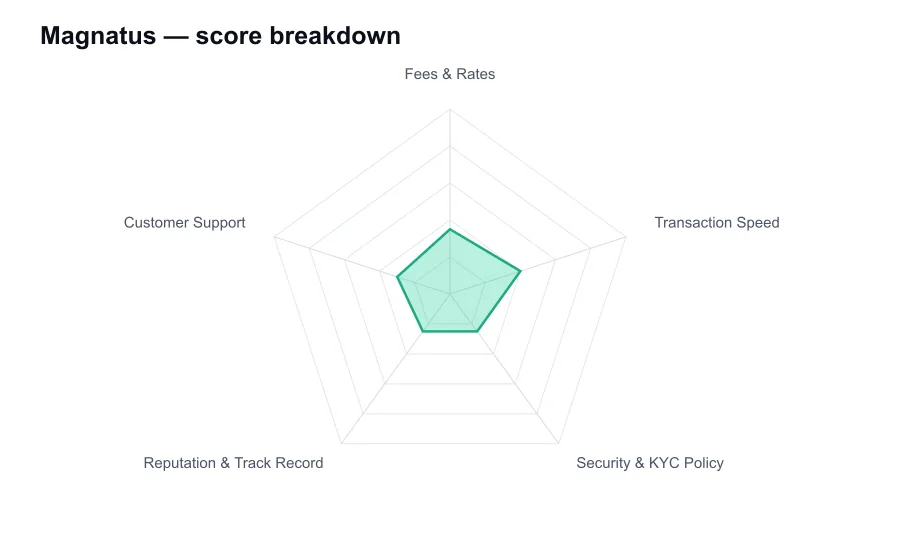
Magnatus occupies an awkward corner of the crypto market. It presents itself in exchange and swap comparison contexts, yet it doesn't have the public footprint, independently documented trading history, or operational transparency expected from a serious retail venue. That doesn't automatically make it fraudulent. It does mean a buyer should treat it as an unproven service, rather than placing it in the same mental category as Kraken, Coinbase, Bitstamp, or even better-known instant-swap platforms.
The first problem is basic verification. I could not establish a sufficiently reliable official corporate profile, regulatory registration, audited reserve report, or durable public documentation set that would let me confidently describe Magnatus as a mature exchange. There are plenty of crypto brands with limited media coverage, especially small regional operators, but a legitimate provider handling customer assets should still make its legal entity, terms, privacy policy, custody model, and contact routes easy to find.
That lack of disclosure matters more than a glossy front end or a promising rate quote. An exchange isn't just a website that can produce a swap. It is a counterparty, a custody risk, and sometimes a gatekeeper between a customer and their funds. If a transaction is delayed, a wallet is flagged, or an account is restricted, the quality of the underlying operation suddenly becomes the whole story. Magnatus hasn't built enough visible evidence to earn much benefit of the doubt here.
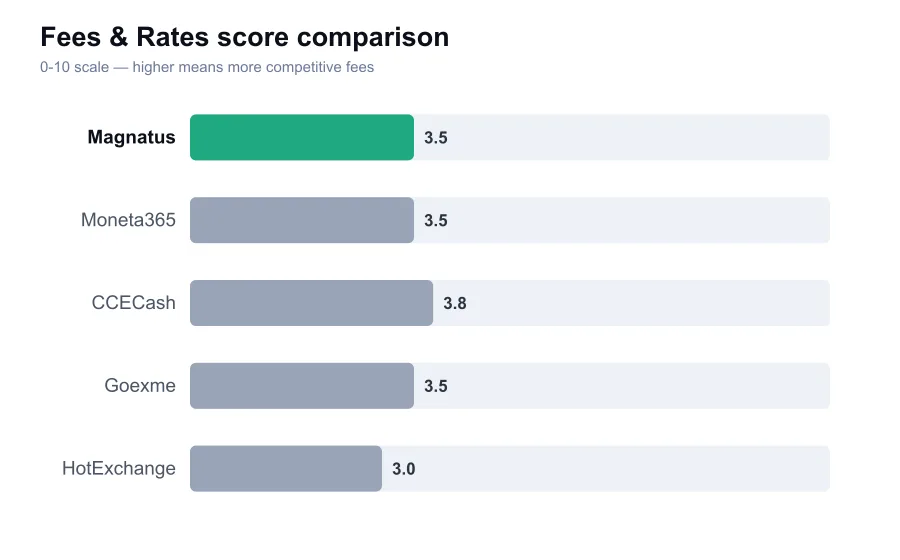
Pricing is also hard to assess with confidence. I found no consistently published maker and taker schedule comparable with the 0.40 percent and lower tiers offered by Kraken Pro, or the transparent quote structure used by established instant-swap services. A provider can advertise competitive rates and still embed its compensation in the exchange quote. Without a live, repeatable quote comparison and a stated policy on spreads, network fees, and failed transactions, users can't tell whether a cheap-looking trade is actually cheap.
That doesn't mean every Magnatus quote is necessarily poor. Smaller services sometimes source liquidity through external partners and can be competitive for an individual route. The issue is that a customer has no dependable basis for comparing one quote to the market. Before sending anything, I would price the same amount and asset pair against Coinbase Advanced, Kraken, Changelly, and a self-custody route through a major decentralized exchange. If the difference is more than a fraction of a percent, that difference can quickly exceed the apparent convenience.
Speed claims deserve the same caution. Blockchain settlement is only one part of a swap. A service may receive a deposit within minutes, then hold it for compliance screening, liquidity sourcing, manual review, or a wallet confirmation threshold. Ethereum transactions can be visible quickly but become expensive in busy periods. Bitcoin may require multiple confirmations, which can push a simple exchange beyond an hour. No public operational statistics from Magnatus make it possible to judge its normal completion time rather than its best-case time.
For a small test swap, speed is something a user can measure. For a large purchase, it shouldn't be an experiment. Anyone considering Magnatus should first send an amount they can afford to have tied up for a while, record the quoted output, deposit time, confirmation time, and payout time, then compare the result with the quoted terms. That's not paranoia. It is the sensible approach whenever the provider has not earned trust through years of public performance.
Security information is where Magnatus is weakest. I could not verify meaningful detail on cold-storage practices, wallet segregation, insurance, penetration testing, bug bounty coverage, independent audits, or proof of reserves. Security isn't proved by a padlock icon and generic language about encryption. Those are table stakes. Users should want to know who has control of private keys, whether customer assets are commingled, and what happens if the operating company becomes insolvent.
The KYC position is similarly unclear from a reviewer’s perspective. Some swap providers advertise low-friction onboarding but reserve the right to demand identification after funds arrive. That model can produce a miserable user experience if screening is triggered mid-transaction. A platform may be legally entitled to request documents, but fair operators explain this possibility before the deposit and give realistic information about review times. I couldn't verify that Magnatus offers that level of clarity.
Reputation is built slowly and tested under stress. With Magnatus, the problem isn't a long catalogue of confirmed failures. It is the opposite. There is too little reliable third-party reporting, too little established community discussion, and too little independently verifiable history to assess how it behaves when something goes wrong. That should lower a risk-conscious customer's confidence. Silence isn't a track record.
Customer support is difficult to award points for unless it is demonstrably reachable. A responsive email address, published ticket process, support hours, and a record of resolving public complaints would help. I wasn't able to confirm a robust support operation around Magnatus. If a provider's assistance depends on a chat widget or a social account, users should assume they may have limited recourse during a dispute, especially outside normal business hours.
There is also a practical issue that gets overlooked: recovery. With an established exchange, a customer can often point to a licensed entity, a formal complaint route, detailed transaction logs, and a visible leadership team. With a lightly documented brand, recovery becomes much harder. You may have a transaction hash, but a transaction hash doesn't force a company to answer an email or return funds from a custody wallet.
Magnatus may appeal to people looking for a route that isn't available on their usual exchange, but it hasn't demonstrated enough to justify treating it as a primary venue. The burden of proof should be on the provider, not on the customer. A convincing rate alone doesn't meet that burden.
My view is blunt. Until Magnatus publishes clear legal information, transparent fees, credible security details, and a support record that can be independently checked, it belongs in the high-caution category. If you use it at all, use a self-custody wallet, make a small test transaction, and don't leave funds sitting on the platform. Most retail users have safer, better-documented alternatives.