Goexme appears in the long tail of small crypto exchange brands, a part of the market where a working website and a trading interface can look more reassuring than the business behind them really is. It isn't a venue with the public profile of Kraken, Coinbase, Binance, or even a well established regional operator. That matters before anyone looks at a quoted rate. Crypto trading is largely a trust business, and Goexme doesn't offer enough independently verifiable history to earn that trust by default.
The first problem is basic transparency. Publicly accessible information about its ownership, licensing, headquarters, leadership, reserves, and operating history is thin. A smaller exchange can still be legitimate, of course, but it needs to compensate with unusually clear disclosures. Goexme doesn't appear to meet that standard. I would want a legal entity name, jurisdiction, registration number, custody explanation, and a clearly dated fee schedule before depositing a meaningful amount.
Its apparent appeal is simplicity. Platforms in this category commonly position themselves as a quick route from one coin to another, without the dense order books, margin panels, and institutional tooling that overwhelm newcomers. That can be useful for a one-off conversion. It also creates a familiar trap. A clean instant-swap quote can conceal a wider spread than the headline fee suggests, particularly on smaller tokens or during fast market moves.
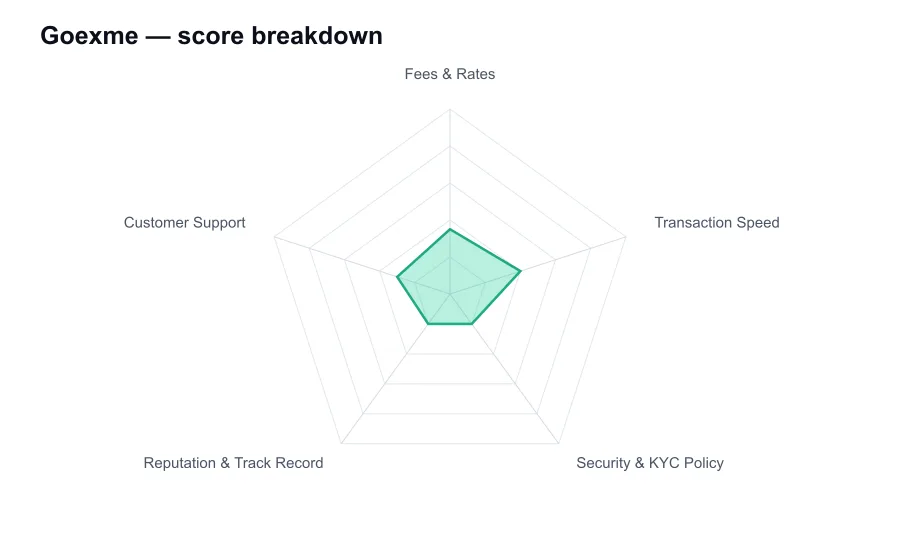
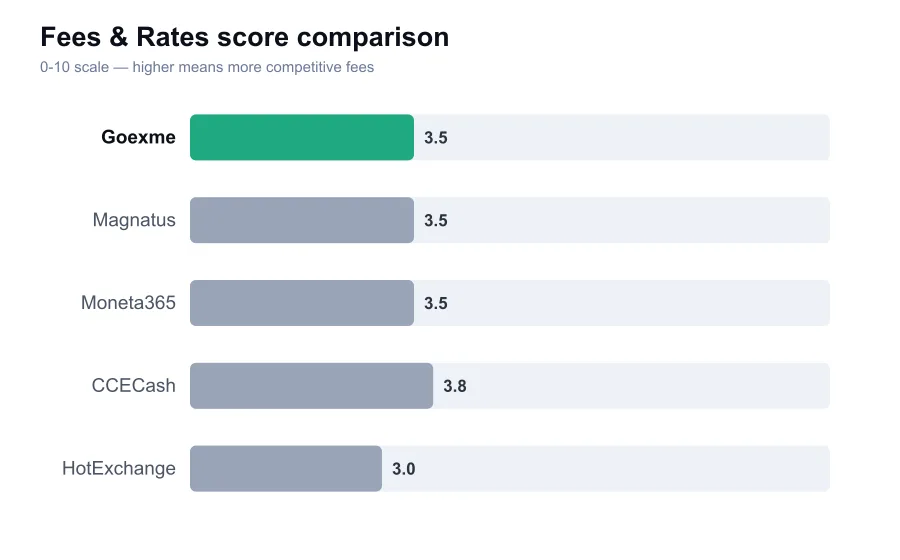
There is no sufficiently reliable public basis for treating Goexme's published or displayed exchange rate as cheap. A low or zero stated commission doesn't prove a low-cost trade. The real number is the difference between the market price available on liquid venues and the amount of crypto actually delivered after network costs. Unless a user compares the quote against CoinGecko or a major exchange at the same moment, the cost is hard to judge.
That lack of fee clarity is more serious than it sounds. At an established exchange, a trader can separate maker fees, taker fees, withdrawal charges, deposit policies, and conversion spreads. With Goexme, those components aren't documented with the degree of detail a careful buyer should expect. For small experimental transactions the uncertainty may be tolerable. For repeat trading, it is an unnecessary disadvantage against transparent competitors.
Speed claims should also be read carefully. An instant conversion service can approve an order quickly, but it cannot make blockchains settle faster. Bitcoin deposits still need confirmations, Ethereum transactions can be delayed by congestion, and outbound transfers depend on the provider's wallet operations. A swap that begins promptly may still take an hour or longer if a network is busy or a compliance review is triggered.
The more important question is whether an order has a reliable status trail. Good exchanges provide a transaction identifier, on-chain hash, timestamp, quoted rate, final execution rate, and a support route that works if something breaks. Goexme has not built a public reputation for those operational details. If a transfer is delayed, users should be prepared to provide the sending transaction hash and wait rather than assume a chatbot can resolve it instantly.
Security is where the thin public record becomes a decisive weakness. I could not verify a meaningful external security program, named custody provider, proof-of-reserves publication, regulated trust structure, or a long record of public incident reporting. None of those items alone makes an exchange safe, but their absence removes the evidence a reviewer would normally use to assess counterparty risk. The safest assumption is that funds sent there are exposed to both market and platform risk.
KYC policy is similarly difficult to assess with confidence. Some smaller swap services advertise low-friction access, then request identity documents when a transaction triggers an automated risk flag. That model is not unusual, but it can be frustrating if terms do not explain the process, review timing, document standards, or refund path. Anyone who needs a predictable fiat off-ramp or formal account verification should use a regulated exchange with an explicit onboarding policy.
Goexme's reputation is not strong enough to offset those concerns. It lacks the accumulated evidence that comes from years of broad user coverage, regulatory engagement, major security reporting, and substantial independent discussion. Silence is not proof of misconduct. It is also not proof of reliability. In crypto, an unfamiliar brand should be treated as unproven until it earns confidence through transparent conduct, not through an attractive landing page.
Customer support is another area where smaller providers often reveal their limits. If the only practical route is a web form, Telegram account, or generic email address, the customer has little leverage during a failed transaction. There is no clearly established record of Goexme maintaining phone support, a detailed service-level commitment, or a broad public support knowledge base. That is a poor fit for anyone moving money they cannot afford to have tied up.
I wouldn't use Goexme as a wallet, a recurring purchase venue, or a place to park an active balance. If someone is determined to test it, the sensible approach is painfully conservative. Verify the destination address, send the minimum amount, record every screen and transaction hash, and do not send a second transfer until the first has arrived. That is not a workflow most people need to accept in 2026.
There are better options for nearly every use case. Kraken and Coinbase provide more accountability in many jurisdictions. Bitstamp and Independent Reserve offer more established compliance-led models in their respective markets. For straightforward self-custody swaps, a reputable decentralized route may also be easier to inspect, though it introduces its own smart-contract and wallet risks.
My view is blunt: Goexme hasn't supplied enough verifiable evidence to justify confidence beyond a tiny test transaction, if that. The potential convenience of a small exchange is not a meaningful advantage if fees are opaque, support is hard to evaluate, and custody practices are unclear. A cheap-looking quote is not compensation for uncertain counterparty risk. Most prospective users should skip it and choose a provider with a public operating record.