ClickPay is a difficult crypto provider to assess because the name is used by several unrelated payment and financial technology businesses. That alone is not a cosmetic problem. A customer searching for an exchange, a merchant checkout tool, or a crypto on ramp could easily land on material for a different company. In a market where clear legal identity and custody arrangements matter, ClickPay's ambiguous public footprint puts it far behind established names such as Coinbase, Kraken, Bitstamp, or even smaller but clearly documented services.
I could not verify a single, widely recognized crypto exchange operation operating under the ClickPay name with a transparent fee schedule, listed supported assets, licensing disclosures, and independently checkable trading infrastructure. That makes a conventional exchange review impossible in the usual sense. It also means prospective users should resist filling in the gaps with assumptions. A polished checkout page, a Telegram account, or a logo that resembles a fintech brand is not evidence that a provider is regulated, solvent, or equipped to safeguard customer funds.
The first question should be which ClickPay you are dealing with. Ask for the exact website address, registered company name, jurisdiction, terms of service, and privacy policy before creating an account. If a seller directs you to a payment link, confirm whether ClickPay is merely processing an invoice or is actually taking custody of crypto. Those are very different arrangements. Payment processors can be legitimate while still offering little of the investor protection, reporting, and withdrawal control expected from a proper exchange.
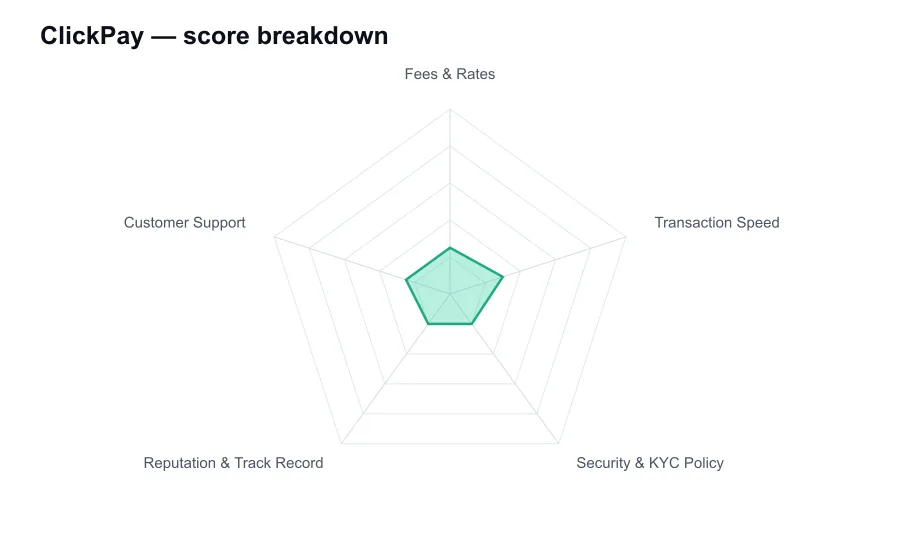
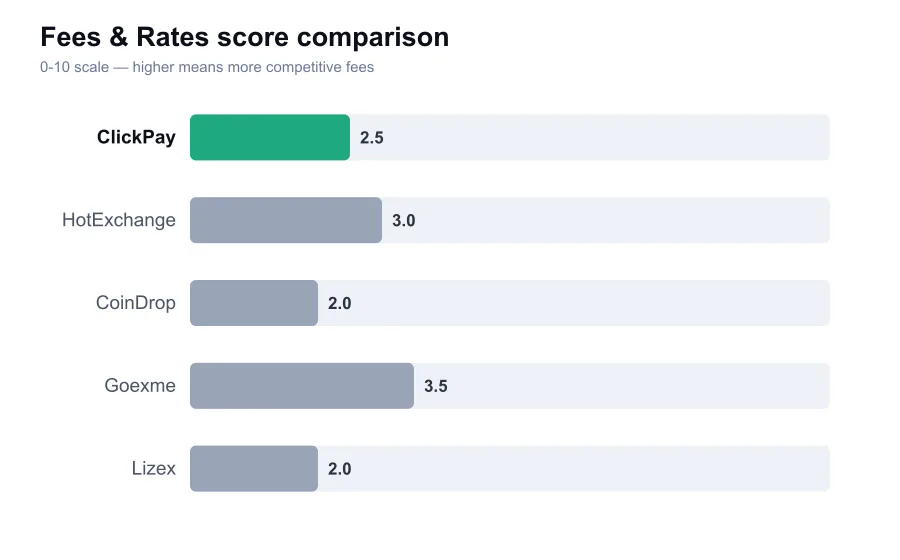
Fees are especially opaque here. I found no reliable, broadly applicable public crypto trading tariff that would let a user compare ClickPay with the 0.16 percent maker and 0.26 percent taker starting fees at Kraken Pro, or the published spread and transaction pricing used by mainstream retail apps. If a service doesn't state its exchange rate, network charge, card fee, refund policy, and conversion margin before payment, the user cannot calculate the real cost. That is a poor starting point for either trading or buying crypto.
A provider may advertise zero commission while making money through a wide conversion spread. That is common across the industry and not automatically dishonest, but it must be disclosed clearly enough for a customer to evaluate. With ClickPay, the absence of a verifiable standard rate card creates a more basic concern: there is no dependable basis for saying whether prices are competitive. For a one off merchant payment, a small premium may be tolerable. For recurring purchases or active trading, opacity is a deal breaker.
Speed claims should receive the same skepticism. Card payments can be authorized in seconds, while blockchain settlement depends on the asset, network congestion, and the number of confirmations required by the receiving platform. Bitcoin transfers can take from minutes to much longer in busy periods. Stablecoin transfers may appear quickly on some networks, but a provider can still hold funds for compliance review. Without documented processing times and withdrawal rules, ClickPay cannot be credited with fast service simply because a payment page loads quickly.
The security picture is thinner than it should be. I could not establish a public security architecture for a crypto ClickPay operation, including whether assets are held in segregated wallets, whether cold storage is used, whether a third party has audited reserves, or whether account protections include authenticator app based two factor authentication and withdrawal address whitelisting. These are now basic questions. A platform holding customer assets should answer them directly, not bury vague assurances under general statements about encryption.
KYC policy is equally unclear. Legitimate fiat to crypto services generally verify identity because card networks, banks, and anti money laundering rules require it. That can be inconvenient, but a documented process is safer than a vague claim that no verification is needed. Conversely, demanding a passport, selfie, and proof of address through an unfamiliar link with no identifiable operator creates its own privacy risk. Users should never send identity documents until they have verified the company behind the portal.
Reputation is where ClickPay struggles most. I could not find the kind of long operating history, public executive accountability, regulatory record, or substantial independent user feedback that lets a reviewer separate a young service from an unreliable one. A lack of complaints isn't reassuring when there is also a lack of meaningful evidence that a crypto service has processed withdrawals through market stress. Track record is built when customers can verify it, not when a brand simply exists online.
Customer support is hard to score positively for the same reason. A support email or chat button is not enough if response standards, escalation routes, and dispute processes are unclear. For a merchant checkout issue, users need to know who resolves underpayments, duplicate transactions, refund requests, and wrong network deposits. For a custodial account, they need a reachable team when withdrawals are delayed. ClickPay offers too little publicly verifiable information to inspire confidence on either front.
There is a sensible way to approach a service like this if you have no alternative. Keep the transaction small, use a wallet you control, document the quoted price and payment terms, and do a test withdrawal before committing meaningful funds. Do not leave a balance on an unverified platform. Do not accept a support agent's request to pay an extra release fee, tax, insurance deposit, or verification charge to unlock a withdrawal. Those demands are classic warning signs in crypto fraud.
ClickPay might be relevant if it is attached to a known merchant and the payment is limited to a specific purchase. Even then, compare the merchant's own invoice details with the processor's destination address and contact the merchant through an independently verified channel if anything changes at the last minute. A payment processor is not a sensible place to store assets, speculate on tokens, or make frequent conversions when its public trading terms cannot be verified.
The comparison with established exchanges is unflattering. Kraken publishes fee tiers and security controls. Coinbase provides extensive legal disclosures and support documentation, even if its retail pricing can be expensive. Binance has its own regulatory and service controversies, but its products, trading pairs, and withdrawal mechanics are still visible and testable. ClickPay's problem is not that it lacks every feature those firms have. Its problem is that the public evidence needed to assess it is missing.
My view is blunt: treat ClickPay as unproven for crypto use unless the exact entity can be independently verified and its role is limited to a known merchant transaction. The possible convenience of a quick payment flow doesn't compensate for unclear ownership, unclear fees, and unclear custody. There are too many established options for buying, selling, and storing crypto to make blind trust a reasonable trade. Until ClickPay provides transparent documentation and a verifiable track record, caution should be the default.