HotExchange sits in an uncomfortable category of crypto provider, the lightly documented exchange brand that is difficult to place in the real market. It doesn't have the institutional visibility, regulatory footprint, or widely examined operating history of major centralized exchanges. That doesn't automatically make it fraudulent, and responsible reviewing shouldn't make that leap. It does mean users should demand evidence before they hand over coins, documents, or bank details.
A credible exchange makes its identity easy to establish. It tells customers which legal company serves them, where that company is registered, what regulator applies, how assets are held, and what recourse exists in a dispute. HotExchange has not established a public profile with that level of clarity. For an ordinary consumer, that is already enough to look elsewhere. There is no shortage of exchanges competing for business with fuller disclosures.
The brand name itself also creates a discovery problem. Generic exchange names are easily confused with unrelated products, cloned websites, social media accounts, and affiliate pages. Users need to check the exact domain, certificate, withdrawal address, and communication channel every time. If a provider's identity is hard to distinguish from lookalikes, it has a responsibility to offer unusually strong official verification. I haven't seen evidence that HotExchange does so.
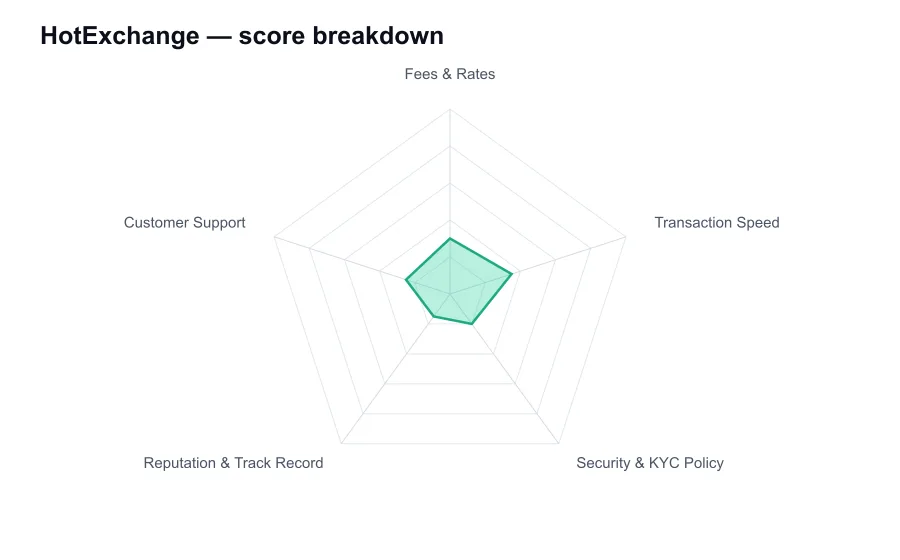
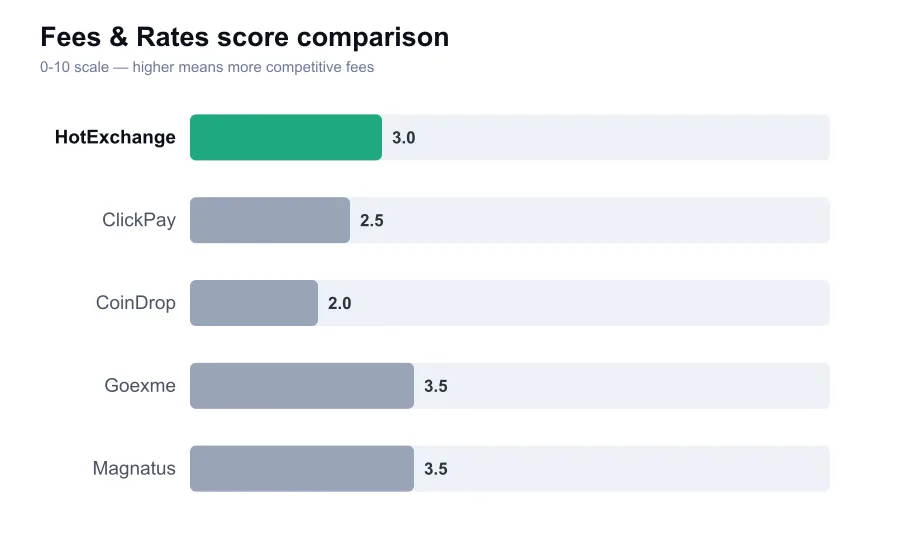
Fees cannot be judged fairly without a stable, accessible public schedule. HotExchange does not have the kind of transparent maker-taker table, withdrawal matrix, and fiat funding policy that active traders should expect. A service can call a trade commission-free while recovering its margin through the conversion rate. That is common across instant-buy products, but serious venues show customers enough data to calculate the actual price of liquidity.
For a buyer converting $500 of USDT into BTC, a two percent spread costs far more than an advertised 0.1 percent trading charge. A hidden difference becomes even larger with thinly traded assets. HotExchange gives prospective users little reason to believe its pricing is consistently competitive with deep-liquidity platforms. Without reliable data, I score fees on transparency rather than optimism, and the platform fares poorly.
Transaction speed is equally hard to separate from marketing. A platform may credit an internal account quickly, yet still delay withdrawals for manual checks, wallet maintenance, or liquidity management. Real speed means deposits are recognized after the stated confirmations, orders execute near their quoted price, and withdrawals broadcast with a visible transaction hash. There is not a deep body of public operational evidence showing HotExchange performs those basics consistently.
A lack of published status pages and operational reporting is a practical concern. Major exchanges sometimes experience wallet outages too, but users can see the issue, follow updates, and compare reported conditions against social channels. With a small opaque provider, a delayed withdrawal can feel indistinguishable from a support failure. That uncertainty is precisely what a customer should avoid while markets are moving quickly.
Security claims need proof, not icons in a website footer. I could not independently confirm HotExchange's cold-storage policy, reserve attestations, penetration-testing program, bug bounty, insurance terms, or meaningful corporate controls. Two-factor authentication, if offered, is a useful account feature but it does not answer the bigger question of how the operator protects pooled customer assets. The distinction gets overlooked far too often.
The same caution applies to personal data. Exchanges that perform KYC collect some of the most sensitive documents a person owns. A reputable business identifies the entity handling that information, outlines retention and sharing practices, and provides a clear compliance policy. With HotExchange, the KYC requirements and the process for additional checks are not sufficiently clear from a public due-diligence perspective. I would not upload identification without first resolving those questions.
Reputation is built slowly through visible conduct. It comes from years of customers withdrawing funds, regulators recognizing the business, journalists being able to contact executives, and the company responding openly to incidents. HotExchange lacks that weight of evidence. Reviews attached to minor exchange brands can be manipulated, copied, or too sparse to tell a useful story, so star ratings alone should not persuade anyone.
Support may be adequate for routine questions, but routine questions aren't the test. The test is a stuck withdrawal, a mismatched destination tag, an account lock after KYC, or a deposit that has enough blockchain confirmations but isn't credited. A good provider has accountable ticketing, clear response expectations, and a documented escalation path. HotExchange has not demonstrated a support operation that inspires confidence in those situations.
The sensible security posture is simple. Do not use it for a payroll conversion, business treasury, large stablecoin sale, or savings. Never accept instructions to pay a release fee, tax, or extra deposit in order to unlock an account. That pattern is a serious red flag across the industry, regardless of the name on the website. Keep records and verify every claim through independently sourced contact details.
There are established alternatives at almost every level. A trader wanting advanced markets can compare Kraken, Coinbase Advanced, or regional regulated exchanges. Someone who only wants a quick swap can use a known provider after comparing its final quote, or use a decentralized exchange from self-custody if they understand wallet security and slippage. HotExchange doesn't offer a clear reason to accept more uncertainty.
My verdict is that HotExchange is not ready for a trust-based recommendation. The absence of accessible evidence on fees, custody, compliance, and support leaves too many unanswered questions. Some users will be tempted by easy onboarding or promotional pricing, but those aren't durable advantages. A crypto exchange should reduce uncertainty, not ask customers to live with it.