LetsExchange is one of the better-known instant cryptocurrency exchange aggregators. It is designed for users who want to convert one asset into another without maintaining a balance on a centralised exchange. The company routes orders through liquidity partners and pays the output to a wallet address supplied by the user. It competes most directly with ChangeNOW, SimpleSwap, SwapSpace, and StealthEX, while also offering an API and white-label tools for businesses.
The service has leaned hard into breadth. LetsExchange lists a very large number of assets and networks, including mainstream coins, stablecoins, and many smaller tokens that are awkward to access through a single conventional exchange. That catalogue is useful, but it should not be mistaken for deep liquidity in every pair. A token can be listed while still carrying a wide spread, a high minimum, or a route dependent on one external partner.
The customer experience is pleasantly direct. Select the send asset and receive asset, enter the amount, choose a rate type, add a receiving address, and send the deposit. There is no order-book interface to learn. For a user with coins already in a private wallet, that is much less cumbersome than depositing to a trading platform, waiting for credit, executing a trade, and withdrawing again. Convenience is the product being sold.
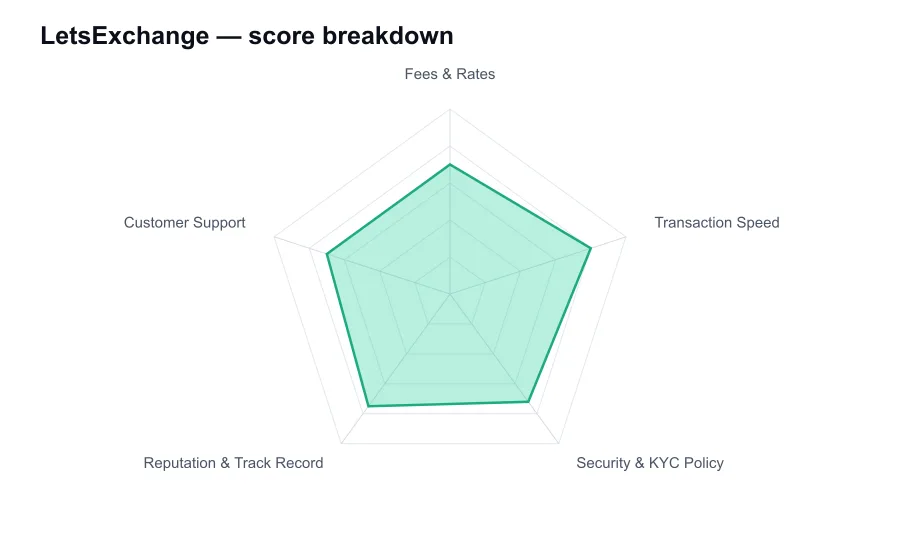
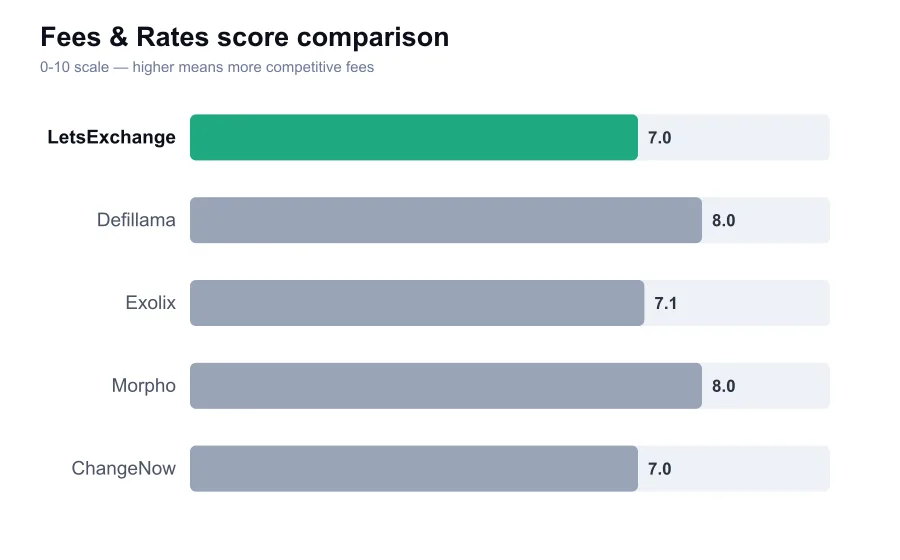
LetsExchange markets fee transparency more clearly than many smaller swap sites, but users should understand what that means. The platform may show a service fee, while the final quote also reflects liquidity-provider pricing and network fees. The headline fee is not the whole cost. The only number that matters is the quantity of crypto due to land in the destination wallet. Compare that result across services for the exact same amount and network.
For liquid pairs, LetsExchange can be competitive enough that the convenience premium is modest. It is especially practical for people converting a mid-sized wallet balance without wanting to expose it to an exchange account. For very large orders, frequent trading, or highly liquid pairs such as BTC-USDT and ETH-USDC, order-book exchanges usually remain cheaper. A maker order on Kraken Pro or Coinbase Advanced is simply a different and often more efficient economic model.
The rate modes deserve attention. A floating exchange rate changes with the market while the transaction is being processed. It may deliver more or less than the estimate, although in a sharp move the downside is what users remember. A fixed-rate transaction locks a payout subject to the stated deposit conditions and time window. I prefer fixed rates for any transfer large enough that a percentage-point surprise would sting. The extra spread is often insurance worth buying.
Speed is good by instant-exchange standards. LetsExchange can process straightforward transactions quickly once it sees the necessary blockchain confirmations and obtains liquidity. Fast chains and established pairs may complete in a matter of minutes. Bitcoin deposits, Ethereum during high gas demand, bridge-like cross-network routes, and tokens requiring additional checks can take materially longer. The website cannot force a congested blockchain to move faster.
Users sometimes blame the service for delays that began before the deposit arrived. Sending on an unsupported network, omitting a required memo or destination tag, paying too little network fee, or transferring below the minimum can create a recovery case rather than a normal swap. LetsExchange provides transaction tracking, which helps, but it cannot turn an incorrectly sent asset into an automatic refund. Read the deposit instructions carefully, especially with XRP, XLM, TON, Cosmos-based assets, and exchange-issued stablecoins.
Privacy is a core part of the offer. LetsExchange generally permits crypto-to-crypto swaps without forcing every customer through a full account registration and KYC process. That does not mean the platform is outside anti-money-laundering controls. Its terms allow risk screening and can require identification, source-of-funds information, or other documents in a flagged case. Anyone who believes an instant exchange guarantees unconditional anonymity is setting themselves up for an unpleasant surprise.
The non-custodial model is still a genuine security benefit. LetsExchange does not function like a bank account holding an idle customer portfolio, so there is less exposure to a mass withdrawal freeze or a breach of a permanent platform balance. Yet the user has to trust the site at the moment of exchange, and phishing remains a serious danger. Bookmark the official domain, verify the certificate and address, and never use a link supplied in a social-media reply.
LetsExchange has a stronger market profile than many anonymous-looking swap websites. It has operated for several years, developed business integrations, and accumulated a sizeable visible footprint across crypto review channels. That is meaningful, though it is not equivalent to regulation, audited reserves, or deposit insurance. Its reputation is solid for an instant-exchange service, but it should be judged against others in that niche, not against a heavily supervised global exchange.
The real weakness is dispute handling. The instant-swap business is smooth when a route works and frustrating when it does not. A rate discrepancy, delayed liquidity provider, compliance hold, or mistaken network can require an extended ticket exchange. LetsExchange offers round-the-clock support channels and transaction tracking, which is better than disappearing behind a generic contact form. Still, support cannot always provide the immediate certainty that a user expects after sending an irreversible transfer.
Its partner and API business is a positive sign because it indicates that LetsExchange is more than a thin consumer landing page. Developers can integrate conversion functionality, and other crypto services can use its liquidity-routing infrastructure. That does not remove counterparty risk. It does suggest a more established operating model than a one-purpose site with no visible product beyond a swap widget.
I would use LetsExchange for a controlled, wallet-to-wallet conversion where I had compared the actual output and accepted the route's conditions. It is particularly useful for asset variety and for users who do not want another custodial account. I would not use it for high-frequency trading or a transaction whose timing and exact execution price are critical. It is a capable convenience tool, and a relatively credible one, but it remains an intermediary operating in a market where users should stay alert.