XGram sits in the broad category of online crypto exchangers that promise a direct path from one asset or payment method to another. It is not the sort of venue people use to run a trading strategy or park a portfolio for years. Its appeal is transactional: choose a direction, receive a quote, pay, and wait for a payout. For the right user, that is refreshingly uncomplicated. For the wrong user, it can obscure important risks behind a very short checkout flow.
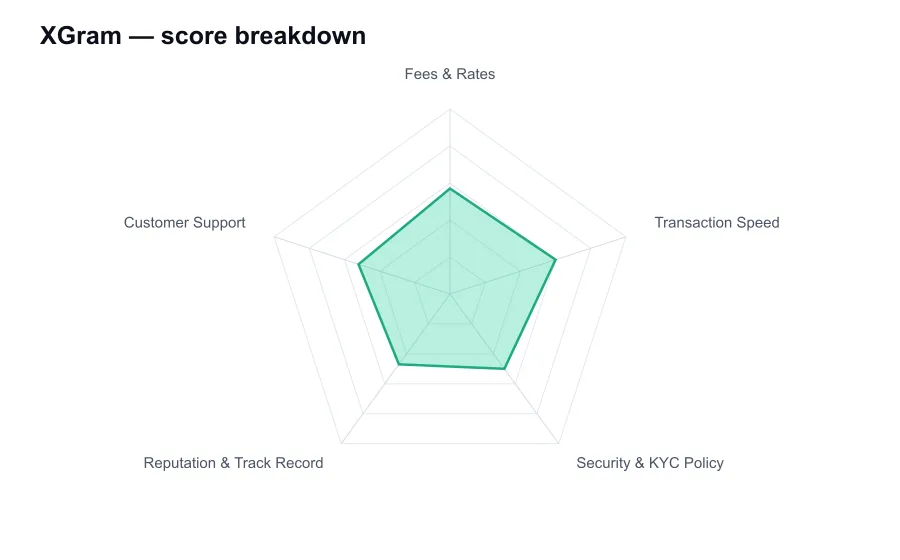
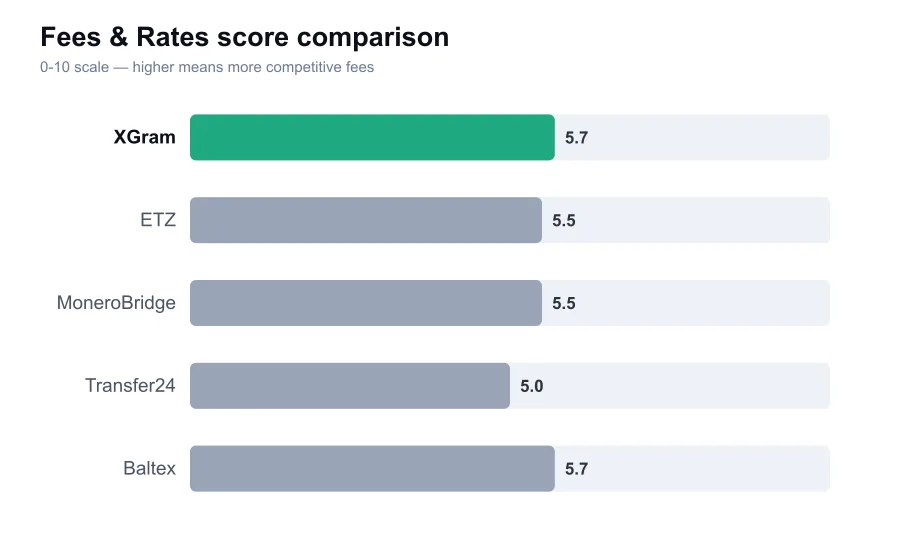
The first thing I would say about XGram is that convenience is not the same as price leadership. Independent exchangers often package their margin inside a rate rather than showing a separate trading commission. That can make an order page look clean, but it also puts the burden on the customer to understand the all-in cost. A quote is only attractive if the receiving amount still compares well after every network and payment charge.
There is no sensible way to judge a rate by looking at the market price on a chart and expecting to receive that number. XGram has to cover execution risk, inventory, liquidity sourcing, blockchain fees, fraud losses, and its own margin. The question is whether its margin is reasonable for the service provided. On a difficult or less liquid route, a wider spread may be defensible. On a major stablecoin pair, I expect competition to keep the quote tighter.
Before using XGram, I would run a live comparison with at least two alternatives. Use the same amount, same network, and same destination type. A low minimum can be handy for a test order, but it does not prove good pricing at a larger size. Some exchangers have sufficient reserve for small payouts while a larger order receives a poorer rate or waits for an operator to source liquidity.
Speed depends on how XGram handles the middle of the transaction. A crypto deposit must first arrive and receive enough confirmations. Then the service needs to recognize it, apply the agreed terms, and broadcast the outgoing payment. On fast networks, the blockchain part can be brief. On Bitcoin or under heavy Ethereum congestion, the waiting can be substantial even if the exchanger is working efficiently.
Fixed-rate orders need particular care. If XGram offers a rate lock for a limited period, the customer needs to send the exact required amount before that window closes. Sending late, sending less, or paying from an incompatible network can push the order into a manual process. Floating-rate orders reduce the provider's market risk but leave the user exposed to price movement. Neither model is universally better. The right choice depends on whether certainty of output matters more than avoiding a rate-lock deadline.
A service can claim fast processing and still disappoint on exceptions. The meaningful test is what happens after an unconfirmed deposit, an incorrect destination memo, or a payout that has been sent but has not arrived in a wallet interface. Good support can identify the transaction hash and status. Poor support gives vague reassurance. That difference is especially important at a smaller exchanger, where there may be no large public support operation behind the site.
Security at XGram begins with the user's own process. Visit the service through a verified URL, inspect the order details, and never reuse an address from an old order unless the current page explicitly instructs you to do so. Exchange deposit addresses may be order-specific. Use a wallet you control, turn on its available security protections, and double-check the selected chain. USDT on one network is not interchangeable with USDT on another.
The absence of a long-term custody account can be a modest security advantage. You are not leaving funds exposed on a platform indefinitely. But it does not remove counterparty risk during an active transaction. You are still paying XGram before receiving the output. That is why independent reputation, a visible support channel, and a sensible trial transaction matter more here than they do at a deep, regulated exchange with published reserve and compliance information.
Users looking for complete anonymity should be cautious about assumptions. Any exchanger may apply transaction monitoring and may request verification where law, payment-provider rules, fraud indicators, or risk controls require it. A provider that accepts an order with little upfront friction is not promising that every transaction will be untouched by review. If your use case cannot withstand a request for documents, a centralized financial service may not be suitable at all.
XGram's public reputation should be judged proportionately. It is not in the same category as long-running global exchanges that have survived several market cycles under intense scrutiny. Smaller services can still perform honestly, but their evidence base is thinner. Search for recent feedback with useful details, such as the asset, network, approximate completion time, and whether an issue was resolved. Comments with no specifics are weak evidence in either direction.
I would also check whether reported delays have a pattern. A handful of complaints about slow Bitcoin confirmations may be ordinary network reality. Repeated reports of rate changes, withheld orders without explanation, or unanswered tickets would be more concerning. Context matters. Some customers make mistakes, but a service that handles mistakes professionally usually shows that in its public responses.
Support is a practical score, not a marketing badge. XGram may have chat or ticket channels, but prospective customers should look for a clear way to contact a human and provide an order number. Send a question before placing an unusually important order. Ask about a real detail, not "are you safe?" For example, confirm the accepted network for a token or ask whether a stated payout method is currently available.
XGram works best for someone who knows the basics and wants a direct exchange without the ceremony of a trading platform. It is a poor fit for a person buying their first crypto, using borrowed money, or sending funds needed for a deadline. Those users need the stronger educational material, clearer dispute path, and more formal customer protections offered by established regulated providers.
My final view is measured but not dismissive. XGram may be useful as a route-specific exchanger, especially after a small successful test, but it has not earned blind trust. Watch the final payout, respect blockchain mechanics, and assume that a review can happen. If the quote is not clearly better than a bigger competitor's, I see little reason to take the extra counterparty risk.