MoneroBridge is a small instant-swap service aimed squarely at people who want to move into or out of Monero without opening a conventional exchange account. It occupies the privacy-first corner of the market rather than trying to compete with Binance, Kraken, or Coinbase as a broad trading venue. The appeal is obvious: choose a pair, enter a receiving address, send funds, and wait for the conversion. For a quick XMR swap, that stripped-down approach can feel refreshingly direct.
The trade-off is that MoneroBridge is not a household name, and it has never earned the kind of public operating history that makes a user comfortable treating it as financial infrastructure. Its website and flow resemble many noncustodial instant exchangers, but a clean interface is not evidence of deep liquidity, robust reserves, or mature compliance operations. I would approach it as a transaction tool, not a place to build a long-term relationship or hold funds.
Monero remains difficult to buy on major regulated platforms in some jurisdictions. Delistings, local restrictions, and cautious banking partners have pushed many users toward instant exchange services. MoneroBridge benefits from that gap. It can be useful for a person who already holds BTC, ETH, LTC, or another liquid asset and simply needs XMR delivered to a self-custody wallet. That is a legitimate use case, and the service understands it.
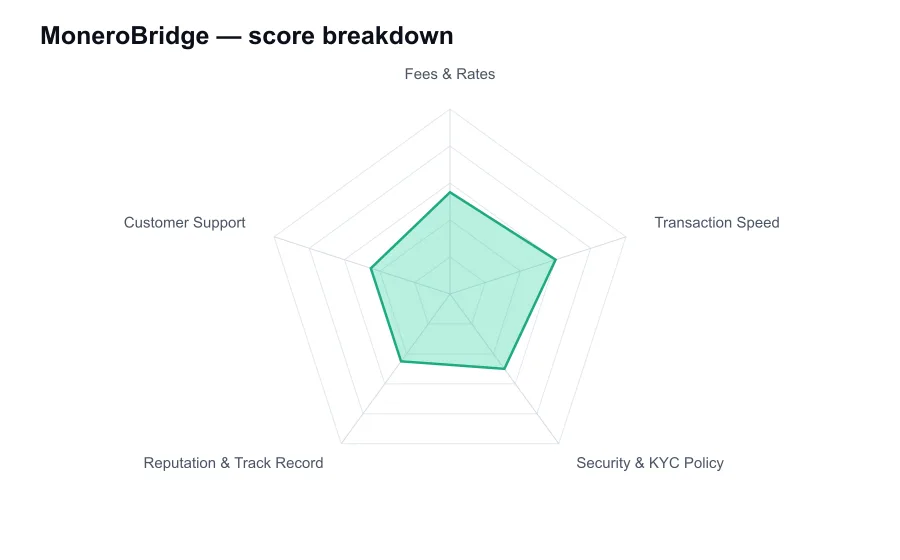
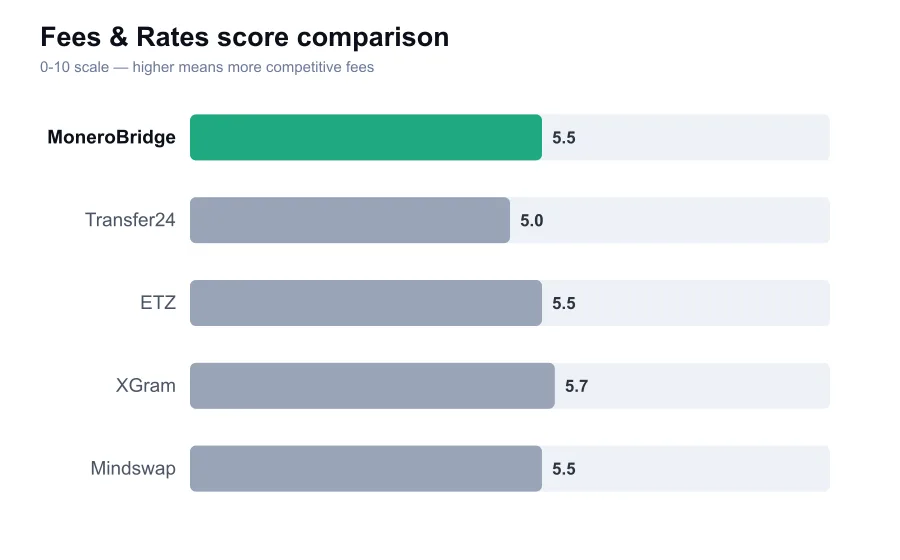
Pricing is the first place where the marketing language around simple swaps needs a skeptical reading. MoneroBridge does not operate like an order-book exchange with a clearly displayed maker and taker schedule. The economic cost is generally embedded in the quoted conversion rate, along with network fees and whatever spread its liquidity partners charge. That does not automatically make it expensive, but it makes apples-to-apples comparison harder than it should be.
A quoted amount can look attractive until the user compares the final XMR received against a live market reference. For modest swaps, convenience may justify a slightly weaker rate. For a larger conversion, even a one or two percent gap versus a deep venue or a competing instant exchanger can be material. I would always open at least two alternatives, such as ChangeNOW, SimpleSwap, or an established exchange where XMR is legally available, before sending anything.
The difference between floating and fixed-rate quotes matters here. A floating quote exposes the final amount to price movement, liquidity changes, and blockchain confirmation delays. A fixed quote gives more certainty but can build a wider margin into the rate. Neither model is inherently bad. The problem is that users often see a number on screen, assume it is guaranteed, and only discover the distinction after an unfavorable payout. Read the quote terms before funding the order.
Speed is usually decent for a simple conversion, though the service cannot outrun the blockchains it uses. Bitcoin deposits may require several confirmations, while Monero transactions have their own confirmation and wallet scanning behavior. A routine swap can complete in minutes to an hour. During volatile markets, congested chains, or liquidity interruptions, it can take longer. Anyone who needs a precise execution time should not rely on an instant-swap desk.
Monero swaps also create a practical delay that newcomers sometimes misread as a failed payment. A wallet may need time to refresh and recognize an incoming XMR output. That is separate from the exchange processing stage. Before opening a support ticket, users should check the transaction ID, the correct Monero address, network status, and their wallet's synchronization state. Still, a service should provide clear status updates, and MoneroBridge's public transparency in that area is not especially strong.
Its noncustodial framing deserves careful wording. MoneroBridge does not present itself as a custodial account platform where customers park balances, which reduces the classic exchange failure risk. Yet it does take control of the asset sent for an individual swap until it completes the conversion. There is still counterparty exposure. If the service, a liquidity partner, or an automated compliance system pauses the order, the customer has limited leverage beyond support correspondence.
The service is often sought out because it advertises a low-friction, no-account experience. That should not be confused with a promise that every order is free from identity checks. Instant exchangers can request additional information when an order triggers fraud, sanctions, source-of-funds, or transaction-monitoring concerns. If privacy is the reason for choosing MoneroBridge, do not send an amount you could not tolerate having delayed while a review is resolved.
I also would not give MoneroBridge a high security score merely because it supports Monero. Privacy of the received asset and operational security of the provider are different things. Public evidence of independent security audits, corporate disclosure, proof of reserves, and detailed incident handling is limited compared with major centralized exchanges. The sensible security practice is simple: send from your own wallet, receive to your own wallet, verify every address character, and never leave an extra balance behind.
Reputation is where MoneroBridge lags far behind larger competitors. It has a narrower and less independently documented track record, so it is difficult to judge how it handles disputed swaps at scale or during stressed markets. A handful of smooth transactions proves very little. I did not find the depth of transparent corporate information, long-running public support record, or independently verifiable reliability that would justify a strong trust premium.
Support appears to be primarily ticket or email based, which is normal for a small swap provider but not ideal when money is stuck. A useful ticket should include the order ID, sending transaction hash, exact asset, amount, and receiving address. Users should expect response times to vary. There is no compelling reason to expect the kind of round-the-clock, multilingual escalation process offered by a large regulated exchange.
MoneroBridge is best viewed as a convenience route for an informed self-custody user making a limited Monero conversion. It is not the service I would choose for a large purchase, urgent market trade, or any transfer where a delayed review would create serious consequences. Its simple workflow has value, but its modest public footprint demands caution. Test with a small amount first, compare the quote, and treat the completed swap as the end of the relationship.