Transfer24 presents itself in the instant-exchange corner of crypto, a category built for users who want to convert one digital asset into another without opening a conventional trading account. The proposition is familiar: select the pair, provide a receiving address, send the deposit, and receive the converted asset. For someone who already holds crypto and wants a one-off swap, that can feel far less cumbersome than depositing into a centralized exchange.
This category demands a stricter review than its polished interfaces often receive. An instant exchanger is not simply a neutral calculator. It may source liquidity from partners, apply a spread, manage transaction screening, and control the moment at which a rate is locked or repriced. The customer sees a short form, but the service behind it can be opaque. That makes quote quality, policy clarity, and support responsiveness much more important than marketing language.
Transfer24's practical appeal is its low-friction workflow. There is usually no order book to decipher, no need to learn charting tools, and no reason to keep a standing balance if the transaction completes normally. That is a real advantage for a user converting a small amount of BTC to USDT, or swapping an asset that is inconvenient to trade on their preferred exchange. Simplicity, however, should not be mistaken for lower counterparty risk.
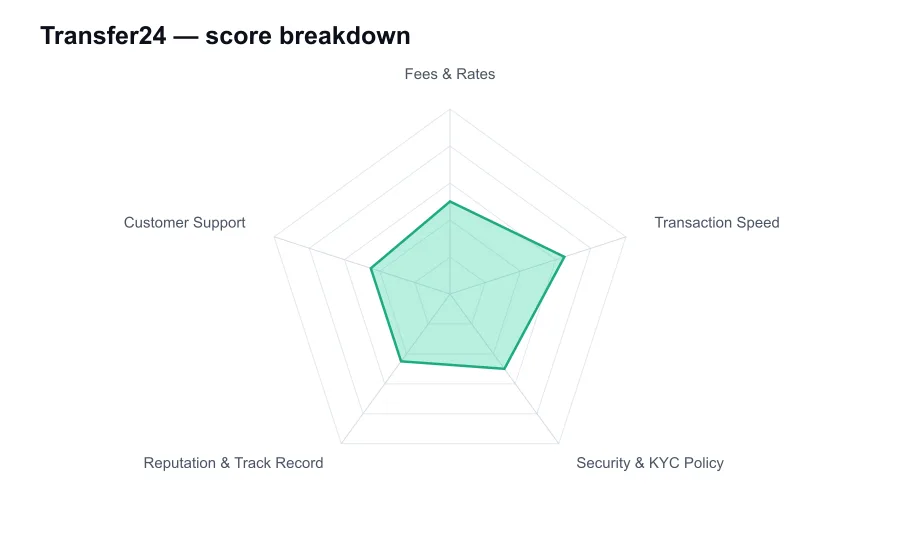
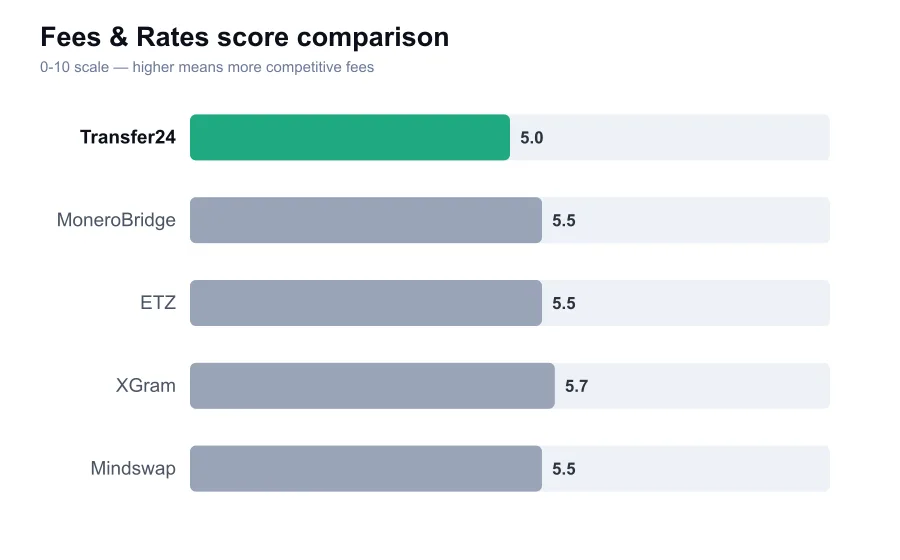
Fees are rarely best understood as a separate percentage on services like this. The relevant number is the gap between the market value of the deposit and the amount the service promises to deliver. That gap can include a provider margin, liquidity partner costs, blockchain network fees, and volatility protection. A stated low fee means very little if the final output is materially worse than the price available through a liquid exchange or decentralized route.
Before approving a Transfer24 order, compare the exact expected output with at least one competing instant exchanger and one liquid market reference. Trocador, ChangeNOW, SimpleSwap, and a direct exchange trade can provide useful benchmarks, though every service may quote a different network fee and rate type. Do not compare only the first number displayed. Compare the amount that will arrive in your wallet, on the same network, after every deduction.
Fixed-rate orders can reduce anxiety in a fast market, provided the service genuinely locks the output under clearly disclosed conditions. Floating-rate orders may offer a better initial figure but leave the customer exposed to price movement while the deposit confirms. Transfer24 users should read the order page carefully and take a screenshot of the quoted amount, rate type, destination address, and order identifier. That simple habit is invaluable if a dispute arises.
Speed is a mixed story because the service cannot bypass blockchain confirmations. A swap involving fast networks can complete relatively quickly once the deposit is detected. Bitcoin deposits, Ethereum congestion, and anti-fraud checks can extend the process significantly. The phrase instant exchange describes the ordering experience, not an unconditional guarantee that every transfer arrives in seconds.
The main operational risk is a transaction that lands in review or becomes delayed after a sharp market move. A responsible provider will show an identifiable order status, explain what confirmation stage is pending, and offer a support path tied to the order ID. A weak provider leaves users staring at a generic waiting screen. With Transfer24, I would not send a large amount until a small transaction has demonstrated the actual timing and communication quality for the pair and network I intend to use.
KYC policy deserves close attention. Many instant exchangers advertise registration-free transactions but reserve the right to request identity documents if automated compliance checks flag a transfer. That arrangement is common, but it is not the same as guaranteed no-KYC service. If anonymity is crucial to your use case, do not assume a no-sign-up page means a transaction cannot be paused for verification.
That conditional approach can create a difficult customer experience. A user may send coins expecting a quick swap, then face a document request after the funds have already left their wallet. The right response is not outrage at the existence of compliance controls, but caution before depositing. Read the terms on refunds, rejected verification, source-of-funds requests, and the treatment of unsupported deposits. If the policy is unclear, choose a provider whose process is clearer.
On technical security, the best feature of an instant exchanger is that users can send the output straight to their own wallet rather than maintaining a custodial trading balance. That limits exposure after the swap, but there is still counterparty exposure during the transaction. The service controls the deposit address and conversion process. Verify the site address, avoid links from ads or unsolicited messages, and double-check every character of the receiving address.
Transfer24 does not have the long, deeply documented public track record of the largest exchanges or the most widely scrutinized non-custodial protocols. Smaller providers can operate honestly and efficiently, but limited independent visibility should affect how much trust a customer extends. I would treat it as a transactional service, not a custody destination. That means using it for the conversion, then keeping assets in a wallet you control.
Support is the decisive test for a lesser-known exchanger. Good support should identify an order, explain whether the deposit has confirmed, state whether a rate changed, and provide a concrete next step. It should not ask customers to share seed phrases, private keys, or remote access to a device. Any request of that kind is an immediate stop sign. Keep communications within the provider's documented official channels.
My view is that Transfer24 can be appropriate for a small, simple crypto-to-crypto conversion after careful quote comparison. Its streamlined format is useful, but it offers less transparency and fewer protections than a major regulated exchange. Test the full process with an amount you can afford to have delayed, choose familiar networks, and document the order. Users who require assured liquidity, formal dispute handling, or predictable compliance treatment should look elsewhere. Convenience is the product here, and convenience should be priced and risk-managed accordingly.