Kingex is a non-custodial cryptocurrency exchange service aimed at people who want to swap assets without opening a conventional trading account. It sits in the same broad category as ChangeNOW, SimpleSwap, and StealthEX rather than Binance or Kraken. You choose a pair, send crypto to a quoted deposit address, and receive the destination asset in your own wallet. There are no charting tools, order books, margin products, or fiat banking features to distract from that basic job.
That narrow focus has appeal. A user moving BTC into ETH, stablecoins, or a lesser-known asset may prefer a one-off exchange over parking funds at a centralised platform. Kingex doesn't require users to leave a standing balance with the service, which removes one of the biggest risks associated with normal exchanges. It is a swap intermediary, though, not a trustless decentralised exchange. During the transaction, the service and its liquidity partners still have operational control over the route and settlement.
The interface is straightforward enough for beginners. The workflow asks for the amount to send, the asset to receive, and a destination wallet address. Kingex then provides a deposit address and a quoted output. That sounds familiar because it is. The difference between competent instant-swap sites is rarely the screen design. It is whether the quote is fair, whether a transaction reaches completion without drama, and what happens when a blockchain transaction does not behave as expected.
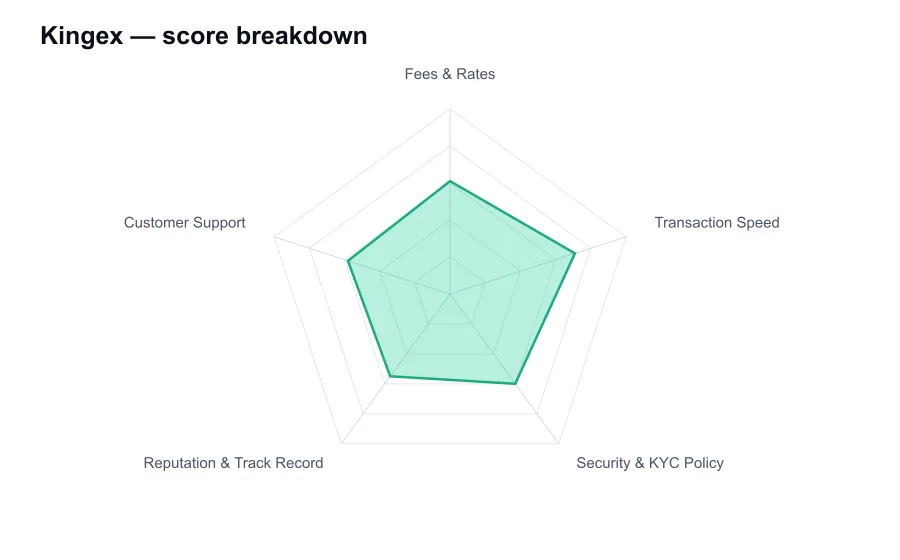
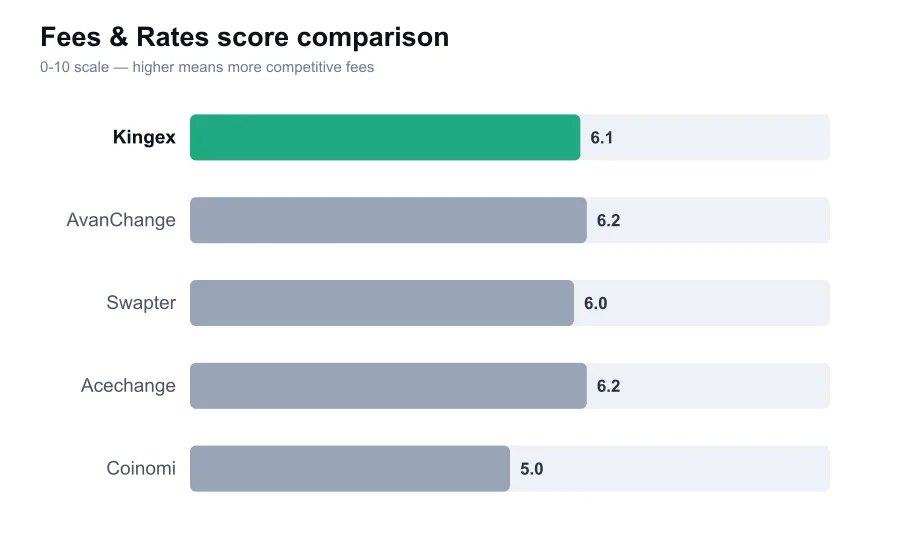
Kingex generally does not present a single universal trading fee in the clear way an order-book exchange does. Its compensation is embedded in the exchange rate, alongside network costs and the spread charged by liquidity sources. This is common in the instant-swap market, but it makes apples-to-apples comparison essential. A quote that claims no service fee may still cost more than buying on Kraken Pro and withdrawing, particularly for liquid pairs such as BTC, ETH, USDT, and SOL.
For small, urgent swaps, the convenience premium can be reasonable. For a larger conversion, I would open Kingex alongside at least two alternatives and compare the actual amount received, not the headline rate. Even a spread of one or two percent becomes expensive quickly. The service is most compelling where the user values speed and avoiding registration over getting institutional-grade pricing. It is not where a trader needs consistently tight execution.
Rate type matters as well. Floating-rate transactions expose the final payout to market movement between the quote and execution. In fast markets, that can produce a noticeably different result from the amount displayed at the start. Fixed-rate options, where available for a pair, are usually the safer choice for anyone swapping a meaningful sum. They can cost slightly more, but they turn a vague price risk into a known cost. That is a sensible trade for most retail users.
Transaction speed depends far more on the chains and the liquidity route than on the website itself. A swap involving Litecoin, XRP, or Solana can often settle after the required deposit confirmations and a brief processing period. Bitcoin and Ethereum transfers can take longer, especially during congestion or if a sender chose a low network fee. A realistic expectation is minutes for simple routes, with longer waits possible when confirmations, liquidity checks, or manual review intervene.
Kingex is not the place to make a time-critical trade that depends on a precise market price. Instant exchanges cannot promise the timing discipline of an executed limit order on a deep venue. Nor can they rescue a sender who uses an underfunded gas fee or sends funds on the wrong network. Before transferring, check the network label, the minimum deposit, and the destination address character by character. That boring advice prevents a surprising share of crypto-exchange disasters.
The platform's no-account model is a meaningful privacy advantage. A routine crypto-to-crypto swap can generally be started without handing over a passport, selfie, or proof of address. But no-KYC should never be read as no-compliance. Like comparable providers, Kingex may request identity information or source-of-funds evidence if automated transaction monitoring flags a transfer. A paused swap pending documents is still a real possibility, particularly for unusually large, high-risk, or blockchain-linked funds.
Security is therefore mixed rather than simple. Not holding a customer account balance reduces exposure to an exchange-wide wallet breach and removes password-reset risk. Yet users are still trusting Kingex with a live transfer, its web infrastructure, and the liquidity counterparties it selects. There is limited public detail available about corporate operations, reserves, security audits, insurance, or the exact counterparties behind each route. That lack of transparency is normal for smaller swap services, but it deserves a score penalty.
Kingex has a much lighter public track record than the market leaders. It has been visible as a crypto-swap brand, but it does not have the long operating history, regulatory footprint, or independently scrutinised infrastructure of Coinbase, Kraken, or Bitstamp. That does not prove it is unsafe. It does mean a careful user should not treat it as a place to route life-changing amounts merely because a small test transaction worked well.
The most practical way to use Kingex is cautiously. Start with a modest amount, verify that the receiving wallet works, and record the transaction ID, quoted rate, deposit address, and support ticket details if anything goes wrong. If the first exchange is smooth, that establishes only that one route worked at one moment. It is useful evidence, not a blanket guarantee. Crypto users can become too relaxed after one uneventful swap.
Customer support appears to be centred on online contact channels rather than the kind of phone-based escalation available from a major regulated broker. That is adequate for address questions and routine status updates. It is less reassuring when a transfer is stuck, a compliance check begins, or the paid-out amount differs from expectations. Response quality is hard to judge from a website alone, and support is exactly where smaller instant exchanges tend to reveal their limits.
Kingex has a legitimate use case for wallet-to-wallet users who want a simple conversion and understand the risks. It is not a bad tool, but its proposition is convenience rather than exceptional pricing, deep transparency, or institutional reassurance. Use fixed quotes where possible, compare the received amount before committing, and do a test swap before sending serious money. I would choose a large exchange for recurring trading, high-value conversions, or any situation where dependable escalation and published compliance standards matter more than anonymity.