StealthEX is a noncustodial instant exchange service, not a traditional order book exchange. It gathers quotes from liquidity providers and lets users swap one crypto asset for another without opening a standard trading account. That puts it in the same practical category as ChangeNOW, SimpleSwap, and SwapSpace. Its appeal is convenience, particularly for people who want to exchange coins without depositing funds into a long term custodial account.
The service has been operating since 2018, which gives it more history than a surprising number of instant exchange brands. StealthEX supports a large catalog of coins and tokens, including major networks and a rotating collection of newer assets. The broad selection is useful, but it should not be mistaken for deep liquidity in every pair. BTC, ETH, USDT, and other major assets are a very different proposition from thinly traded tokens.
The basic flow is familiar. Select the assets, enter a receiving address, send funds to the displayed deposit address, and wait for the provider route to settle the trade. No account is usually needed for ordinary swaps. That removes the irritation of registration, but it also means the user must get the address and network right. A typo or wrong-chain transfer has none of the safety rails offered by a custodial exchange.
StealthEX advertises floating and fixed rate options. Floating swaps follow the market during processing, while fixed rate swaps lock a quoted amount for a limited window, subject to conditions shown before confirmation. That choice is genuinely useful. A floating quote can be better in calm markets, but a fixed rate is often worth the extra cost when moving a meaningful amount through a volatile pair. Users should read the final quote, not just the headline rate.
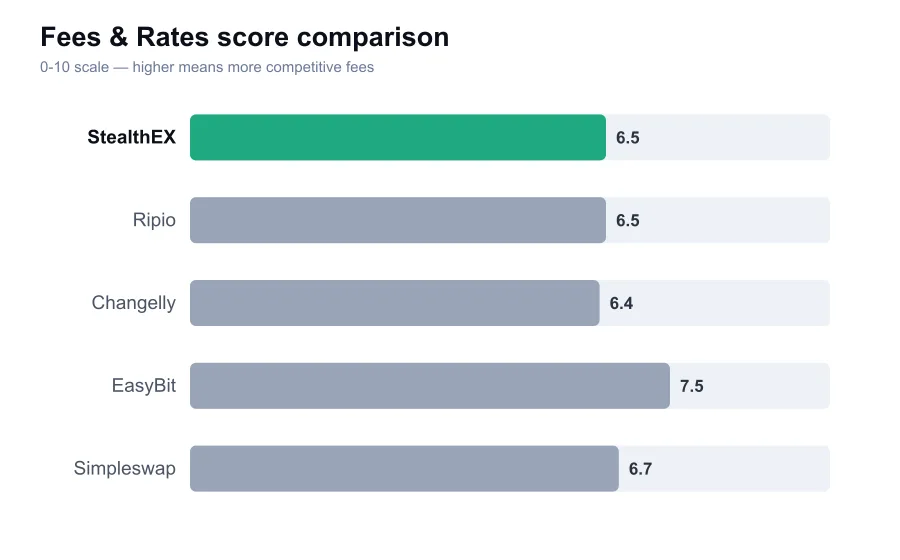
Fees are the part that requires the most skepticism. StealthEX does not present a universally simple flat trading fee across every route. The displayed quote incorporates provider pricing, liquidity spread, network costs, and the service's margin. That is normal for this type of platform, but it makes headline comparisons tricky. The only fee figure that matters is the amount you will actually receive, compared against several competing quote services at the same moment.
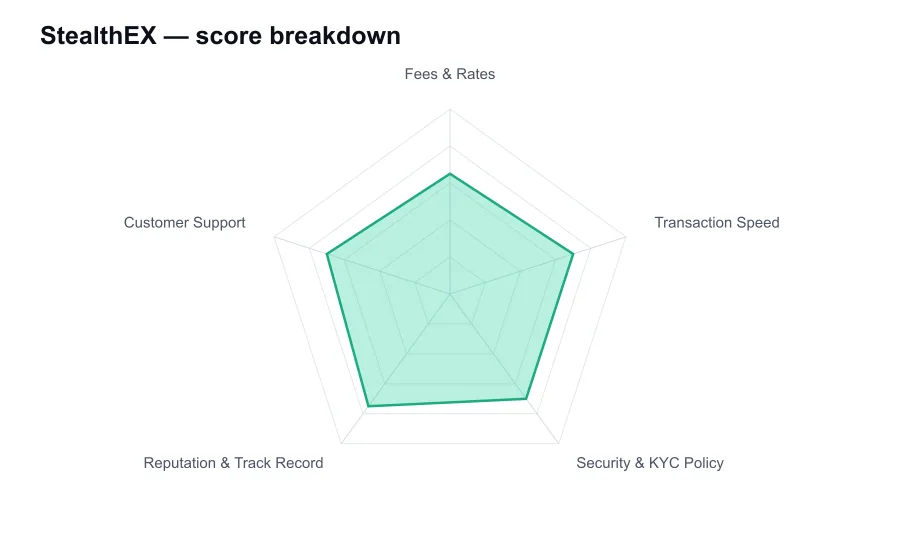
On common pairs, StealthEX can be reasonably priced, though it is rarely the cheapest route every time. Aggregators are valuable precisely because rates move between providers. In my checks of services in this category, ChangeNOW may occasionally quote better for major pairs, while StealthEX can be competitive on certain altcoin routes. Anyone swapping more than a small test amount should compare at least two or three quotes before committing.
Speed is usually decent, but it depends on the asset being sent and the liquidity partner handling the swap. A fast network transfer and liquid pair may complete in minutes. Bitcoin deposits, blockchain congestion, required confirmations, provider checks, or thin liquidity can stretch the process far longer. The site cannot make a slow chain fast. Promises of instant exchange should be read as a product label, not a guaranteed settlement time.
The fixed rate function helps reduce price uncertainty, but it does not remove operational delays. If a user sends after the quote window expires, sends an incorrect amount, or uses a network that is congested, the transaction may need manual handling. That is where instant exchange services can become frustrating. The swap may still complete, but the clean, automatic experience gives way to a support ticket and an uncertain timeline.
StealthEX's noncustodial design is a meaningful advantage. The platform does not hold a standing balance in the way a centralized exchange does, and users generally send funds only for the duration of a swap. That reduces exposure to a platform account breach. It does not eliminate counterparty risk. During a trade, funds are in transit, and users must trust the service and its liquidity partners to execute and return the promised asset.
The company says it follows anti money laundering procedures and can request verification where transactions trigger compliance review. This is common across no registration exchanges. The practical point is simple, no routine signup does not mean no KYC under any circumstance. Funds can be delayed if a transaction is flagged. People using any instant exchange should avoid sending funds from suspicious sources and should not assume an anonymous service can bypass legal screening.
Reputation is respectable but not spotless, which is a fair description of most services in this market. StealthEX has a longer operating record than many rivals and maintains public support channels, reviews, and partner integrations. Complaints tend to focus on delayed transactions, rate differences on floating swaps, and verification requests. Those are serious annoyances, but they are not by themselves evidence that the service is fraudulent. They are the recurring risks of this business model.
Support is available through live chat and email, with a stated 24 hour operation. For normal questions, responses are often reasonably quick. The real test is a transaction that has stalled or been routed into compliance review. At that point, support quality varies with the case and the liquidity provider involved. StealthEX does better than completely anonymous sites because it has identifiable channels, but it cannot offer the certainty of a regulated exchange support desk.
I would use StealthEX for a straightforward conversion where I wanted no account, especially if its final quote was competitive and the destination wallet was under my control. I would not use it for a large, time critical transfer without first making a small test swap. Nor would I use it as a place to hold assets, because that is not what it is built to do. The service works best as a tool, not a financial home.
StealthEX is a credible middle tier instant exchange with a good asset range and a useful fixed rate option. Its privacy friendly entry point is attractive, but the lack of routine registration should not be romanticized. Pricing is quote based, settlement can vary, and compliance checks can still happen. Compared with newer, less documented swap sites, it has earned more trust. Compared with a major exchange, it offers less control, less recourse, and less predictable execution.