Maple is not a conventional crypto exchange, and judging it as one would miss the point. It is an onchain credit marketplace built around institutional and accredited lending, permissioned pools, and, more recently, consumer-facing access to yield through Syrup. Its natural competitors are platforms such as Aave, Morpho, Clearpool, Goldfinch, and private credit funds, not Coinbase or Binance. That distinction matters because the key risk is credit and smart-contract risk, not simply the price of a token swap.
The original Maple proposition was attractive: bring undercollateralized institutional borrowing onchain, use professional pool delegates to assess borrowers, and allow lenders to earn yield funded by real borrowing demand. In a market dominated by overcollateralized DeFi loans, that was ambitious. It also introduced a familiar finance problem that code can't eliminate. If a borrower fails, lenders can lose money.
Maple has evolved significantly since its early lending pools. The current ecosystem includes institutional lending products and Syrup, a permissionless front end aimed at USDC holders seeking yield linked to Maple's lending activity. That makes the service easier to approach, but not simpler in economic terms. A user depositing stablecoins isn't buying a savings account. They are taking exposure to lending performance, smart-contract design, liquidity terms, and the platform's ability to manage risk through a rough credit cycle.
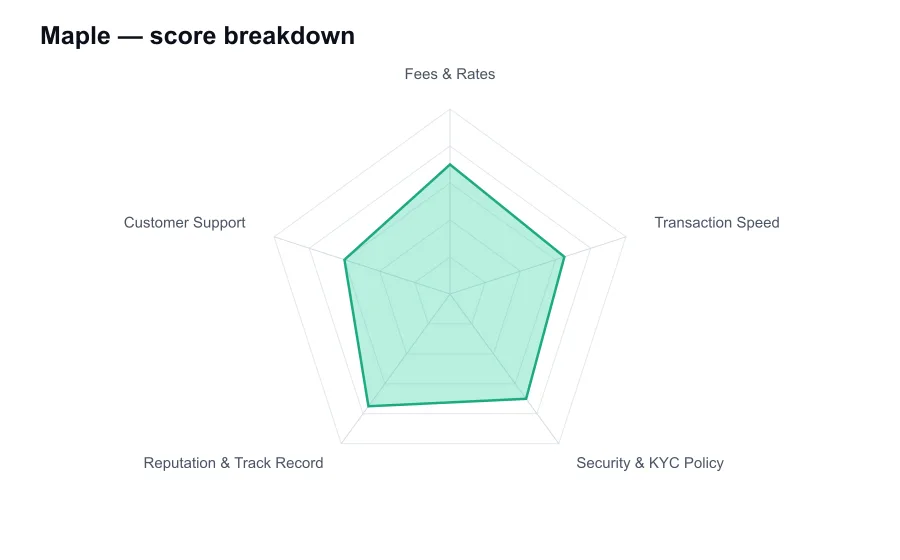
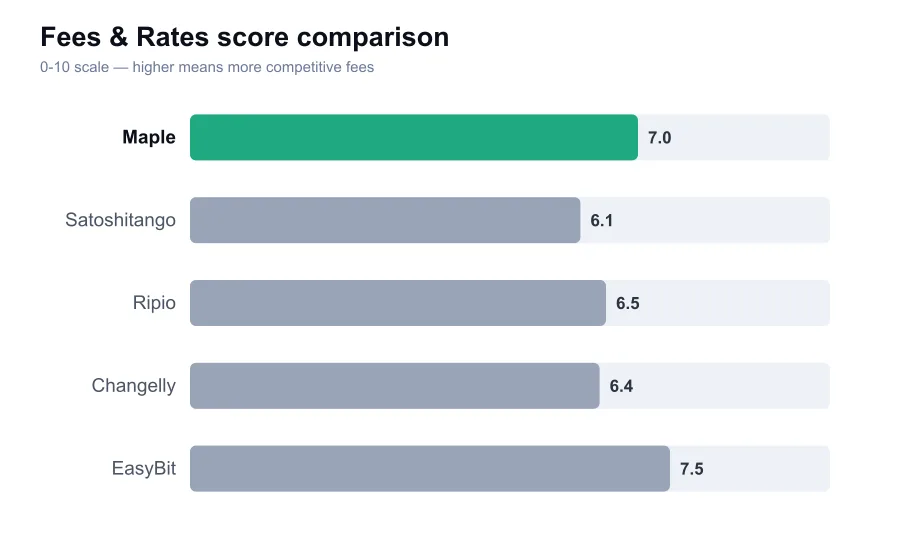
Fees aren't presented like an exchange's neat maker and taker grid. They vary by product, pool, and route. Lending yields shown to users are generally net of protocol and pool-level economics, but the exact composition can change. Borrowers pay interest and fees negotiated or set through pool terms. Lenders should read the specific pool documents rather than assuming the advertised annual percentage yield is a guaranteed return or a direct equivalent to a bank deposit rate.
That product-specific structure is reasonable for private credit, but it is less friendly than a standard exchange schedule. A 10 percent quoted yield can be compelling, yet it says nothing by itself about duration, withdrawal rights, counterparty quality, or loss protection. Yield is compensation for risk, not a promotional coupon. Maple is better at making credit opportunities accessible than at making them intuitively comparable for casual users.
Transaction speed is mostly dictated by the chain and the product. Depositing USDC into a smart contract can settle in minutes, depending on network congestion and wallet setup. Getting money out can be different. Some lending products have withdrawal windows, liquidity constraints, or queue mechanics. That is a feature of lending, not necessarily a defect, but users accustomed to selling spot crypto instantly can find it uncomfortable.
Maple's institutional origins also mean that certain pools use permissioning and formal onboarding. Borrowers are vetted, and lender access can depend on jurisdiction and eligibility. Syrup broadened access, but it doesn't erase legal and geographic restrictions. The cleanest way to think about the KYC question is this: it depends on the product. Don't assume that using a wallet rather than a centralized exchange makes every Maple product anonymous, unrestricted, or appropriate for every resident.
On technical security, Maple has a stronger public record than a small anonymous swap site. Its contracts, documentation, governance materials, and audit history are accessible enough for sophisticated users to inspect. Still, audited code is not insured code. Audits find some flaws, not all flaws, and lending protocols can be harmed by governance errors, oracle dependencies, operational mistakes, or bad credit decisions without a smart contract being hacked.
The most important mark on Maple's record is the 2022 Orthogonal Trading default. Orthogonal borrowed from Maple pools and was later accused of misrepresenting its financial position, leaving a large shortfall reported at roughly $54 million. That episode was painful, and it was exactly the kind of event undercollateralized lending has to survive. Maple did not escape unscathed. Anyone reviewing the protocol honestly has to treat that as evidence that delegate diligence and borrower disclosure can fail.
To Maple's credit, it didn't simply disappear after the crisis. The protocol reworked products, strengthened risk management, and continued building through a brutal market period. That resilience is meaningful. It is not a blank cheque. The lesson from Orthogonal isn't that Maple is unsafe by definition. The lesson is that attractive onchain credit yields can conceal ordinary, stubborn credit risk, and customers should not mentally classify USDC lending as cash.
Reputation today is mixed but far more substantial than that of a newly launched yield app. Maple has recognizable founders, years of protocol history, institutional participants, public governance, and a track record of both success and failure. That makes it more assessable. I would rather evaluate a protocol that has faced a well-documented crisis than one with no history at all, even if the crisis lowers the score.
Support is adequate for a DeFi protocol and inadequate if you expect a bank concierge. Documentation, Discord, community channels, and product guides are useful, especially for technically capable users. But a user who signs the wrong transaction, sends assets to the wrong address, or misunderstands withdrawal mechanics shouldn't expect a support team to reverse it. Smart-contract transactions don't have a chargeback desk.
The practical approach is to separate assets by purpose. If you need stablecoins available tomorrow for payroll, a house deposit, or active trading, they don't belong in an onchain credit strategy. If you have a diversified digital-asset allocation and understand that yield can decline or losses can occur, Maple can be a serious option. Read the pool terms, inspect eligibility, and assess whether the stated yield still looks worthwhile after accounting for liquidity and risk.
Maple is one of the more credible attempts to build real capital markets on public blockchains. It earns credit for persistence, product depth, and a willingness to operate in a demanding institutional segment. But it is not low-risk yield, and its history gives no sensible reviewer permission to pretend otherwise.
My take is that Maple fits sophisticated stablecoin holders far better than first-time DeFi users. The protocol has more substance than most yield platforms, yet the very thing that makes it interesting, undercollateralized credit, is what makes it unsuitable for money you cannot afford to lock up or lose. Use it as a deliberate risk allocation, not as a substitute for a cash account.