EasyBit is an instant cryptocurrency exchange service aimed at users who want a quick asset-for-asset conversion without opening a trading account at a large centralized exchange. Its proposition is straightforward: choose the coin you are sending, choose the coin you want to receive, provide a destination address, and let EasyBit source and complete the conversion. That places it closer to Changelly, ChangeNOW, SimpleSwap, and StealthEX than to an order-book exchange such as Kraken.
The service is built for convenience rather than trading depth. You do not get advanced charts, conditional orders, lending, derivatives, or an internal portfolio management suite. In return, the process can be much less cumbersome for someone moving funds between wallets. A user who already owns crypto and needs to turn Litecoin into USDC, or exchange BTC for ETH, may prefer this model to depositing coins at a major exchange, placing an order, and then waiting through a withdrawal process.
EasyBit offers both floating-rate and fixed-rate exchanges. That distinction matters more than most users realize. A floating rate gives you the market rate available as the exchange processes the order, so the received amount can rise or fall between quote and completion. A fixed rate locks a quoted payout for a limited period, usually in exchange for a slightly less favorable price or a stricter time window for sending the deposit. For volatile assets, fixed-rate execution can be worth the premium.
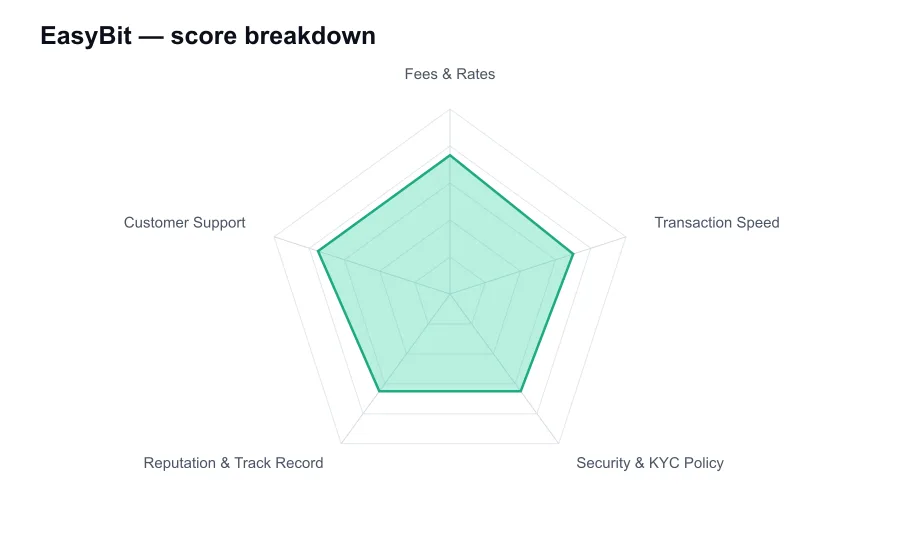
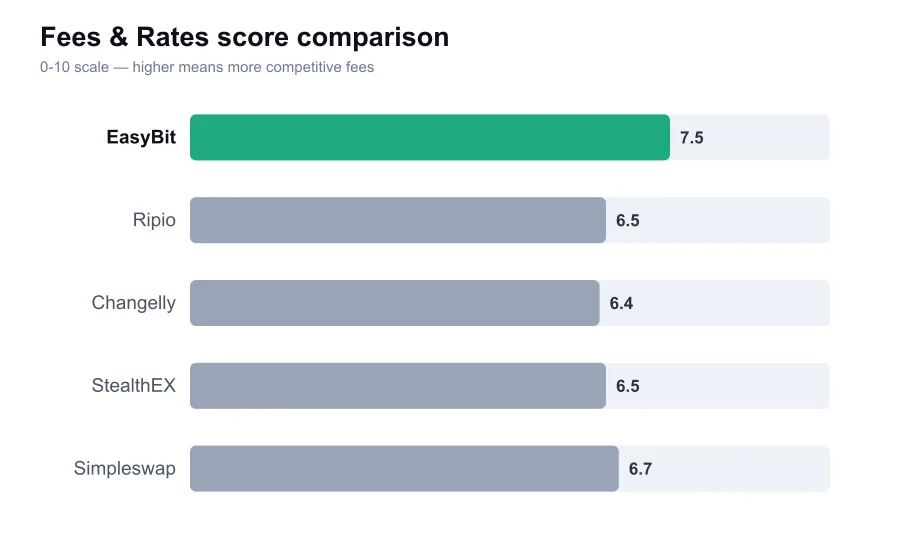
The platform has advertised a relatively low service fee structure, commonly around 0.25% for floating exchanges, though the final quote also includes liquidity provider costs, blockchain network fees, and spread. This is the part that deserves scrutiny. Instant exchanges often look inexpensive on a stated fee basis but can still produce a weaker final payout than an order-book exchange or a competing swap service. The only number that really matters is how much of the destination asset reaches your wallet.
I would always compare EasyBit's final quote against at least two alternatives before sending a sizeable transfer. Check the same amount, same network, same asset pair, and same rate type. Small differences can be trivial for a $50 experiment but material for a five-figure swap. Be especially careful with stablecoin network selection. Receiving USDT on Tron, Ethereum, BNB Smart Chain, or Polygon are not interchangeable outcomes, even though the ticker symbol is the same.
Transaction speed is generally good for an instant exchange, but it is not actually instant in the literal sense. EasyBit must detect your deposit, wait for the required network confirmations, execute or hedge the conversion, and broadcast the outgoing transaction. A straightforward swap on a fast chain may finish in several minutes. Bitcoin deposits, congested Ethereum transactions, liquidity checks, or AML review can stretch the experience considerably. The quoted time should be read as typical, not guaranteed.
The most common cause of delay is not necessarily the provider. Users frequently send an amount below the minimum, use the wrong network, omit a required memo or destination tag, or set an unusually low network fee. In those cases, even responsive support can only do so much. Before sending, confirm the deposit address, exact asset, required amount, and whether the recipient wallet supports the selected chain. Test transactions are sensible for unfamiliar coins or first-time use.
EasyBit's non-custodial framing is broadly accurate in the limited sense that it does not operate a long-term customer trading balance in the way a centralized exchange does. However, the service necessarily controls the deposited funds while the conversion is being processed. That is temporary counterparty risk. You are trusting the company and its liquidity partners to deliver the quoted or applicable output. This is safer than leaving a large balance indefinitely on an exchange, but it is not the same as an onchain atomic swap.
No routine account registration or KYC is one reason users consider services like EasyBit. In normal flows, a wallet address can be enough to start an exchange. But no-KYC should never be read as a promise that verification can never occur. EasyBit maintains AML and compliance controls, and an exchange can be paused if automated screening or a transaction pattern triggers a review. That is common across instant exchange services and is the point where frustrated users often discover the limits of privacy-focused marketing.
A provider that can request documents needs clear policy communication and competent case handling. EasyBit publishes compliance information and offers support channels, which is better than a completely anonymous swap page. Still, the practical test is how exceptions are handled, and users should not send time-sensitive funds if a delay would create serious financial trouble. Any service with compliance screening can create an uncomfortable gap between a fast marketing promise and a manual review reality.
EasyBit has been operating for several years and has built a visible presence among instant exchange comparison sites and crypto wallet users. That gives it more credibility than a newly launched anonymous converter. It does not have the institutional transparency, audited financial statements, or long regulatory record of a major licensed exchange. Its reputation is therefore decent within its category, but the category itself requires more caution than people often admit.
Customer support is one of EasyBit's better points. The platform promotes around-the-clock assistance through live chat and email, and a transaction identifier gives support something concrete to investigate. For a standard delayed transaction, that is much more useful than shouting into a decentralized protocol's Discord channel. Support still cannot fix a wrong recipient address or reverse a completed blockchain transfer, so users need realistic expectations.
The interface is clear enough that a newcomer can make a swap, although I would not confuse ease of use with low risk. EasyBit's best use case is a simple conversion between established assets where you know the destination wallet and can tolerate normal confirmation times. It becomes less attractive for obscure tokens, huge orders, or situations where you need a legally defined execution venue and a detailed trade record.
EasyBit is a credible convenience service, not a replacement for a full exchange. Its low advertised fee, fixed-rate option, and account-light workflow are appealing. The trade-off is less transparency around the underlying execution than an open order book provides, plus the possibility of compliance review despite the no-registration experience. Use it for practical wallet-to-wallet swaps, compare the final payout carefully, and do not send an amount you cannot afford to have delayed.