CryptoVortex is not a provider I can place alongside established exchanges on the available public evidence. The name may appear in promotional material, social posts, or websites using exchange language, but I could not verify a clearly identified, reputable operating company with the disclosures a customer should demand. That does not prove every use of the name is fraudulent. It does mean the service has not earned a presumption of trust.
Crypto names are unusually easy to recycle. A brand can be used by a trading site, a bot seller, a signal group, a wallet, or an outright impersonator. Before discussing spreads or features, a reviewer needs to establish the exact domain, legal entity, jurisdiction, and product. I could not confirm a stable official CryptoVortex exchange identity that meets that basic threshold. Readers should treat similarly named sites as separate entities until proven otherwise.
A genuine platform handling customer money should make its legal terms easy to locate and should identify who customers contract with. It should state where disputes are governed, how customer assets are held, what restrictions apply, and how account closure works. If these details are buried, inconsistent, copied from another company, or absent entirely, the platform is already failing an important test. Professional finance is not allergic to paperwork.
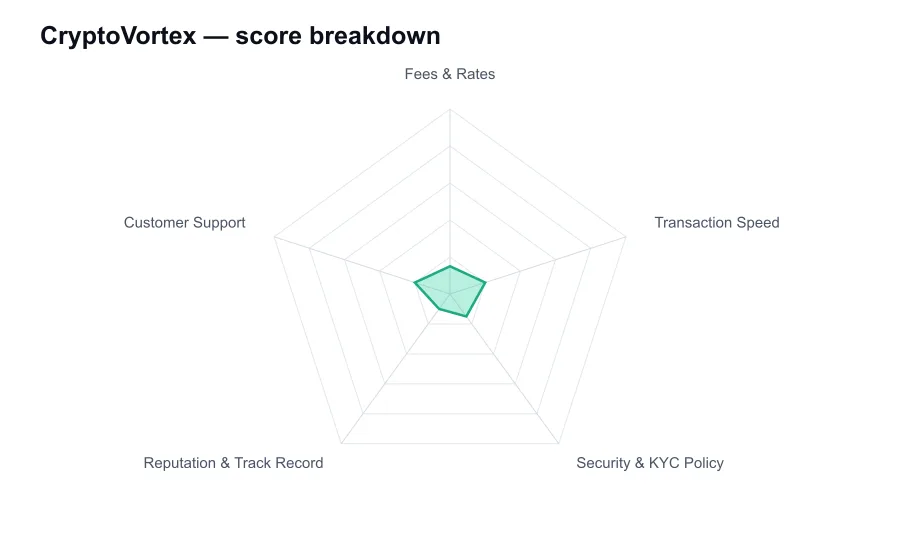
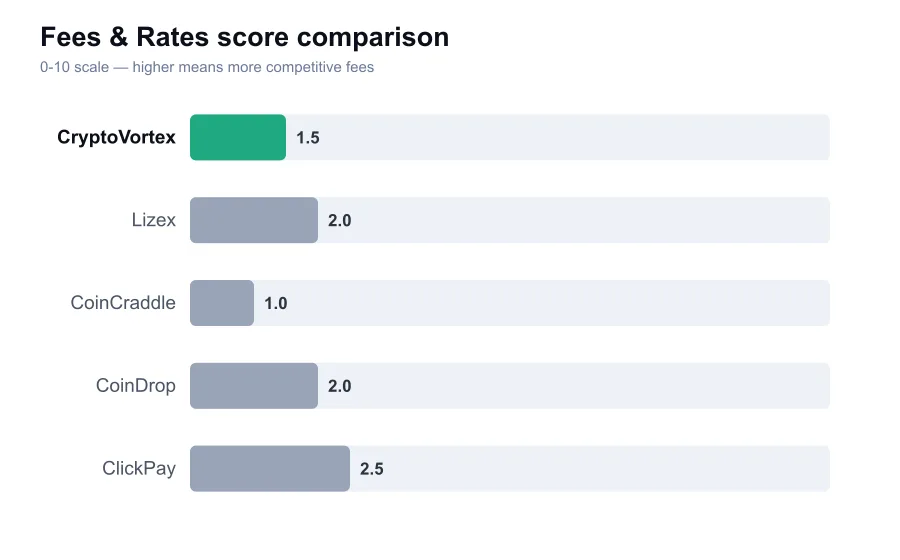
The fee picture is consequently impossible to score generously. Some questionable platforms advertise zero commission while earning through wide spreads, withdrawal charges, conversion margins, or trading conditions that only appear after a deposit. Others show impressive profits on a dashboard without providing a transparent market execution record. A fee schedule is meaningful only if it says exactly what a customer pays, what rate is used, and what cash or coin can be withdrawn afterward.
Do not rely on screenshots of gains, influencer testimonials, or a displayed account balance. Those are easy to manufacture and tell you nothing about withdrawal reliability. The meaningful test is whether a user can deposit, trade, withdraw principal and profits, and close the account without being asked for a surprise tax, release fee, liquidity fee, or additional verification payment. Legitimate regulated firms do not demand a fresh crypto transfer to unlock your own withdrawal.
Speed claims deserve no benefit of the doubt either. A dashboard can credit a deposit instantly, but that is merely an internal database entry. It does not establish that the provider has custody of the claimed assets or can process an external withdrawal. A reputable exchange publishes withdrawal procedures, confirmation requirements, minimums, limits, and status information. I could not verify that level of operational detail for CryptoVortex.
If a site offers managed trading, artificial intelligence profits, guaranteed returns, or account managers who pressure clients to act quickly, step away. Crypto markets do not produce guaranteed income, and legitimate firms do not need to manufacture urgency. High pressure calls, private messaging apps, romance based investment conversations, and requests to install remote desktop software are not normal customer service. They are common components of investment fraud.
Security information is similarly inadequate. A site can display a padlock icon, claim bank grade encryption, and show generic badges without demonstrating cold storage, segregation of customer assets, penetration testing, two factor authentication, or a process for handling compromised accounts. HTTPS only protects the connection between a browser and a site. It says nothing about whether the people operating the site are trustworthy or whether deposited assets exist.
The KYC issue requires care. Lack of KYC does not automatically make a wallet unsafe, and strong KYC does not make a business honest. But unclear verification rules are a specific risk. Scam operations sometimes accept deposits with minimal friction, then use incomplete or shifting verification demands to prevent withdrawals. A real provider explains its identity requirements before money is sent and does not make customers pay additional crypto to complete compliance.
CryptoVortex also lacks the public track record needed for a good reputation score. I found no comparable history of named leadership, longstanding regulatory registration, credible independent media coverage, or a transparent record through major market events. That is a substantial weakness, not a minor missing feature. With crypto custody, reputation is built slowly through visible operations and tested withdrawals, not through attractive promises.
Support is another area where an unknown provider can be actively dangerous. Fast replies are not inherently good if the responder is trying to push a larger deposit or persuade a customer to ignore doubts. Good support provides documented answers, account security advice, and clear escalation routes. It does not request a recovery phrase, send payment instructions to a personal wallet, or insist that a customer continue the conversation on an unaccountable messaging app.
Anyone who has already sent funds should preserve evidence. Save transaction hashes, addresses, emails, chat logs, bank receipts, screenshots, and the exact web address. Do not send further money to recover an earlier deposit, even if someone claims it is for tax, insurance, account activation, or blockchain synchronization. Contact the relevant bank, card issuer, exchange, or local fraud reporting body quickly. Recovery is difficult, but delay makes it harder.
For prospective users, the practical answer is easier. Do not make CryptoVortex your first exchange, trading account, or wallet counterparty. Use a provider whose registration, leadership, fee model, and customer history can be independently checked. If you want self custody, use a well known wallet and retain your own keys. If you want to trade, choose a major exchange with transparent markets and an established withdrawal record.
My verdict is not a subtle one. CryptoVortex has too little verifiable information to justify trust, and the absence of basics is especially troubling in a business that may receive irreversible crypto payments. A low score here reflects lack of proof, not a claim that every related page has committed a crime. The sensible response to an unverified financial provider is caution, not curiosity with your savings. Leave it alone until independent evidence materially improves.