1Mile is a lightly documented exchange brand operating in a market full of small instant-conversion services. It should not be confused with a large, heavily regulated trading platform simply because it offers cryptocurrency exchange functions. The basic proposition is familiar: choose a pair, provide destination details, transfer the source asset and receive the converted asset. That can be useful, but the business model leaves little margin for uncertainty once funds have been sent.
The problem for a reviewer is not that a smaller service is automatically poor. Plenty of niche payment and exchange businesses begin with a limited public footprint. The problem is that 1Mile does not have the deep, independently verifiable history, volume of third-party scrutiny or detailed corporate disclosure that lets a customer evaluate it in the same way as Kraken, Bitstamp, Coinbase or a long-running decentralized protocol.
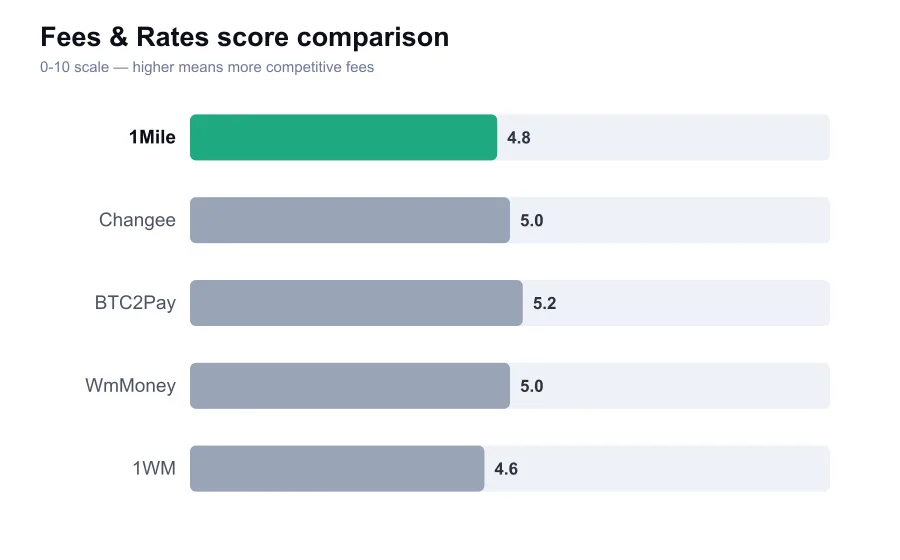
A prospective customer should begin by distinguishing an advertised rate from an all-in rate. Instant exchangers commonly show a quote that includes their margin rather than itemizing a commission. The quoted receive amount may also change before completion on floating-rate orders. Without a clearly published fee table, the only sensible test is to compare the exact expected payout, on the same network and at the same moment, with alternatives such as ChangeNOW, Changelly or a direct exchange withdrawal.
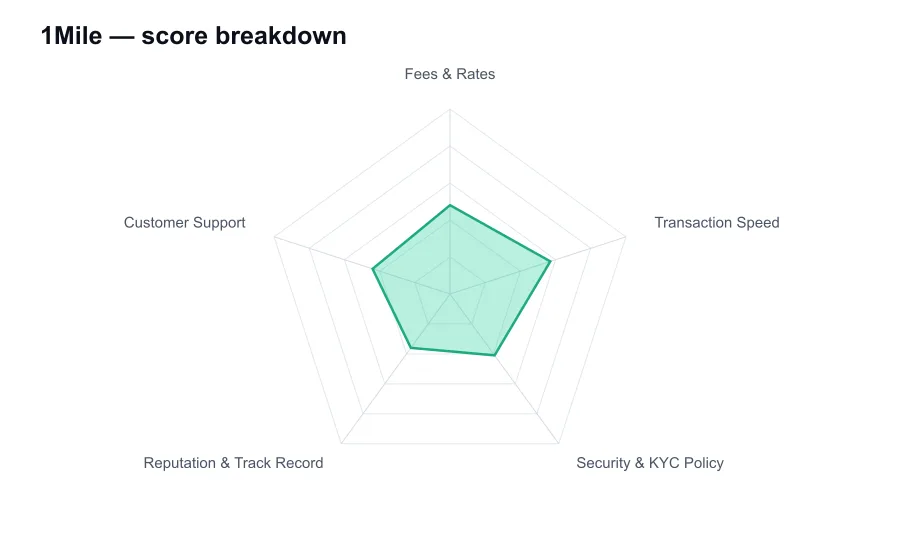
That lack of fee transparency earns 1Mile a middling score rather than a failing one. Quote-based pricing is normal for this class of service, and a competitive quote can be perfectly acceptable. The concern is that it makes routine comparison more difficult and makes marketing claims hard to audit. A user cannot simply say, "the fee is 0.5 percent," if the operator does not publish that number as a stable policy.
Network fees deserve special attention. Sending ERC-20 USDT, for example, may be expensive even if the displayed exchange spread looks modest. A cheap-looking conversion can become poor value after withdrawal or settlement costs are included. Users should also ensure that the receiving wallet supports the selected network. Confusing ERC-20, TRC-20, BEP-20 and other versions of a token is one of the most common and painful mistakes in crypto transfers.
Transaction speed will be governed by more than 1Mile's own processing. The sender's wallet must broadcast the transaction, the blockchain must confirm it, the exchange service must process or source the conversion, and the receiving network must confirm the payout. A low-fee Bitcoin transaction can wait a long time. A token swap on a fast chain might settle much faster. Any promise of instant completion should be read as a target for normal conditions, not a contractual guarantee.
The best case is a standard liquid pair, an exact payment amount, a healthy blockchain and no compliance alert. Those orders can complete quickly. The worst case is more revealing: an underpayment, an expired invoice, a memo error, a congested network or a risk review. That is where customers find out whether a small operator has competent reconciliation procedures. Public evidence about 1Mile's handling of those edge cases is not strong enough for me to recommend using it for a large amount.
Security claims deserve the same skepticism. A browser padlock only says the connection is encrypted. It does not prove that the operator has segregated funds, strong internal access controls, meaningful insurance, regular external audits or a robust incident-response plan. If 1Mile is functioning as an intermediary during an exchange, the customer is exposed to its operational competence for at least the period between receiving the deposit and sending the payout.
The account-light nature of an instant exchange can reduce the attack surface associated with stored customer balances. There is no reason to leave coins on the service after a completed trade. That is a benefit. Yet it doesn't remove counterparty risk during the order itself, and it doesn't protect anyone who lands on an imitation website. Verify the exact domain from a trusted source, avoid sponsored search advertisements, and never accept an address change delivered through a random message.
KYC is another area where small providers need explicit policies. A service may permit an order without registration but still reserve the right to request identity documents or source-of-funds information after automated screening. That can surprise users who equate an account-free checkout with guaranteed anonymity. It is more accurate to call such services low-friction, not consequence-free. If privacy is central to your decision, read the terms before depositing rather than after a transaction is held.
1Mile's reputation is limited by the scarcity of durable, high-quality independent reporting. Search results, referral pages and anonymous review snippets do not carry the same weight as a long record of regulatory disclosures, established community discussion and documented resolution of complaints. The absence of a widely reported catastrophe is not proof of reliability. It may simply mean the service is too small to have been closely tested in public.
Support is therefore a major practical risk. With an ordinary order, you may never need it. With a missing payout, it becomes the whole product. Before trying 1Mile, I would locate its official support route, see whether it provides a ticket reference, preserve every transaction hash and avoid communicating through unofficial social-media accounts. A genuine operator should be able to identify an order from its ID and explain the next required step without asking for wallet seed phrases or remote computer access.
There is no reason to dismiss every lesser-known exchange service, but there is also no reason to give one the benefit of the doubt with money you cannot afford to tie up. A first transaction should be small enough that a delay is annoying, not damaging. Use an asset and network you understand, send the exact amount, and wait for completion before repeating the order. That approach tests the rate, speed and support without gambling on trust.
Compared with a major centralized exchange, 1Mile offers less bureaucracy and potentially a faster path from one coin to another. Compared with an established noncustodial aggregator, it offers less visible routing and fewer tools for independently checking execution. It occupies a narrow middle ground, useful only if its quote is clearly better for a small swap and the user accepts the lower transparency.
My judgment is cautious. 1Mile may perform adequately for a modest, routine conversion, but the available public evidence does not justify treating it as a preferred venue for substantial funds. Transparent fees, clearer company information and a larger independently reviewed support record would change that assessment. Until then, compare aggressively, test small and keep custody of your assets everywhere except the brief moment required to complete an order.
That is not a glamorous verdict, but it is the honest one. In crypto, convenience is cheap to advertise and difficult to prove under stress. 1Mile has not demonstrated the depth needed to compete on trust with established exchanges or major DeFi infrastructure. For a small experiment it may be serviceable. For serious financial activity, there are better documented choices.