1WM is another small exchange-style provider that requires a more skeptical reading than the famous brands in crypto. It appears to operate around direct conversion rather than a deep, transparent trading market. That puts it in a crowded category where the interface can be extremely simple but the real quality is only revealed by pricing, payout reliability and the operator's response when a transaction does not go exactly as planned.
A direct exchanger has a legitimate use. Somebody holding one asset may want another without opening a custodial account, passing through a full trading interface or leaving a balance on an exchange. For that person, entering a wallet address and completing one conversion is appealing. The downside is that the user usually cannot inspect an order book, choose among visible counterparties or independently confirm where the liquidity came from.
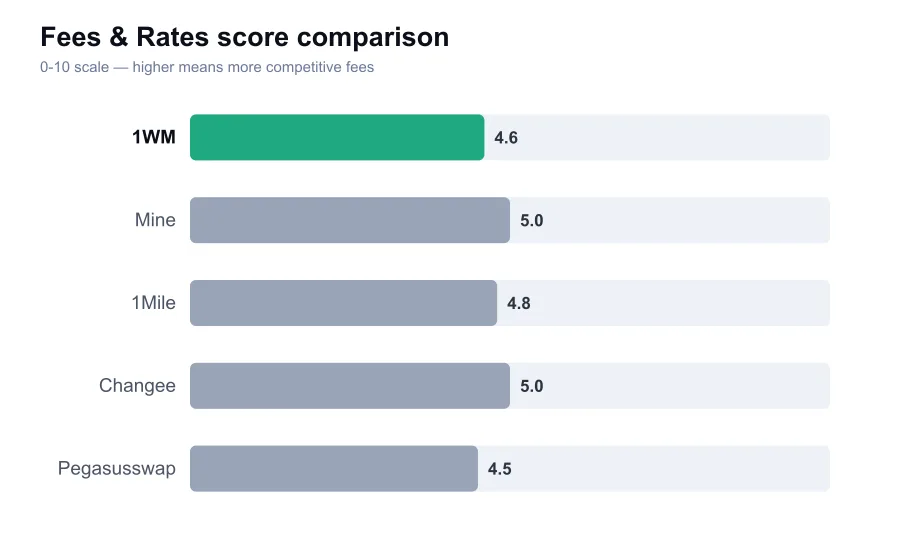
With 1WM, the first thing I would scrutinize is the final payout. Small exchange providers commonly fold their revenue into a spread between market pricing and the rate offered to the customer. That is not inherently deceptive, but it is less transparent than a published 0.1 percent spot fee plus a listed withdrawal charge. A competitive quote can still be good value, but the burden is on the customer to compare it in real time.
Do not make that comparison using a price chart alone. Check the source amount, the precise destination asset, the network, the minimum received amount, any stated service fee and the blockchain fee required to fund the order. USDT is not one universal asset operationally. A cheap TRON transfer and a costly Ethereum transfer may carry the same ticker but have very different practical costs and delivery times.
The absence of a dependable public fee schedule makes planning harder for repeat users. A trader moving funds frequently can often do better through a major exchange with known maker, taker and withdrawal fees, particularly if they already have an account. 1WM's model makes more sense only for occasional exchanges where the all-in quote beats that more cumbersome route. If it does not, there is no compelling reason to accept additional counterparty uncertainty.
Speed is mostly a chain-level question, then an operations question. Once 1WM receives the deposit, it may need to wait for confirmations, conduct automated checks, obtain liquidity and broadcast the outgoing payment. Fast chains can make a routine order feel quick. Bitcoin, Ethereum congestion, large transfers and unusual pairs can produce a noticeably longer wait. Anyone promising a fixed minute count for every cryptocurrency route is overselling the process.
An exact payment is essential. Many instant-exchange orders are generated for a specific amount and have a payment window. Sending too little, too much, or after the quoted rate has expired can create manual work. Before transferring funds, I would save the order page, confirm the network in the wallet itself and make sure the destination does not require a memo or tag that has been omitted. These details matter more than the design of the website.
On security, 1WM does not present the level of publicly verifiable infrastructure detail that one expects from a mature, regulated exchange. There is a difference between basic website security and demonstrable operational security. Customers should want to know how funds are handled, whether access controls are independently tested, what the refund process is, and how identity information is stored if compliance checks occur. Sparse disclosure means those questions cannot be answered with much confidence.
The lack of a permanent account balance does offer one advantage. Users can complete a swap and return the coins to their own wallet, rather than leaving assets exposed on an exchange. But during the exchange, the service is still a counterparty. That makes phishing protection critical. Navigate from a verified bookmark, not an advertisement or an unsolicited chat link, and remember that real support staff will never need a recovery phrase to locate an order.
KYC policy needs careful reading rather than assumptions. Some small exchangers market low-friction access but retain the right to pause an order for compliance or anti-money-laundering checks. That is common across the industry and not, by itself, a criticism. The concern arises if there is no clear explanation of what triggers a review, what documents might be needed, how long a review may take, and how a customer can obtain a refund if verification is not completed.
1WM's public reputation is not comparable to the established history of exchanges such as Kraken or Bitstamp, nor to the highly visible onchain record of a protocol like 1inch. There is limited high-quality external material through which to assess long-term reliability. That makes positive promotional reviews less persuasive than they may look. A real reputation is built through years of independently discussed wins, losses, support cases and transparent responses.
Support is the area where an obscure instant exchanger most needs to exceed expectations, because there is no account manager, branch office or formal broker relationship behind a one-off order. The practical questions are basic. Is there a clear official contact channel? Will a customer receive an order identifier? Can the team explain a delayed transaction with a transaction hash? Can a refund be made safely if a payout cannot proceed? I would verify the available channels before depositing.
This does not mean every customer will encounter a problem. Most ordinary swaps, on liquid pairs and correctly selected networks, are mechanically straightforward. It does mean that a service should be judged by its ability to handle the exceptions, and that is where 1WM lacks enough public evidence to earn high trust marks. A smooth first order is encouraging, but it is not the same as a proven operational record.
For a cautious user, the appropriate process is boring and effective. Compare the quote with two larger alternatives. Send a small amount from a wallet you control. Wait for the payout, record the actual effective rate and test only the official support channel if there is a delay. If any part of that experience feels unclear, do not scale up. There is no shortage of exchange options in this market.
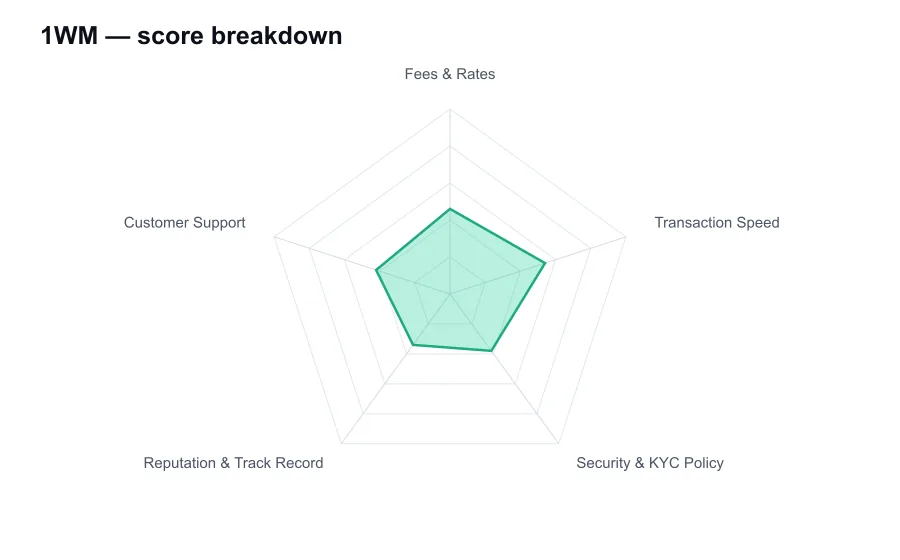
I see 1WM as a conditional convenience service, not a destination exchange. It could be useful if it supports a particular route at a meaningfully better final payout than its competitors. It is not compelling enough on disclosed security, fee transparency, public reputation or support evidence to be a default recommendation. Users with meaningful sums should value a boring, well-documented provider over a supposedly frictionless checkout.
The final assessment is therefore restrained. 1WM may handle a small routine conversion adequately, but it has not built the public case required for stronger confidence. Its scores reflect the uncertainty around a thinly documented operator, not a claim that every order will fail. Test with an amount you can afford to have delayed, keep records, and use a better-established exchange for anything that matters financially.