111Obmen is a small, instant-exchange style service rather than a full trading venue. It sits in the part of the market where a user picks a pair, enters a receiving address, pays an invoice and waits for the exchange to complete. That model can be convenient for someone swapping one asset for another without opening an account, but it also means the buyer is relying heavily on the operator's liquidity, compliance decisions and responsiveness when a transfer goes wrong.
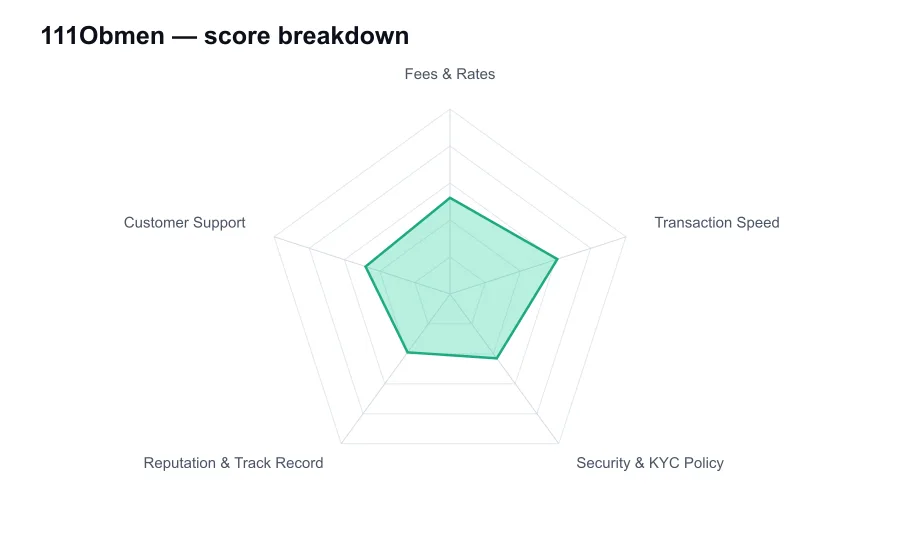
The first issue is visibility. 111Obmen has nowhere near the public footprint of Changelly, ChangeNOW, FixedFloat or a major centralized exchange. Small services can work perfectly well, but a thin independent record makes it difficult to separate a young business from a business that simply has not earned market attention. I wouldn't treat a polished website or a listing on an exchange-monitoring site as proof of deep reserves or long-term reliability.
Its appeal is the simple flow. There is no order book to decipher, no advanced trading screen and usually no reason to fund an internal wallet. For a straightforward crypto-to-crypto conversion, that is a better experience than depositing coins at Binance or OKX, making a spot trade and then withdrawing. The trade-off is that the rate shown by an instant exchanger includes its own spread and any supplier costs, so simplicity does not automatically mean a cheaper deal.
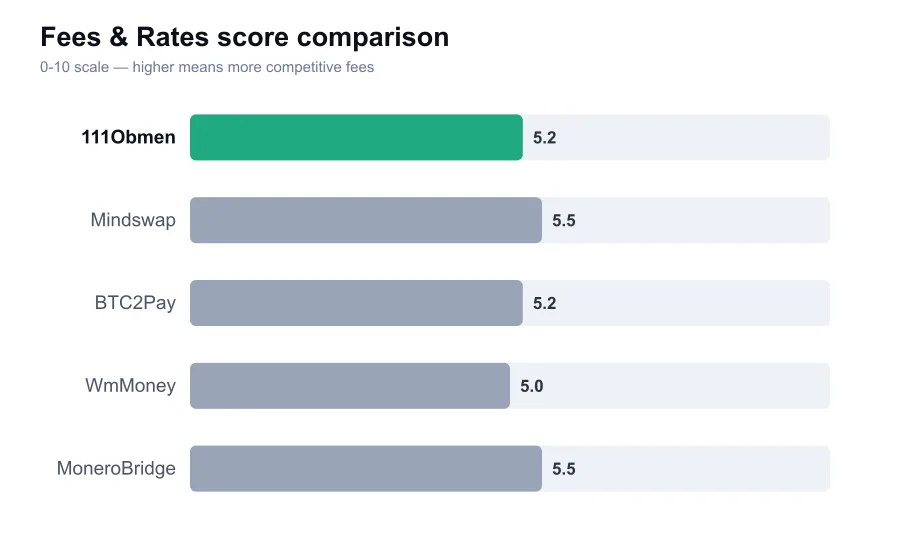
111Obmen's pricing needs to be judged quote by quote. The service does not publish the sort of transparent, universal maker and taker schedule that a conventional exchange does. Instead, the effective cost is embedded in the offered conversion rate, with network charges and liquidity conditions also affecting the result. That makes it harder to know the true fee before comparing the final amount against at least two competitors.
This is where small exchangers often disappoint experienced users. A rate can look attractive until the user compares the amount of BTC, USDT or ETH actually received with the amount offered by a larger noncustodial aggregator. A modest percentage difference matters a lot on a four-figure exchange. I would take a screenshot of the quote, check whether it is fixed or floating, and compare the final receive amount rather than trusting labels such as "best rate".
A floating-rate order is particularly risky during a busy market. If the outgoing coin moves sharply while confirmations are arriving, the completed amount may be materially lower than the first estimate. Fixed-rate routes reduce that uncertainty, but only if the service explicitly promises a locked rate for a stated time and the user sends the exact amount promptly. Do not assume every 111Obmen route has the same rate protection.
Speed is similarly dependent on the asset. A swap paid with Litecoin, TRON-based USDT or another quick network can reasonably finish after the required confirmations and a short processing window. Bitcoin, Ethereum during congestion, and any route involving a third-party payout provider can take much longer. The service's interface may describe an exchange as instant, but blockchain settlement and liquidity sourcing still set the real clock.
For a routine order, the lack of account registration is convenient. It also removes some account-security headaches because there is no reusable customer balance waiting in a hosted wallet. Users should still verify the domain carefully, check the destination address on the payment page, and keep the order ID and transaction hash. Instant exchangers are a frequent target for lookalike websites, and a mistaken payment address cannot be reversed by customer support.
No-account access should not be confused with a guarantee of no identity checks. Like other exchange services, 111Obmen may request information if its risk controls flag a transaction, the source of funds appears problematic, or a compliance partner requires clarification. That possibility is common across the sector, but the crucial question is whether the rules, review process and refund handling are clear before money is sent. Publicly available detail on those operational safeguards is limited.
That limited disclosure is the service's biggest weakness. Large platforms publish security architecture, corporate information, licensing claims where applicable, incident notices and detailed terms. 111Obmen provides a transaction service, not the same level of institutional transparency. I would not send a large treasury transfer, proceeds from a property sale, or funds needed for an urgent payment through a provider with this little independently verifiable operating history.
Reputation has to be assessed with restraint. A handful of positive comments, even if genuine, cannot establish how a business handles delayed orders, compliance holds or disputes. The meaningful test is a broad, dated pattern of independent reviews and a record of public responses when things go wrong. 111Obmen does not have the volume of widely scrutinized feedback that lets a reviewer make the same confident call available for 1inch or established exchange brands.
Support matters more here than it does on an onchain swap protocol. If an invoice is underpaid, paid late, sent with the wrong memo, or delayed by a wallet's fee setting, a human operator may be the only route to a resolution. The available support channels appear geared toward order assistance rather than a large, documented support organization. That's acceptable for a small test trade, but it is not reassuring for a time-sensitive large conversion.
My practical approach would be conservative. Start with a genuinely small amount, preferably on a low-fee network, and test the whole sequence from quote to receipt. Check that the returned asset arrives in the correct network and wallet, then assess the effective rate from your own records. Never send a second, larger payment to the same invoice unless support specifically confirms the procedure in writing.
111Obmen may suit a user who values a quick, account-light swap and is prepared to do their own due diligence. It has not earned the level of trust that would justify treating it as a primary exchange or long-term custody option. The lack of a published standard fee schedule, modest public track record and uncertain support depth are not minor details. They are the central facts a careful customer should weigh before using it.
The service is not automatically unsafe because it is small, but small is precisely why the burden of caution shifts to the user. For low-value, non-urgent exchanges, the straightforward workflow may be enough. For larger amounts, regulated fiat activity, or any situation where a delayed payout would hurt, I would choose a more established provider with clearer pricing and a stronger dispute record. 111Obmen is a test-first service, not a trust-first recommendation.