1inch is not a conventional exchange in the Coinbase or Kraken sense. It is a decentralized finance aggregator and protocol suite that searches liquidity across decentralized exchanges, then builds a route intended to get the user a competitive onchain swap. That distinction matters. 1inch does not normally take custody of the coins in a connected wallet, and it does not operate a central order book where customers deposit assets and trust the company to settle later.
The product has become one of the better known names in DeFi because its routing solved a real problem. Liquidity on Ethereum and other networks is fragmented across pools and venues. A direct swap on one automated market maker can be expensive or can suffer poor price impact. 1inch can split an order across sources, use several pools, and seek a route that beats a single-venue trade.
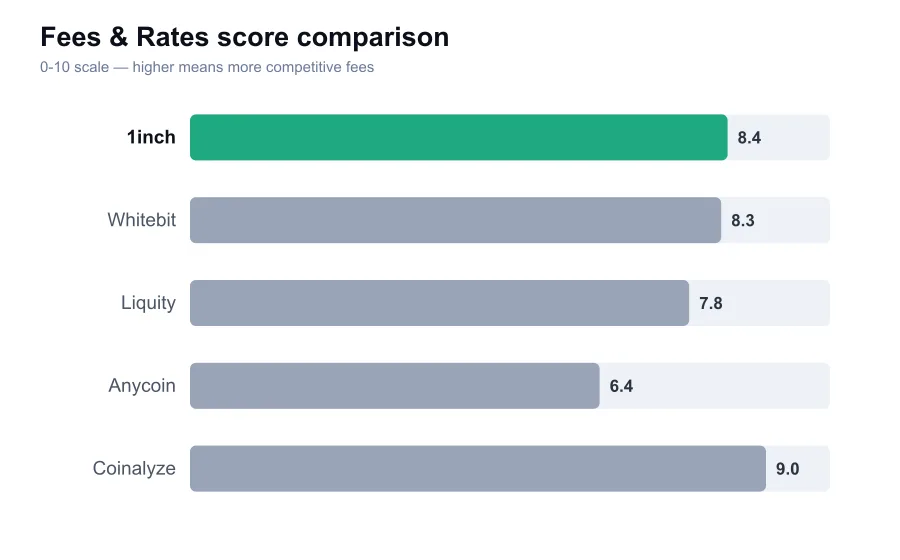
For ordinary swaps, 1inch itself has historically not charged a separate platform fee in the way a retail broker does. That does not mean trading is free. The user pays network gas, pays the liquidity providers' pool fees embedded in routes, and may incur price impact or token-specific costs. In some cases, a route that saves a fraction of a percent on price can cost more gas than it saves, particularly on Ethereum mainnet.
That is why the best 1inch users do not stare only at the advertised rate. They inspect the final output, gas estimate, route, and minimum received amount before approving. For a small Ethereum swap, a simple Uniswap trade may occasionally be cheaper because the approval and transaction costs outweigh sophisticated routing. For a larger order, aggregation can be genuinely valuable, since avoiding a weak pool or dividing the trade can reduce slippage by far more than the extra computation costs.
Limit orders are one of 1inch's strongest practical features. Instead of sitting in front of a screen waiting for a price, a user can create an onchain signed order that may be filled by resolvers when conditions meet the terms. The exact mechanics and availability vary by network and version, but the concept is useful for traders who want more control than a basic market swap. It is a meaningful differentiator from wallet swap buttons that only execute immediately.
The Fusion mode is another important part of the design. It uses a Dutch-auction style approach in which resolvers compete to fill an order, with the stated goal of allowing swaps without the user directly paying network gas. That can be excellent for users who dislike holding native gas tokens for each trade. It is not magic free execution, though. Costs and execution economics are reflected in the quote, and speed depends on resolver interest and market conditions.
Speed at 1inch is blockchain speed. On a responsive layer 2 such as Arbitrum, Optimism, Base or Polygon, a normal swap can feel close to immediate after wallet confirmation. On Ethereum mainnet, the transaction enters the mempool and settlement depends on the fee selected and network congestion. Fusion orders may fill quickly, but they are not guaranteed to fill instantly, especially for unusual tokens, thin liquidity or aggressive limit prices.
Security is where 1inch is fundamentally stronger than a small custodial exchanger, but it asks more of the user. There is no account password to reset and no central balance for an exchange hacker to drain. Funds remain under the user's wallet control until a smart contract transaction is approved. That eliminates one category of risk while introducing smart contract, wallet, token and approval risks that many newcomers underestimate.
1inch has had its protocols audited by recognized security firms over its life, and its code and contracts have received intense public attention. Still, DeFi audits are not insurance. A user can approve an unlimited token allowance, interact with a fake token, sign a malicious permit, or connect a wallet to a phishing page. The safest routine is to use the verified app domain, check every wallet prompt, use limited approvals where practical, and periodically revoke allowances that are no longer needed.
KYC is not a standard requirement for using the noncustodial protocol from a self-custody wallet. That is a major reason DeFi users choose it. Yet access can be affected by geography, interface restrictions, third-party wallet rules, or the compliance policies of an onramp. More importantly, no-KYC does not mean no responsibility. Users remain responsible for tax reporting, sanctions compliance and ensuring that the assets they use are lawful in their jurisdiction.
The project's track record is substantial by DeFi standards. 1inch launched in 2019 and survived several brutal market cycles, network fee spikes, exploits elsewhere in DeFi and changing regulatory pressure. Its token, DAO governance, wallet products and developer-facing protocols have not made it flawless, but they do show a project with a durable ecosystem rather than a disposable swap site. That history carries more weight than token marketing.
I do have reservations about the user experience. The interface is far easier than it was in early DeFi, but it can still confuse somebody who does not understand gas, wrapped assets, approvals, token decimals or network selection. The huge universe of tradable tokens is a feature and a hazard. 1inch can find liquidity for assets a centralized exchange would never list, but availability is not an endorsement of a token's legitimacy.
Support is not the polished, account-specific service one expects from a large regulated broker. Users have documentation, help resources, community channels and wallet support materials, but there is no customer-service agent who can reverse an approved blockchain transaction. That is not a defect unique to 1inch. It is the price of self-custody. A user who needs phone support, chargebacks or a human recovery path should not use DeFi as their first exchange experience.
Against direct competitors such as Matcha, Paraswap and Uniswap's own interface, 1inch remains a serious contender. The routing, broad network support, limit-order tools and Fusion execution give it real depth. The cheapest route changes constantly, so loyalty is irrational, compare quotes. But 1inch belongs in the shortlist for anyone regularly swapping established tokens from a self-custody wallet.
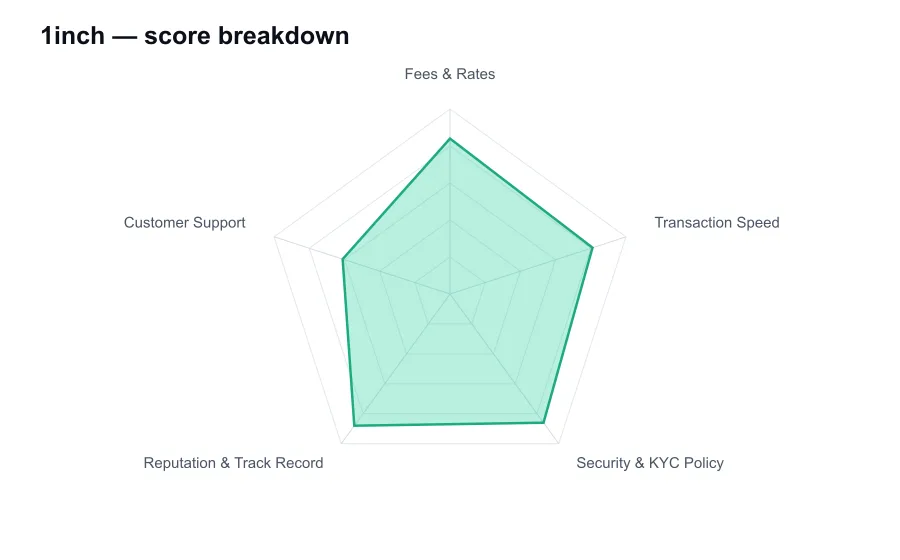
My view is clear. 1inch is excellent infrastructure for a crypto-native user and a poor substitute for a beginner-friendly, regulated exchange. It can reduce slippage and simplify fragmented DEX liquidity, but it cannot protect users from their own wallet mistakes or from the risks of speculative tokens. Use it with a hardware wallet for meaningful balances, read the transaction before signing, and treat the displayed output as a quote to verify rather than a promise to admire.
For the right audience, 1inch deserves a high score because it has delivered useful technology over years rather than selling convenience with vague claims. Fees are often competitive, security is structurally strong, and the reputation is earned. Its weak point is human support, which is inherent to the noncustodial model. If you understand that trade and want control of your assets, 1inch is one of the strongest tools in decentralized exchange.