Nexchange is better understood as cryptocurrency exchange infrastructure and an instant-conversion service than as a full-scale retail trading venue. Its model has traditionally been built around API-driven swaps, white-label integrations, and straightforward asset conversions. That gives it a different personality from a large exchange with charts, derivatives, staking menus, and a social-media-sized customer base. It is built for execution, not spectacle.
That focus can be useful. A business that wants to add crypto conversions to a wallet, checkout flow, or portfolio product may prefer an API provider rather than operating its own order books. Individual users may also appreciate a simple conversion journey. The absence of a complex trading terminal reduces friction, although it also means users give up the price discovery, limit orders, and granular control that an order-book exchange provides.
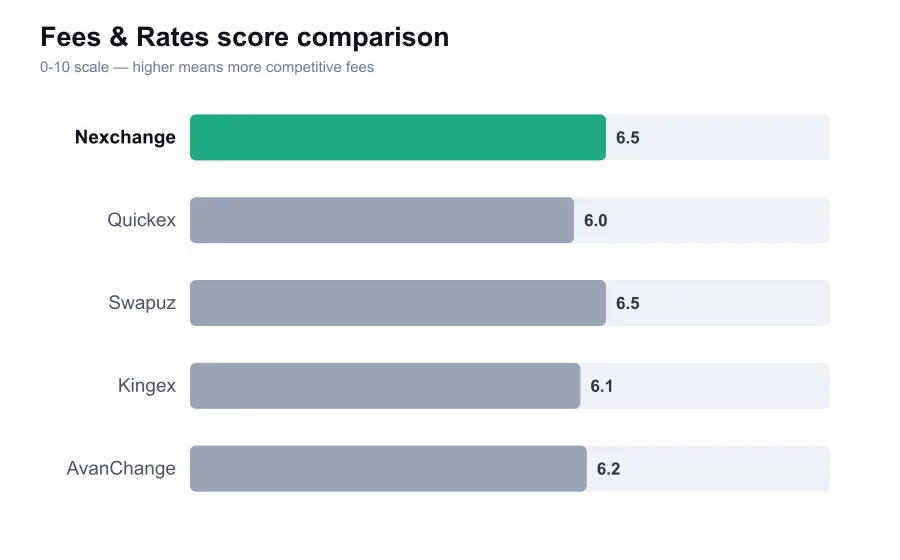
The first question with Nexchange is not whether its interface works. It is whether the quoted rate is competitive for the pair and size you want. Like many instant exchange providers, its practical charge is often a blend of stated service cost, liquidity-provider pricing, network fees, and the spread between the market midpoint and the offered amount. That can be efficient for convenience trades, but it deserves comparison before every sizable order.
A transparent API can be a real advantage for developers because a product can display a quote before the user commits. For retail customers, however, the relevant number remains the final amount delivered. A service may offer a competitive rate on BTC to ETH and a distinctly weaker rate on a thinly traded asset. That is not unique to Nexchange. It is a basic consequence of fragmented liquidity, but users should not assume the brand has one universally good price.
Nexchange has historically marketed both fixed and variable quote approaches. A fixed quote provides protection against price movement during the funding window, while a variable quote can result in more or less received depending on market conditions. Fixed execution is attractive in volatile periods, but the assurance has a cost and depends on the user sending the exact asset and amount within the required time. Read the quote conditions rather than relying on the headline label.
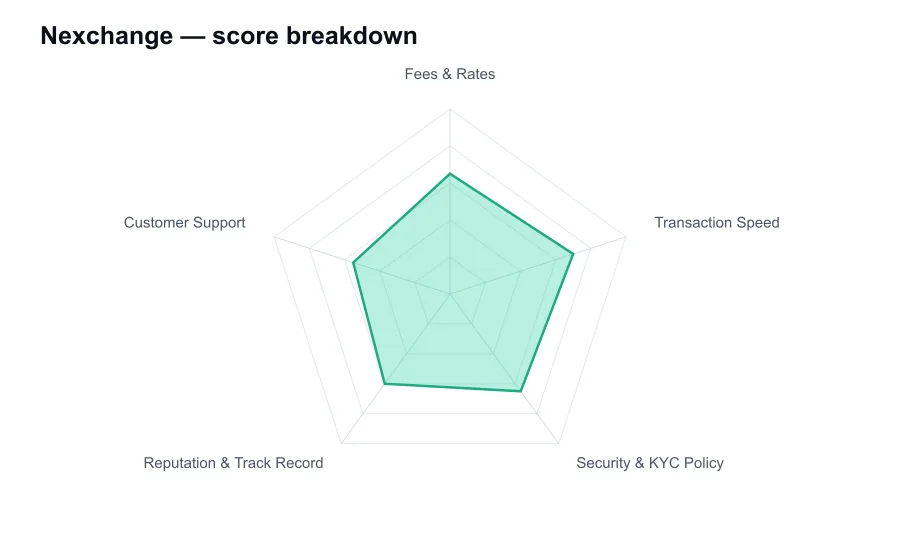
Speed can be good for uncomplicated swaps because the service is designed to automate the path from deposit detection to payout. But no instant exchanger is actually instant in the literal sense. The source chain must confirm the deposit, liquidity must be available, compliance checks must clear, and the destination transaction must be broadcast. A fast network-to-network conversion may finish quickly. A Bitcoin deposit, congested Ethereum transaction, or manual hold can make the experience much slower.
For API clients, reliability involves more than blockchain timing. Quote endpoints, status callbacks, transaction monitoring, rate limits, and idempotent order creation all matter. Nexchange's infrastructure orientation is a plus for teams that can integrate it carefully and test edge cases. It is less appealing to a casual user who simply wants a large familiar brand with phone support and a polished mobile app.
The platform's noncustodial or no-account positioning should be understood in practical terms. During a conversion, Nexchange receives the asset and arranges the payout. That temporary custody is counterparty risk, even if users do not maintain a standing balance. The safest habit is to use a wallet you control at both ends, send only the required amount, and avoid treating a swap address as a permanent deposit address.
Nexchange has a stronger technical identity than many anonymous instant-swap pages because of its API and integration focus. Still, it does not carry the reputational weight or regulatory visibility of a major centralized exchange. A business considering it should conduct vendor due diligence, review current legal terms, test failure handling, and examine the security practices relevant to its own jurisdiction. A retail customer should keep the same mindset, just at a smaller scale.
KYC is another area where expectations need adjusting. A streamlined transaction flow does not mean a provider cannot pause an order for compliance, fraud prevention, sanctions screening, or source-of-funds questions. This can happen across the instant-exchange sector. If your use case cannot tolerate a potential review, a service that performs checks before accepting a transfer may be more appropriate than one that reviews activity after a transaction has begun.
Security depends partly on Nexchange's systems and partly on the user's integration discipline. API keys must be scoped, stored securely, rotated when necessary, and never exposed in client-side code. Callback endpoints need signature verification and replay protection. Retail users have a simpler task but still need to verify URLs, avoid copy-pasted malware addresses, and record the order ID and transaction hashes. The technical nature of the service does not remove basic crypto hygiene.
Its reputation is respectable within the narrower exchange-infrastructure niche, but it is not a consumer institution with the massive review volume and public scrutiny of Kraken or Coinbase. That is neither praise nor condemnation. It means the customer should calibrate exposure. Nexchange may be a sensible tool for an integration or a routine swap, yet it is not where I would send a life-changing amount without first testing the exact route and reading the current conditions.
Support is likely to suit developers better than consumers. Documentation and technical communication matter greatly for API customers, while a retail user with a delayed order needs prompt, plain-language help. Small infrastructure providers often do well on technical tickets and less well on high-touch consumer escalation. Keep a complete record from the start, including timestamps, quote ID, deposit address, transaction hash, and screenshots of the displayed rate.
Nexchange has a clear place in the market for users who value programmable conversion infrastructure and do not need a full brokerage. Its best qualities are the API-oriented design, relatively direct swap model, and flexibility around quote mechanics. Its limitations are equally clear: quoted-rate comparison remains essential, transaction reviews can still occur, and its smaller public profile does not justify blind trust. Use it as a tool, test it properly, and keep custody in your own hands.