Godex is a long-running instant cryptocurrency exchange service that has built its identity around privacy, simple swaps, and a large coin catalog. It is not a spot exchange with an order book, and it does not try to be one. The product is designed for a user who has crypto in one wallet, wants a different crypto in another wallet, and would rather avoid opening a centralized trading account for the journey.
That narrow mission gives Godex a clean user experience. You choose the asset you are sending and receiving, enter an address, and receive a deposit instruction. There is no need to store an ongoing balance on the platform. For users who make occasional wallet-to-wallet conversions, this is far more convenient than the deposit, trade, withdrawal sequence of a conventional exchange.
Godex has historically advertised fixed exchange rates and no registration requirements as central features. A fixed quote can be useful because crypto markets move quickly, especially during the time required for Bitcoin confirmations. The point is not that the quote will always be the market's best price. The point is that users know the expected output before committing, provided they send the correct amount within the requested time conditions.
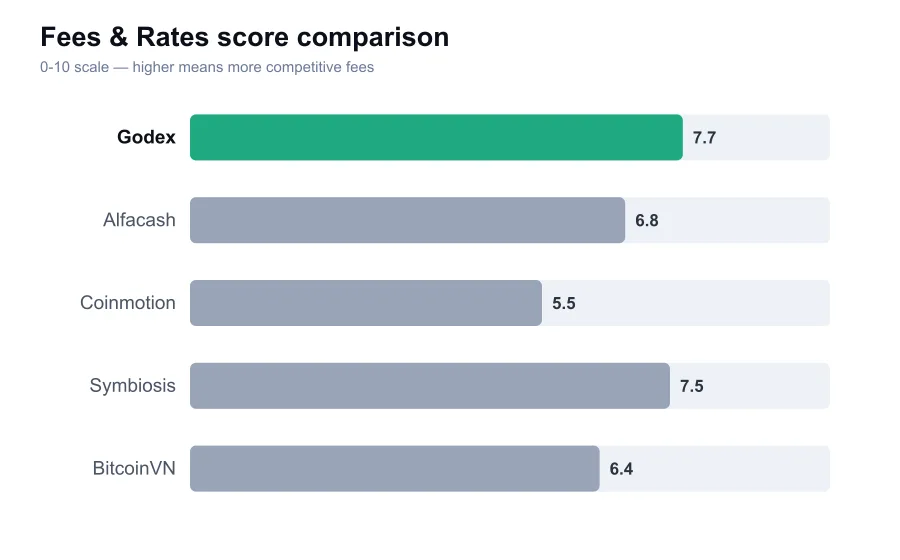
The headline fee commonly associated with Godex is 0.5 percent. That is a competitive number in the instant exchange world, where many services bury their economics in the rate. Still, a stated fee is only the starting point. Network charges, liquidity-provider pricing, and the available route for a particular asset affect the final payout. The practical comparison is always the final amount received, not the percentage printed in a promotional sentence.
On mainstream routes, Godex can offer fair pricing, particularly for users who value a fixed quote and no account requirement. It will rarely beat the raw economics of trading on Binance, Kraken, OKX, or Coinbase Advanced for a verified user with access to those venues. That is not really a flaw. Instant exchanges charge for removing steps and shifting some execution risk away from the customer. The mistake is pretending that convenience comes free.
The service becomes less compelling for frequent small conversions. A 0.5 percent service charge, any route spread, and blockchain fees can add up quickly. Sending a small amount of BTC on-chain is especially inefficient during high-fee periods. Godex makes more sense for a deliberate swap than for repeated rebalancing. If you trade weekly, a proper exchange account with low maker and taker fees will likely save substantial money over time.
Godex's processing speed is solid but tied to network reality. Swaps involving quick chains and liquid assets can complete in a short time after the deposit is detected. Bitcoin and Ethereum are more variable, and token transfers can be slowed by congestion, sender fee selection, or required confirmations. The service's fixed-rate model can reduce price anxiety during that wait, but it cannot eliminate the wait itself.
The platform offers an order page where users can follow transaction progress, which is a basic feature but an important one. A good instant exchange should make it obvious whether it is waiting for a deposit, waiting for confirmations, exchanging, or sending the payout. Godex generally handles this simple transparency well. Users should still save the order ID and both blockchain transaction hashes, since those details are indispensable if an order needs investigation.
Privacy is one of Godex's main attractions. The platform has long promoted no registration and no standard KYC for ordinary exchanges. For users tired of creating an account at every service, that has obvious appeal. It also reduces the amount of personal information sitting in yet another company's database. There is a legitimate privacy benefit in not linking every routine swap to an extensive customer profile.
But Godex should not be described as a guarantee of anonymous, consequence-free exchange activity. Like other providers in this market, it can act on AML or sanctions concerns and may request information where a transaction triggers risk systems. The terms and operational practice of instant exchanges can change, too. If your sole reason for using a service is an expectation that no questions can ever be asked, you are taking a gamble with funds that could be held.
Security is reasonably framed as limited custody rather than zero trust. Godex does not ask customers to retain a trading balance, which is safer than leaving a portfolio on a lightly regulated exchange. Funds are nevertheless under the operator's control during the conversion. The user needs to protect their own wallet, verify the website domain, and avoid impersonators in messaging apps. A no-account service cannot reverse a payout sent to a wrong address.
Godex has a longer market presence than many disposable instant-swap brands, and that matters. It has accumulated a recognizable reputation among users looking for privacy-oriented conversions and a broad selection of assets. Its public standing is still different from the audited, licensed, and heavily scrutinized reputation of a top centralized exchange. It has survived in a difficult niche, which is a positive sign, but longevity should not be confused with the safeguards of a bank.
Customer support is available through the site's contact channels, and the transaction ID gives support staff something concrete to investigate. Routine questions tend to be easier than edge cases involving a delayed network, a mistaken amount, or a transaction subjected to a review. Godex's support is serviceable, not a standout reason to choose it. Users who need phone support, formal complaint paths, or immediate human escalation will find the model frustrating.
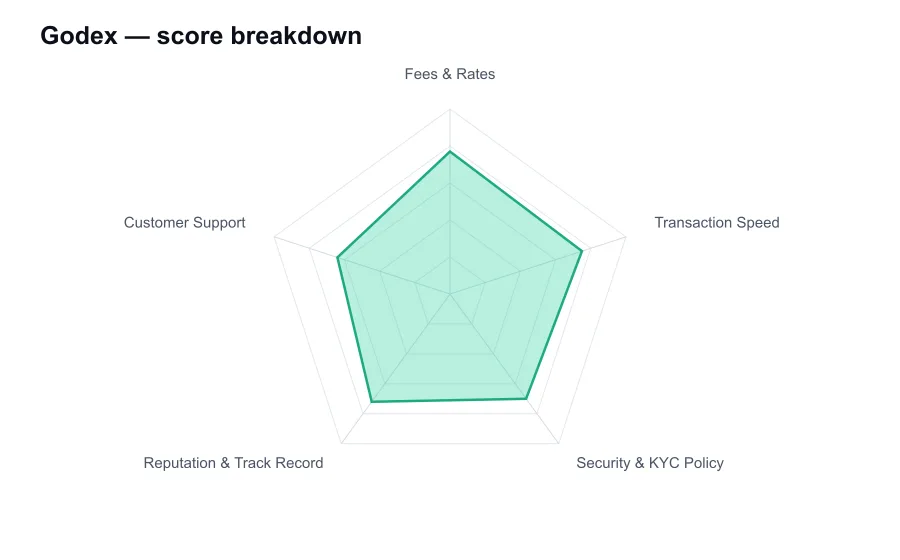
I rate Godex as a dependable middle-to-upper choice for users who value fixed quotes and fewer account demands. It is more established than many obscure swap sites, and its straightforward fee messaging is better than the industry average. The tradeoff is familiar: you are paying for convenience, accepting some counterparty risk, and giving up the execution precision of an order-book exchange. Used carefully, it does what it says. Just do not mistake a smooth one-time swap for a full financial relationship.